







Mandheling coffee, with its rich, bitter profile and distinctive herbal spice aroma, still commands a loyal following even in an era where acidic notes are in vogue. From the perspective of Front Street Coffee, this article traces the origins and varietal evolution of Sumatran coffee cultivation, explains in detail how the region's unique wet-hulling process shapes Mandheling's deep, muted herbal and pine-wood flavors, and provides an in-depth introduction to PWN Golden Mandheling's screening standards and grading system. At the same time, Front Street will share the resting period, pour-over parameters, and brewing steps for medium-dark roasted Mandheling, taking you through the full experience of this classic bitter coffee's layers and sweet aftertaste.
For more specialty coffee knowledge, welcome to follow our WeChat official account: Front Street Coffee (FrontStreet Coffee).
Nowadays, coffees主打 "acidic notes" keep emerging on the market, yet Front Street Mandheling coffee goes against the grain, centering on a rich, mellow bitterness. Although its popularity is not what it once was, it still attracts a group of loyal followers. In the upper right corner of Front Street's bean list, at least one Mandheling coffee bean is always kept available for customers to choose from. Today Front Street will talk about this coffee known as "bitter coffee" — Mandheling.
When did coffee cultivation begin in Sumatra?
Indonesia is the world's second-largest coffee producer, with a very long history of cultivation. According to materials consulted by Front Street, Indonesia's coffee story can be traced back to the late seventeenth century. At that time, Dutch colonists introduced coffee to Java for cultivation, and it subsequently gradually spread to Sumatra, where large-scale planting began.
In the nineteenth century, Indonesian coffee trees suffered severe damage from leaf rust, causing production to plummet. The government therefore introduced more disease-resistant varieties, including Robusta, Tim Tim, and Catimor, to replace the fragile Typica and Bourbon. Today, Tim Tim and Catimor, which carry Robusta genes, have become the main local varieties. Through long years of integration with Sumatra's terroir, Catimor and Tim Tim have developed the region's distinctive herbal and spice flavors; combined with strong disease resistance and considerable yields, they are highly favored by Indonesian coffee growers.
Catimor was first discovered in central Aceh, where locals call it Ateng, short for Aceh Tengah; Tim Tim is called Tim Tim. The Indonesian Mandheling coffee on Front Street's bean list is composed of these two varieties, Ateng and Tim Tim.
About the Wet-Hulling Process
Indonesia's weather is humid and hot, and locals face many challenges when processing green coffee beans, such as moldy beans and unstable sunlight. To shorten the processing cycle and reduce labor costs, a unique processing method emerged — wet hulling.
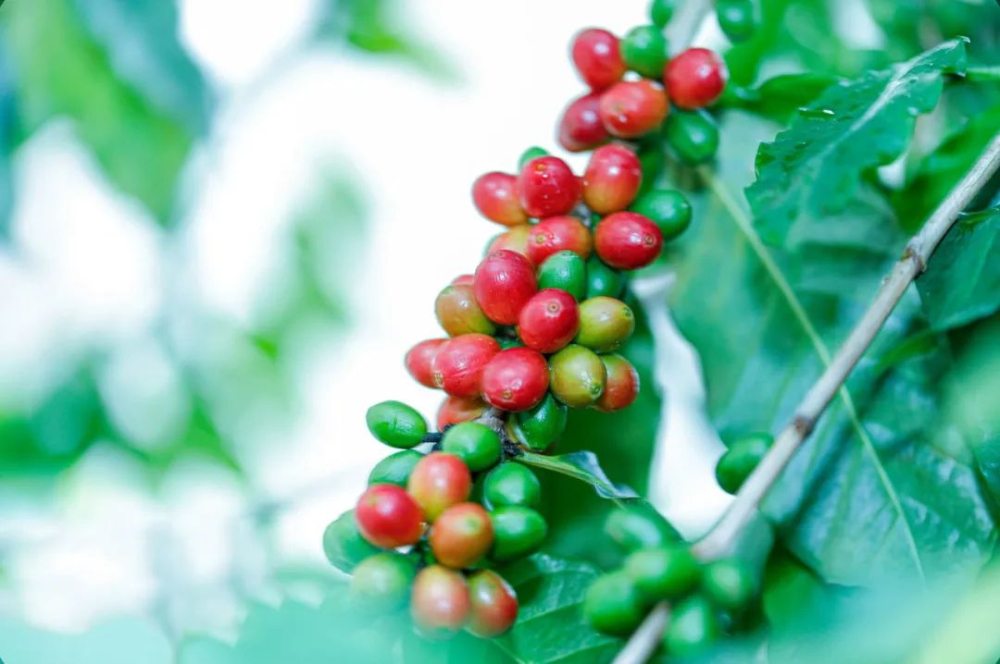
The coffee cherries are first floated to remove underripe beans, then machine-depulped. At this point the mucilage layer still feels slippery to the touch; after fermenting overnight, the mucilage layer is more easily removed under running water, and the surface of the parchment beans becomes rough. Next, the coffee beans are dried in the sun for two days, and the moisture content of the parchment beans drops to 30–50%, a semi-dry state. Locals use a special huller to strip off the still-hard parchment layer through friction, and finally the hulled beans continue drying for two more days until the moisture content reaches 12%.
Because the fermentation and drying times are compressed, and the entire process takes place in a hot, humid environment, the resulting Mandheling coffee carries a deep, muted herbal note as well as flavors such as pine wood. The birth of the wet-hulling method was originally a matter of adapting to local conditions, yet it happened to give Mandheling coffee flavor characteristics different from other full-bodied coffees, making it a classic representative among many coffees. Therefore, Front Street lists Indonesian Mandheling coffee beans in small daily-drinker packaging, hoping that friends who want to learn about different coffee origins can give this classic flavor a try.
What is Golden Mandheling coffee?
Although the wet-hulling method brings a unique flavor, because the semi-dry parchment layer is forcibly stripped off with considerable force before drying, the coffee beans are easily crushed and deformed. Under the subsequent high-temperature sun drying, one side of the bean cracks open, resembling a sheep's hoof, and so it is also called a sheep-hoof bean. Sheep-hoof beans are not considered defective beans, but their appearance is poor, and to improve overall quality, manual sorting and removal are required.
Indonesia's famous green bean purchasing company PWN subjects wet-hulled Mandheling green beans to one machine sorting plus three rounds of manual hand sorting, ensuring that the batches produced reach Indonesia's highest grade, G1. The purpose of machine sorting is to first screen out beans that must be at least 18 screen size; the subsequent multiple manual rounds are used to remove irregular defective beans. The reduction in defect rate greatly improves Mandheling coffee quality. It is said that Mandheling coffee beans that have undergone such layer upon layer of screening give off a golden luster when exposed to sunlight, hence the name Golden Mandheling coffee. In the early days, in order to obtain exclusive supply rights to Golden Mandheling coffee, PWN trademarked the English name "Golden Mandheling," so when purchasing, please pay attention to whether it is Front Street PWN Golden Mandheling coffee.
Through cupping comparisons, Front Street found that the sorted Golden Mandheling coffee has very high cleanliness, with various aromas and sweetness more prominent, and the flavor clearer and more transparent. As a fan of Mandheling coffee, Front Street of course hopes everyone can also share in excellent-quality Mandheling coffee, so in addition to the regular version of Lintong Mandheling daily-drinker beans, the refined Front Street PWN Golden Mandheling coffee has also been added to the regular bean list.
Does Front Street PWN Golden Mandheling coffee taste good?
As mentioned above by Front Street, Mandheling coffee is mainly rich and bitter; after multiple cupping comparisons, Front Street selected a medium-dark roast level, presenting a dark chocolate-like roasted, rich taste while retaining more herbal and spice notes and some acidity.
After roasting, Mandheling coffee beans are rich in carbon dioxide and need a process to release the internal gas so that the flavor is better during extraction. The resting period is related to the coffee's roast level: lightly roasted coffee beans need 4–7 days of degassing after roasting, while medium-dark roasts need about 7–10 days. As coffee beans pass the peak degassing period, the aroma gradually diminishes, so the freshness of the coffee beans is very important. All coffee shipped by Front Street is guaranteed to be freshly roasted within 5 days, so when you receive it, it will be close to its optimal flavor period.
For a purely aromatic, high-quality coffee bean like Golden Mandheling, Front Street believes that the black coffee form best presents the coffee's refined aroma, and it can be extracted by pour-over, siphon, French press, AeroPress, and other methods. Here Front Street uses the hot pour-over method customary in the store.
Front Street Golden Mandheling coffee pour-over parameters: 87–88°C water temperature, medium grind (70% passing rate on China standard No. 20 sieve), 15 grams of coffee powder, 1:15 coffee-to-water ratio, three-stage pouring.
First, wet the coffee bed with twice the coffee powder's weight in water, forming a dome, and let it bloom for 30 seconds. Then, with a small stream, pour in circles from the inside outward until 125 grams, then pause. When the coffee bed drops to half the height of the dripper, continue pouring the third stage with the same fine stream until 225 grams, until all the coffee liquid has filtered through, then remove the dripper; the time is about 2 minutes. Finally, swirl the coffee liquid in the server to even it out and enjoy.
The pour-over Front Street PWN Golden Mandheling coffee has varied layers overall, is rich and full-bodied, and has a clean mouthfeel. Nut and caramel aromas, with chocolate notes, a lasting sweet aftertaste, and high balance.
The above content is compiled by CoffeeHunters, a coffee news website.


