








Latte coffee may seem simple, but it involves multiple steps such as coffee bean roast level, milk steaming, and incorporation and latte art. This article sorts out the historical origins of the latte, analyzes the influence of coffee beans at different roast levels on latte flavor, and recommends several Front Street espresso blend beans suitable for making lattes. It also breaks down in detail the capacity, position, stages, and temperature control of steaming milk foam, as well as the basic process of incorporation and latte art. Whether you are a beginner just starting out or an enthusiast looking to refine your taste, you can find practical references here.

Long before espresso was born, latte coffee already existed. Since the 17th century, Europeans began mixing coffee with milk. In 1867, William Dean Howells first wrote the term "cafe latte" in his book Italian Journeys. At that time, coffee was sweeping the globe, but the espresso machine had not yet appeared, so the brewing method was still quite primitive.
"Latte" is the transliteration of the Italian word "Latte," which originally means milk. So in Italy, if you order a "latte," what you get may very likely just be a glass of pure milk. In other words, latte coffee is essentially a combination of milk and coffee. With the popularity of espresso machines, steam wands became standard equipment, heating milk became effortless, and the modern form of latte coffee was thus established. By the 1980s, a group of baristas in Seattle began to "paint" on the surface of coffee with dense, delicate milk foam, and this was the earliest prototype of latte art.
Every shop's latte will differ slightly in the ratio of milk to coffee, the beans used, and the extraction parameters. But overall, a latte is a drink made by mixing a large amount of milk with espresso. Change the coffee bean, and the flavor of the latte changes; change the milk, and the flavor also changes; even adjusting the ratio of coffee to milk can bring a different taste experience.
What coffee beans should be chosen for making lattes?
Generally speaking, coffee beans used to make lattes must be compatible with espresso machines, so beans with too light a roast level are not suitable. The darker the roast, the stronger the coffee flavor in the latte (caramel and chocolate notes), and it may even be bitter. The lighter the roast, the more prominent the milk flavor, but the acidity may be stronger, and it may also taste bland and lacking in aroma. Therefore, only by choosing a moderate roast level can coffee and milk blend better.

If you are just starting to make lattes and want beautiful crema and a rich coffee flavor, you can choose the medium-dark roasted Front Street. Black Cocoa—an espresso coffee bean recommended by many baristas, including Front Street Black Cocoa Blend, Front Street. Commercial Blend, and Front Street. Front Street Classic Blend. This bean is composed of Brazilian semi-washed, Indonesian Mandheling, and Vietnamese washed beans, with a dark roast treatment, prominent roasted aroma, and full-bodied crema.
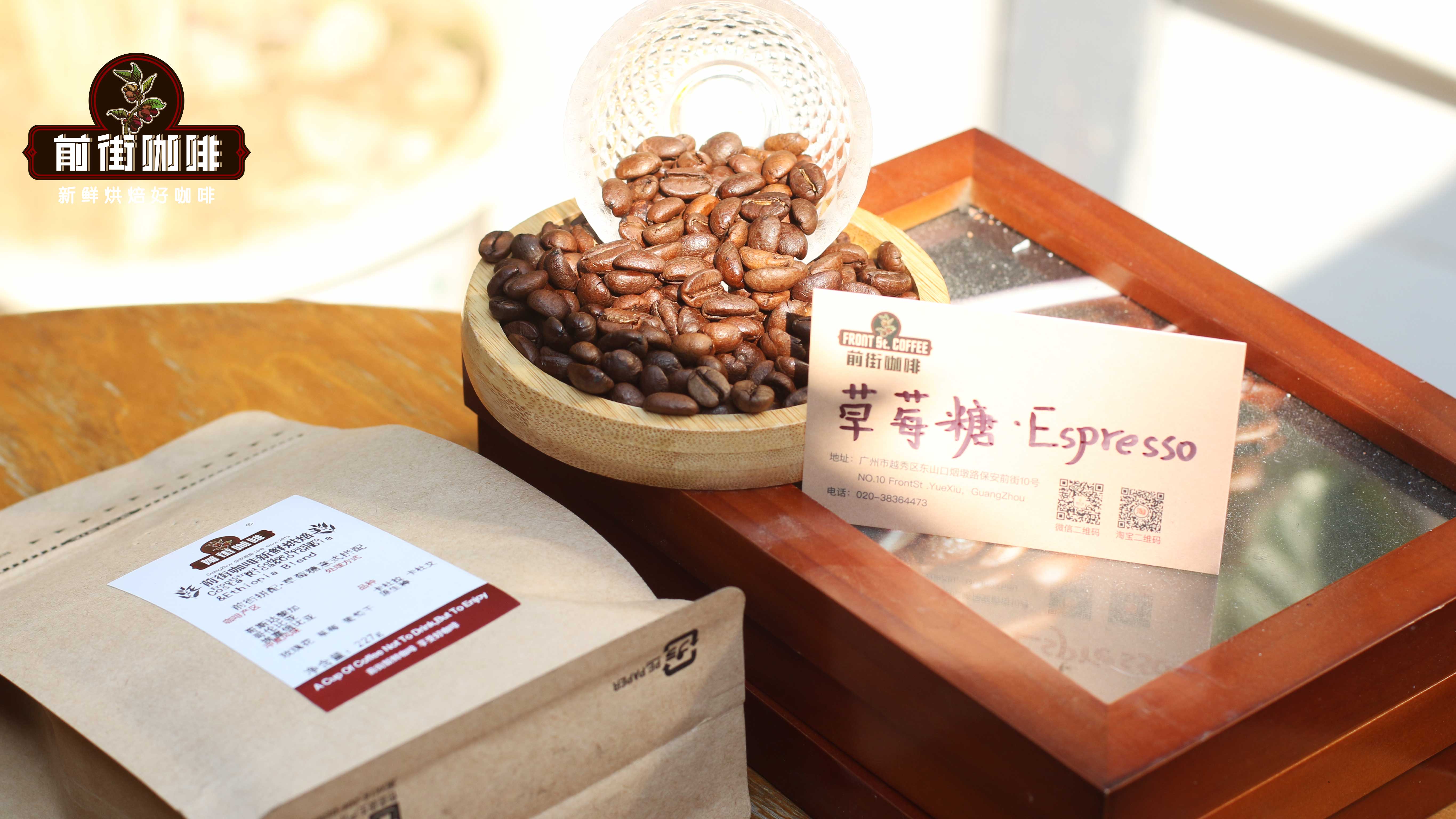
There are also a few coffee beans specifically used to complement the sweetness and richness of milk in iced lattes. In this case, Front Street. Strawberry Candy Espresso Blend is recommended. It combines three major producing regions—Costa Rica, Colombia, and Ethiopia—and carries aromas of roses, citrus, grapes, and dried blueberries.
When buying coffee beans, be sure to pay attention to freshness. After roasting is completed, a large amount of active carbon dioxide remains inside the beans. This gas hinders the entry of air and firmly "locks in" the aroma. But over time, the gas gradually escapes along with the aroma. About two months after roasting, espresso will have almost no crema left, and the good aromas will have disappeared completely. The coffee beans sold by Front Street Coffee are all freshly roasted within 5 days and support shipping within 24 hours, so they are still in their best flavor state when they arrive.
How to make latte coffee
Front Street's latte formula ratio is 1:6, that is, 40 grams of espresso with 240 grams of steamed milk.
Front Street's espresso extraction plan is: 20 grams of coffee powder, extracting 40 grams of espresso liquid within 27 seconds, as the base of the latte.

Next is steaming the milk foam. First, you need a steam wand, which is generally equipped on semi-automatic coffee machines; second, you need a container for milk, such as a milk pitcher or latte art pitcher (professional tools can make the operation smoother).
Finally, there is the choice of milk. Room-temperature milk or cold milk, whole milk or skim milk, can all be steamed into milk foam. But if you want better texture, taste, and stability, Front Street recommends using cold refrigerated whole fresh milk.
1. The optimal capacity for steaming milk: Steaming milk requires a reasonable capacity. Front Street recommends using 40% to 60% of the milk pitcher's total capacity. Too little or too much milk both test steaming technique. Of course, you should also consider the actual amount of milk needed for one cup of coffee to avoid waste. Taking the 550 ml milk pitcher used by Front Street as an example, pour in 240 ml of milk (just reaching the bottom of the pitcher spout).

2. Steaming position: Before preparing to steam, first turn on the steam wand switch to release condensed water steam (close it after releasing). Then pull out the steam wand at a 45-degree angle and use the pitcher spout to fix the position of the steam wand. This time the steam vortex is counterclockwise, and the steam wand is located on the right side of the center cross on the liquid surface, in a half-submerged state.
3. Steaming stage: Turn on the steam switch, and you will hear a "squeaking" sound. At this point, you enter the steaming stage. Depending on the desired thickness of the milk foam, the steaming time also differs (the longer the steaming, the thicker the milk foam). Generally speaking, steaming milk from 50% full to 60% full (the milk foam thickness required for a latte) takes about 3 seconds. The direction in which the milk rotates must be consistent to form a vortex.
4. Texturing stage: At this point, the steam holes need to be fully submerged, only heating, no longer steaming. Do not bury the steam holes at the very bottom; it is recommended to place them in the milk foam layer, which helps with texturing—turning rough milk foam into fine foam. When to stop? It depends on the milk temperature, generally controlled between 55 and 65 degrees Celsius. Excessive temperature causes protein denaturation (usually heat denaturation of proteins in food begins at about 60 degrees Celsius).
Next is incorporation and latte art. After extracting the espresso and steaming the milk, you can incorporate them to complete the latte. Incorporation is a very important part of making a latte. Good incorporation can make the latte taste smooth and comfortable, without any杂乱感. After incorporation is done properly, that is what we commonly call pouring latte art. At this point, a cup of latte coffee is complete.
Front Street Coffee's signature latte flavor: butter-smooth texture, lasting chocolate taste, mixed with caramel and toasted bread aromas, a long finish, and noticeable sweetness.
The above content is compiled by CoffeeHunters, a coffee news website.


