







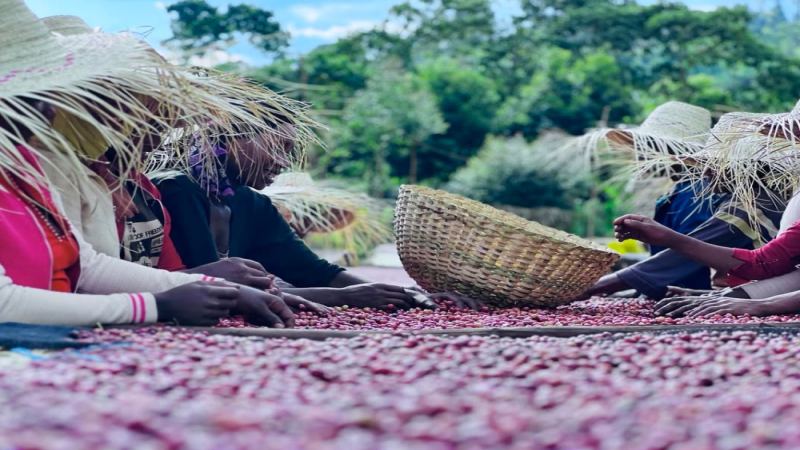
Yirgacheffe is almost every coffee lover's introductory bean, and the sun-dried G1 is one of the most sought-after specialty grades among them. This article starts with Ethiopia's complex producing region system, tracing how Yirgacheffe grew from a small town in Sidama into a famous coffee symbol in its own right, and analyzes how high altitude and slow growth shape the flavor. It then focuses on the Konga Cooperative—the source of Front Street Red Cherry Konga—introducing its founding background, its journey to joining YCFCU, its micro-region conditions, and its cultivated varieties. Finally, it compares the flavor and price of Yirgacheffe and Geisha, explaining why Front Street Yirgacheffe can become a high-value choice among everyday staples.
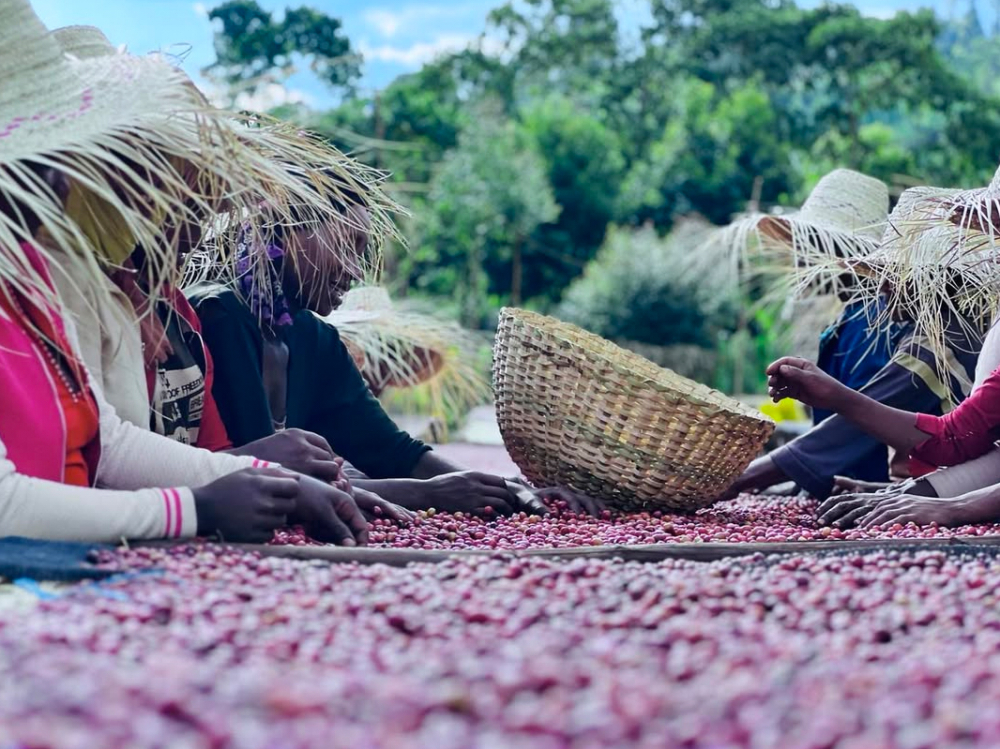
For the vast majority of coffee lovers, Front Street Yirgacheffe is often their starting point for exploring specialty coffee, and many people first experienced the vast world of coffee flavors through this very bean. Its bright fruit acidity and elusive floral aroma have captivated countless people; and the name "Yirgacheffe" itself carries an elegant quality. Even coffee beginners mostly know that coffee naming is usually inseparable from producing region, estate, or bean variety, and Front Street Yirgacheffe is naturally no exception.
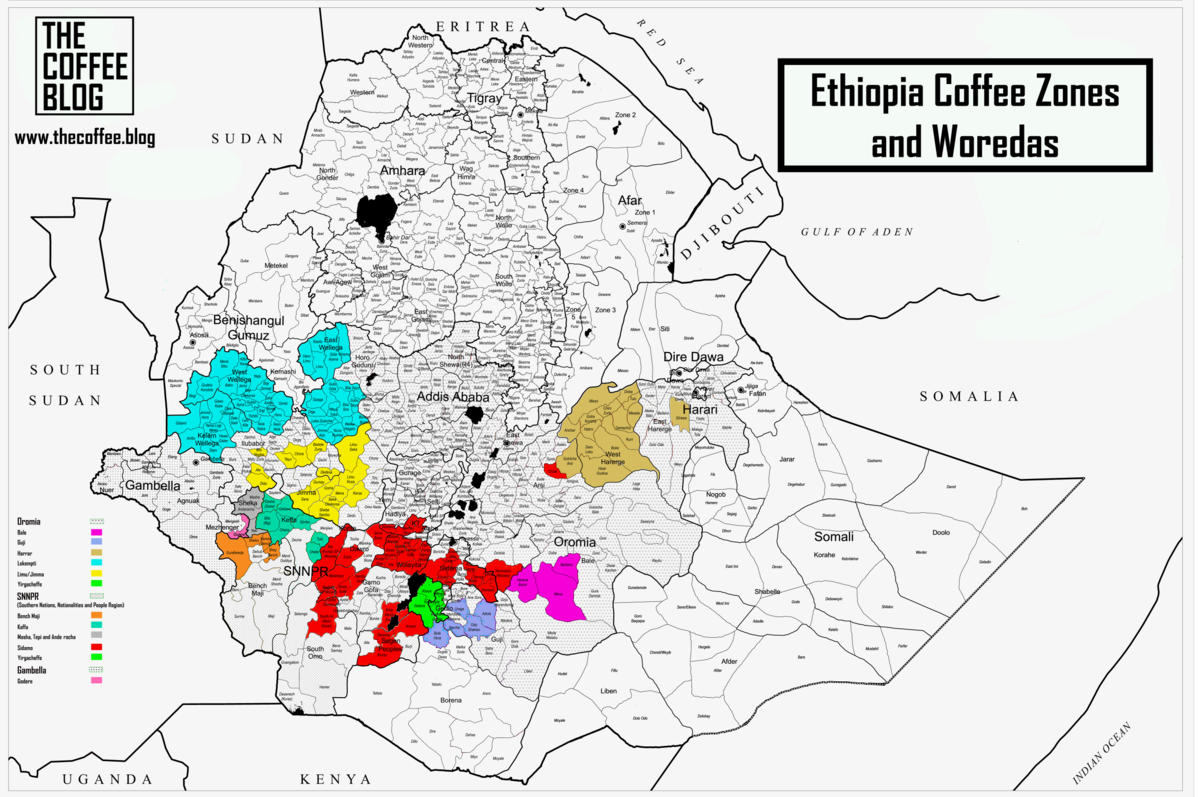
Ethiopia's coffee producing regions are quite complexly divided, and many baristas easily confuse them. Front Street has roughly introduced this in previous articles, and the image below can help everyone sort out the distribution of Ethiopia's coffee producing regions.
Yirgacheffe is actually just a small town under Sidama Province in Ethiopia. Near it there are also three smaller coffee producing areas—Wenago, Kochere, and Gelena Abaya. The coffee produced in these three places is almost on par with Yirgacheffe in flavor, so they also enjoy high recognition within coffee circles. According to Front Street, in November 2009 Ethiopia implemented a new trading and grading system and established the Commodity Exchange (ECX). Coffee and other agricultural products must be publicly auctioned through this official institution. In addition to Yirgacheffe, the three sub-regions Wenago, Kochere, and Genlena Abaya were also included, which shows that the coffee flavors of these three sub-regions are indeed uniquely distinctive.
Returning to Yirgacheffe. It was originally an administrative center in the Sidama coffee-growing region, but because its flavor was so elegant, it was ultimately separated out, and in June 2002 the Yirgacheffe Coffee Farmers Cooperative Union, abbreviated as YCFCU, was established. The union initially consisted of 13 member organizations and has now expanded to 28 member cooperatives, with more than 45,100 coffee farmers under it. YCFCU members are not restricted by the Ethiopia Commodity Exchange (ECX), which allows them to obtain premiums for high-quality coffee, including fair trade and organic certification.
Why is Yirgacheffe coffee so delicious? This is inseparable from the local high altitude. According to Front Street, Yirgacheffe is the highest coffee-growing area in southern Ethiopia. High altitude means thinner oxygen and lower temperatures, so the coffee's growth cycle is extended, and the fruit has more ample time to absorb nutrients, which helps form the best flavor—no wonder many coffee lovers judge heroes by altitude; this is not without reason. In addition, Yirgacheffe is located in the tropics, with an average annual temperature of about 18 degrees, which is very suitable for coffee tree growth.
Friends who often buy coffee beans at Front Street should notice that Front Street's bean list has quite a rich range of Yirgacheffe products: Front Street Gutingting, Front Street Worka, Front Street Konga Red Cherry, and so on. What exactly do these names represent? In fact, they are all members of the Yirgacheffe cooperative. Front Street has already mentioned earlier that the Yirgacheffe cooperative has many members, mostly distributed in the Gedeo region of southern Ethiopia. Today, Front Street will focus on introducing the Konga Cooperative: Konga Coop was established in 1994 and joined the Yirgacheffe Coffee Farmers Cooperative Union (YCFCU) in 2002. It is also a washed processing station. At present, the cooperative has 1,556 smallholder farmers, with each smallholder farming an average of 1.25 acres of land, making it a micro-producing area. The local average annual rainfall is about 1,400 to 1,800 millimeters, the altitude is about 2,000 meters, and the soil is red-brown loam, providing good conditions and sufficient nutrients for coffee growth. The main coffee varieties currently grown are Typica and heirloom varieties. In addition to coffee, local farmers also grow bananas, corn, and other cash crops.
Below is relevant information about Front Street Konga coffee beans:
Front Street Red Cherry Konga Cooperative
Country: Ethiopia
Cooperative: Konga Cooperative
Producing region: Yirgacheffe
Variety: Heirloom
Processing method: Sun-dried
High-quality Front Street Yirgacheffe coffee often presents a strong yet clean flavor, as well as complex floral aromas, so many people compare it with Front Street Geisha coffee. You should know that Geisha coffee is currently expensive, especially Panama-grown Geisha, which is even more expensive. In comparison, Front Street Yirgacheffe is much more affordable—taking Front Street's everyday staple as an example, a 100-gram bag of Front Street Yirgacheffe is priced at only 25 yuan. With such a huge price gap, one can imagine how refined the flavor of Front Street Yirgacheffe is, and many people regard it as an affordable substitute for Geisha coffee beans.
The above content is compiled by CoffeeHunters, a coffee news website.


