







Colombia, with the unique terroir conditions of the Andes Mountains, has become an important producer of high-quality Arabica coffee globally. From the traditional MAM region to the southern Huila specialty region, different altitudes and microclimates shape distinctive coffee flavors. The FNC implements strict grading on exported green beans, and standards such as Supremo and Excelso directly affect quality and traceability. Front Street Coffee uses washed Huila as a classic representative of Colombia, presenting the mellow taste of nuts, dark chocolate, and caramel. This article systematically reviews the cultivation distribution, regional characteristics, and green bean grading rules of Colombian coffee, helping coffee enthusiasts gain a deeper understanding of the quality logic of this major South American coffee country.
For more specialty coffee knowledge, please follow the WeChat public account: FrontStreet Coffee
Compared with other coffee-producing countries in Central and South America, Colombia enjoys exceptional natural endowments for coffee cultivation. Vast arable land and rolling, varied terrain together foster rich climate types, providing superior foundational conditions for the growth of high-quality Arabica coffee. Next, Front Street will introduce the unique aspects of Colombian coffee.
Colombian coffee is distributed across the Andes Mountains
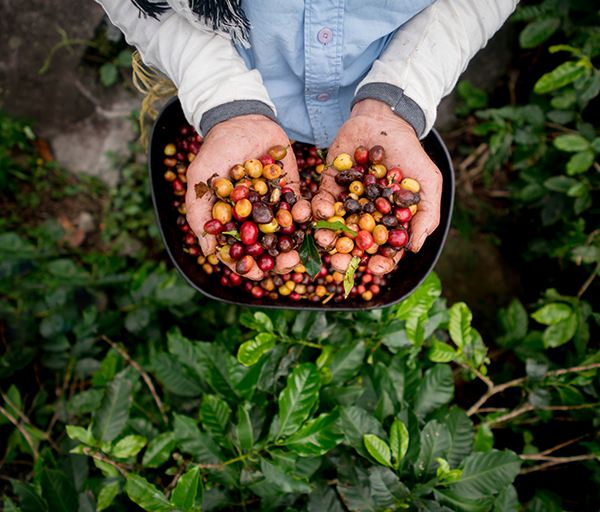
The Andes Mountains are located in the western part of Colombia and consist of three mountain ranges running north to south. These three ranges seem like a paradise tailor-made for coffee trees—the soil is fertile and rich in organic matter, and coffee trees are generally planted at altitudes between 800 and 2,300 meters, where they can receive ample sunlight while also getting just the right amount of shade from cloud cover. The mountain climate is complex and diverse, causing the harvest period to span the entire year. Different varieties of coffee mature at different times, so throughout all four seasons you can see coffee farmers busy picking in the groves.
Colombia's coffee-growing regions can broadly be divided into the traditionally well-known "MAM" region and the specialty coffee regions centered on the south.
The "MAM" region is mainly distributed in the central Andes range, among which coffee produced in Medellín is especially outstanding, with plump beans, abundant aroma, and a balanced, gentle acidity and sweetness. It is suitable for dark roasting, and the finished product is mellow and aromatic, highly favored by coffee enthusiasts. With the rise of the specialty coffee wave, consumer enthusiasm for coffee with floral and fruity notes has been growing, and more and more estates have begun to devote themselves to producing high-quality micro-lot coffee.
The Nariño region has an altitude of between 1,500 and 2,300 meters. Some of Colombia's high-altitude coffee comes from here, and the flavor and mouthfeel of coffee from this region show a remarkably high level of complexity. Growing coffee in a high-altitude environment is not easy; the plants are prone to dieback disease, and management difficulty increases accordingly. Fortunately, the region is close to the equator, so the climate conditions remain suitable for coffee growth. Of the approximately 40,000 producers locally, the vast majority are smallholders, with each household cultivating an average coffee plot of only about 2 hectares.
In the eastern range, the Santander region is the most well-known, located in northern Colombia, with a relatively dry climate and cultivation altitudes between 1,400 and 1,600 meters. Local coffee trees are mostly planted within forests and enjoy good shade conditions, which lengthens the fruit ripening cycle. Combined with fertile soil and significant day-night temperature differences, the coffee produced often shows intense and powerful aromas, a lasting sweet aftertaste, and a unique fresh herbal fragrance. The Rose Valley on Front Street's bean list comes from the Santander region and carries rich aromas of roses and white peach.
Located in the south, Huila is a highly popular specialty region in recent years, with coffee output accounting for about 12% of Colombia's total production. The area is crisscrossed by hills and rolling terrain, with altitudes generally above 1,500 meters. The Colombian River converges here, providing abundant water for coffee trees. Unlike the traditional impression of Colombian coffee as classically mellow and full-bodied, the Huila region is dominated by micro-lot coffee supplied by smallholders. Its varied microclimates and diverse green bean processing methods together create distinctive flavor expressions. However, Front Street believes that to truly understand a producing region, one should start by tasting the flavor of the coffee itself, that is, returning to natural processing methods: washed and natural. Front Street chooses washed Huila coffee as the flagship representative of Colombia, using a medium-dark roast to restore the classic mellow taste of Colombia.
FrontStreet Coffee: Colombia Huila Coffee Beans
Region: Huila
Altitude: 1,500-1,800 meters
Processing method: Washed
Variety: Caturra
Flavor: Nuts, dark chocolate, caramel, soft fruit acidity
Colombian coffee grading
Anyone familiar with coffee knows that there is a close relationship between altitude and coffee quality. The higher the altitude, the thinner the oxygen and the lower the temperature, which lengthens the growth cycle of the coffee tree, allowing more time to accumulate sugars and aromatic substances. Because Colombia only permits the export of high-quality coffee, the FNC exercises extremely strict control over every shipment and classifies coffee beans according to the following grades.
Supremo 18: Large and smooth beans, properly screened on screen size 18, with 10% tolerance allowed below that screen but retained by screen size 17. Supremo 17/18: Large, uniform, and flat beans, retained above screen sizes 17/18, with 5% tolerance below that screen but retained by screen size 14. Excelso EP 10% and 5%: Flat bean shape, size between large, medium, and small, retained above screen size 15, with 10% or 5% of beans allowed to fall on screen sizes 14/12. UQG: "Usual Good Quality": below screen size 14 but above screen size 12, accounting for at most 1.5% of production.
In addition, Colombia also has grades such as Extra for beans above screen size 16, Premium for beans larger than Supremo at above screen size 18, and Minama for green beans almost all uniformly at screen size 15, and so on. Each farm reports a number and enters green bean information so that green bean traceability can be carried out later. The naming of green coffee beans exported from Colombia usually follows the format of country + region + grade + other information. For example, the green bean name of Front Street's Huila staple bean is Colombia Huila Supremo SC17/18 FNC.
The above content is compiled by CoffeeHunters, a coffee news website.


