








Latte may look simple, but it is the drink that best tests the synergy between coffee beans and milk. Why does every shop's latte taste different? The key often lies in three areas: the quality of materials, the ratio of coffee to milk, and the operational details of extraction and integration. Drawing on Front Street's practical experience, this article first discusses how to choose espresso blend beans and fresh milk suitable for lattes, then explains the approximate range of the coffee-to-milk ratio, and finally breaks down the key points of espresso extraction, milk frothing, and integration techniques step by step, helping you make a latte with balanced flavor and a velvety texture.

To make a satisfying latte, Front Street's experience is that the keys to success are concentrated in three places: the quality of the coffee beans and milk themselves, the ratio of espresso to milk, and the operational techniques during extraction and integration.
Point one: Choose suitable materials
Latte seems to have a very low barrier to entry—it appears on almost every coffee bean brand's menu—yet drinks from different shops always taste different. One of the core reasons for this difference is that the milk and coffee beans they choose are not the same.
The flavor of coffee beans directly and strongly shapes the overall direction of a latte. Iced lattes made from most espresso blends present heavy nutty, chocolatey notes and a relatively strong coffee presence; some beans can also bring out the sweetness and richness of milk.
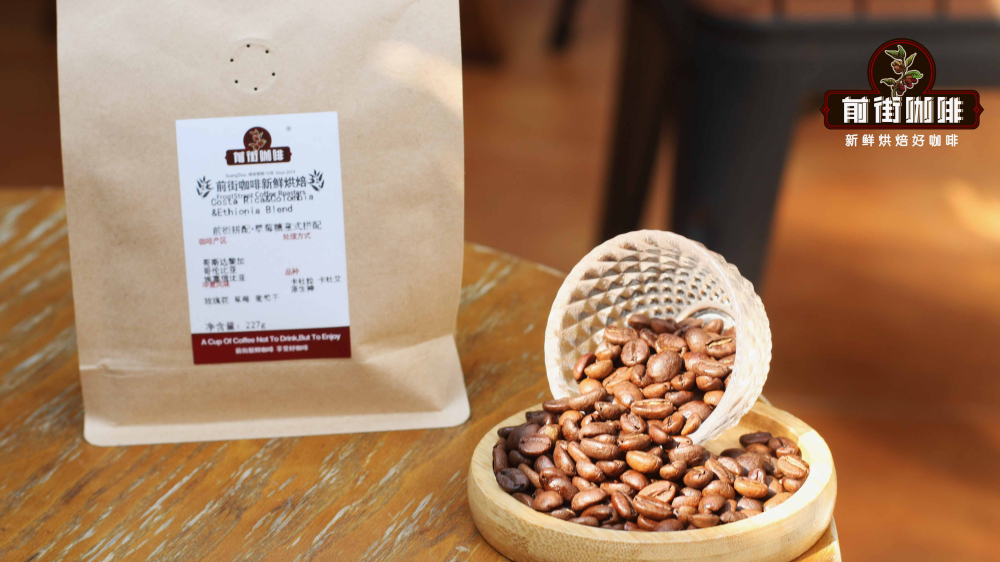
Take this Front Street Strawberry Candy espresso blend as an example. It uses coffee from two producing regions, Costa Rica Tarrazu and Ethiopia, and then blends in Colombian Huila beans with a chocolatey, sweet aroma. The espresso combined this way is not sharp on the palate. After extraction by the coffee machine, it has good crema performance and a velvety texture, while also carrying a sweet-and-sour sensation similar to strawberry gummy candy.
The choice of milk should not be overlooked either. For whole fresh milk alone, there are more than a dozen common types on the market. Some have a prominent milky flavor and a thick mouthfeel, while others are light and thin, almost watery. When choosing, you should not blindly pursue richness, but find the one that fits the coffee. Too strong a milky flavor will suppress the coffee's own taste, while milk that is too watery will make the latte bland.
Point two: A reasonable coffee-to-milk ratio
If the ratio of coffee to milk is improper, the finished drink cannot be considered good. If too much milk is added, the coffee flavor will be diluted; if too little milk is added, the bitterness will become prominent. So when making a latte, it is necessary to master the ratio of the two.
Front Street's view is that there is no rigid formula for latte; it depends on the flavor performance of the espresso and how well it matches the milk. However, you can roughly refer to the range of 1:5 to 1:8.

Front Street's current best-selling Front Street Classic Blend pays tribute to the once-popular "Mamba coffee." It combines Indonesian Mandheling beans with Brazilian espresso beans, retaining both the wild aroma of Mandheling and the smooth mouthfeel of Brazilian beans, with the two complementing and balancing each other in flavor. On the basis of the Mamba recipe, this Front Street Classic espresso blend also adds Robusta, significantly enhancing the crema and making the body of the espresso more solid. It is very suitable for home preparation and can also handle latte art.
This bean has the flavor characteristics of old-school espresso. When paired with milk in an appropriate ratio, you can taste a rich milk chocolate flavor. When Front Street uses this bean to make lattes, the coffee-to-milk ratio is 1:6, that is, 40 grams of espresso paired with 240 milliliters of steamed milk.
Point three: Specific operations
Extracting a qualified espresso and producing fine, velvety milk foam are fundamental to making a good latte. For espresso extraction parameters, Front Street recommends using 20 grams of coffee grounds to extract 40 grams of espresso, with the time controlled at 25 to 30 seconds. When frothing milk, the thickness should be increased from 5 parts full of milk to 6 parts full, and the temperature is recommended to remain between 55 and 60 degrees.
Next is the integration stage. Only by fully mixing the milk and espresso will the coffee taste uniform; if the integration is insufficient, you may get a situation where one sip tastes more milky and the next sip tastes more strongly of coffee.
Good integration first shows as the crema on the surface mixing evenly with the milk foam, reflected in the consistency of the liquid surface color, which is what people often call the "golden ring." Second, the coffee surface should be fine and smooth, with no large bubbles visible.
Integration techniques
① First, the "hardware" must pass! That is, the quality of the espresso and milk foam must be good. The espresso should have rich, viscous crema, and the milk foam should be fine and highly fluid. Many times poor integration is caused by the milk foam being frothed too thick, resulting in poor fluidity, so the milk foam floats on the surface. Before integration, swirling the coffee cup and milk pitcher once to increase the fluidity of the liquids inside will also improve the success rate of integration.
② The height of the pitcher spout during integration. We all know that when pouring latte art, the spout should be lowered close to the coffee surface so that white milk foam appears. The principle is similar: if it is too low, a large amount of milk foam will float on the surface, causing uneven integration. If it is too high, the problem described above will occur, and bubbles will appear on the surface.
Generally, the distance between the pitcher spout and the coffee surface is about 5 to 10 centimeters. Everyone's habits are different, so there is no completely fixed standard for height and distance.

③ Integration technique. The general integration technique is to stir in one direction. Hold the coffee cup with your left hand and the milk pitcher with your right hand, offset the two hands by half a circle, and make relative circular movements. The one-high, one-low stirring force can easily fully mix the coffee and milk. As for how large a circle to make, Front Street suggests making the largest circle possible without touching the wall. Be careful to slowly straighten the hand holding the coffee cup.
The above content is compiled by CoffeeHunters, a coffee news website.


