







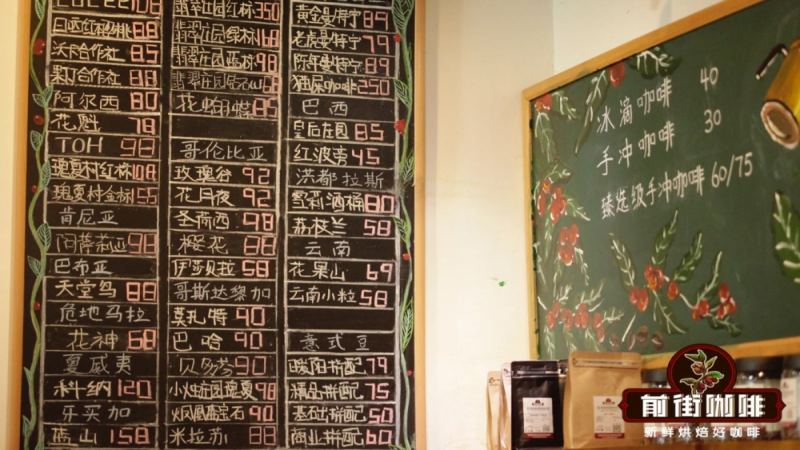
Faced with the dense bean list at Front Street Coffee, many coffee lovers wonder: why can coffee bean names be so long? In fact, behind each string of names lie clues about origin, variety, processing method, or brand positioning. This article systematically sorts out the common naming logic for coffee beans, including naming by production region or producer, by competition-winning titles from green bean competitions, by estate-branded products, and the origin of the special name Mandheling. Finally, it explains the meanings of grading labels such as G1, AA, and SHB, helping you more easily understand the information on coffee bean packaging.
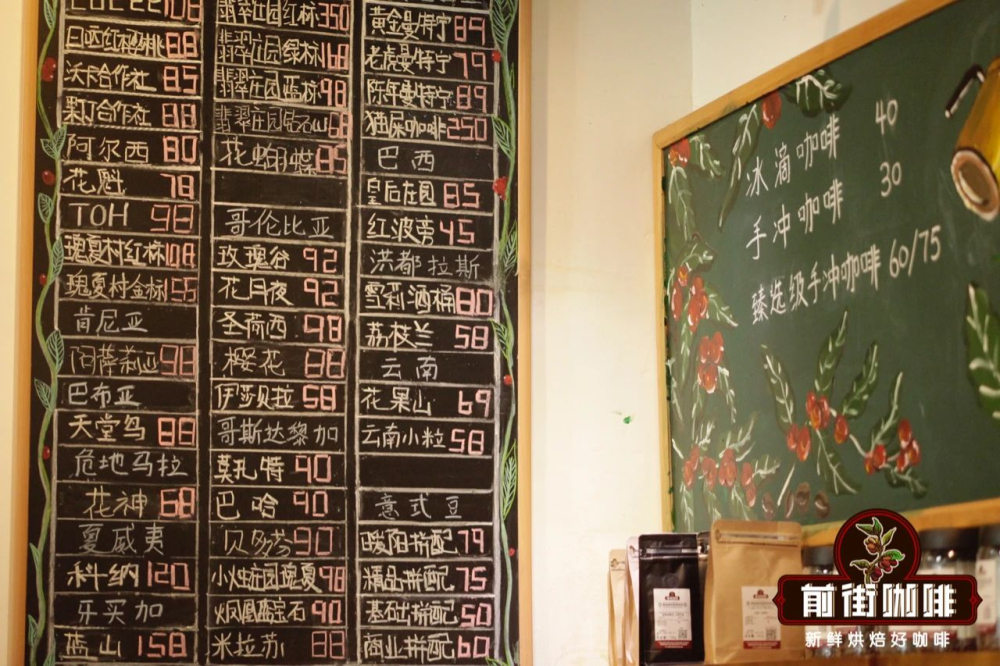
Walking into Front Street Coffee, many customers are momentarily at a loss when faced with the packed bean list. Today, Front Street Coffee will guide everyone through how these coffee bean names actually come about.
Naming by Production Region, Origin, or Producer
At present, the vast majority of single-origin coffees on the market are named this way, and the advantage is that the source of the coffee beans can be seen at a glance. For example, the well-known Yirgacheffe is itself a very famous coffee-producing region in Ethiopia. And the words often seen after Yirgacheffe, such as Gedeb, Kochere, Biloya, and Worka, are the names of more finely divided cooperatives or processing stations within the Yirgacheffe region.
Central and South America, on the other hand, more often names coffees after independent estates or large coffee-producing regions. For example, Colombia's Huila, Cauca, and Narino, Guatemala's Antigua and Huehuetenango, as well as Jamaica Blue Mountain and Hawaii Kona, are actually all names of coffee-producing regions.
Naming by Winning Titles from Green Bean Competitions
Well-known green bean competitions held every year, such as TOH, COE, and BOP, attract great attention from bean traders. Award-winning coffees are often named directly after the titles they win, such as the 2020 Ethiopia COE 22nd place that Front Street Coffee once participated in bidding for, and the well-known 2017 TOH champion "Huakui."
Naming by Coffee Estates for Their Own Products
For some rare varieties or varieties recognized for outstanding flavor, estates usually adopt the method of estate name plus bean variety, such as Geisha, Pink Bourbon, and Pacamara.
If a certain processing method brings a unique flavor, the estate or processing station will also give it an elegant or fitting name, such as Canet Estate's Musician Series, Finca El Arbol's Rose Valley, and Honduras Moca Estate's Sherry.
In addition, estates also classify products according to their own brand positioning. For example, Hacienda La Esmeralda divides its coffees into Esmeralda Special (Geisha Red Label), Private Collection (Geisha Green Label), Geisha 1500 (Geisha Blue Label), Diamond Mountain (specialty Catuai), and Palmyra (ordinary Catuai). The series products of Cafe Granja La Esperanza (with a naming approach similar to that of Hacienda La Esmeralda), Panama Butterfly, Golden Mandheling (explained in detail later), and Guatemala Flor de Dios also belong to this naming method.
The Name Mandheling
Mandheling is quite special. It is neither the name of a producing region nor the name of a coffee variety, but the name of a local coffee-growing tribe, and this name is also a transliteration after mishearing; the original tribal name was pronounced close to "Mandailing." Today, Arabica coffee beans produced in North Sumatra can all be called Mandheling coffee.
There are also many subdivisions under Mandheling coffee, with roughly the following naming methods: named by origin, such as Lintong Mandheling, Gayo Mandheling, and Lake Tawar Mandheling; named by brand, such as Golden Mandheling and Tiger Mandheling. Golden Mandheling is the brand trademark of Pawani Company. Its greatest feature lies in extremely strict bean screening standards: only beans of 18 mesh or above are selected, and they undergo three rounds of manual hand sorting and one round of machine screening. With few defects and large beans, it is no exaggeration to call it the highest-quality Mandheling.
Tiger Mandheling (official name: Mandheling Sumatra Tiger) uses coffee beans from the Lake Tawar area of Aceh and carries an aroma similar to traditional Chinese herbal medicine. Only Mandheling of 17 mesh or above with a defect rate below 4% can be called "Tiger."
There is also Aged Mandheling, named after a special processing method. Aged Mandheling is made by placing coffee beans that have completed wet-hulling into a constant-temperature warehouse for 2 to 3 years of aging. After long maturation, Mandheling's fruit acidity becomes soft and gentle, and its body and unique flavor perform even more amazingly in the mouth.
G1, AA, NO.1, SHB?
Many coffee bean names end with labels such as G1, G2, AA, and AB. These numbers and letters actually all represent coffee grades.
Different coffee-producing countries have different grading standards. Grades such as G1 and G2 usually use defect rate as the basis for grading, with G1 being the highest grade, such as Front Street Washed Yirgacheffe Gedeb G1. AA, AB, and the like are graded by coffee bean size, such as Front Street Kenya AA, which represents Kenya's best coffee quality. SHB means Strictly Hard Bean and is generally a grading standard in Central and South American countries, such as Front Street Costa Rica Tarrazu, which is of SHB grade.
The above content is compiled by CoffeeHunters, a coffee news website.


