








Indonesia's Sumatra is the birthplace of Mandheling coffee, and its unique wet-hulling process gives the coffee low acidity, full body, and herbal flavors. Front Street Coffee has long followed the Sumatra growing region. This article sorts out the origin of the name Mandheling, the connection between PWN and Golden Mandheling, and focuses on comparing the flavor characteristics and roasting suggestions of five beans: Front Street Lintong Mandheling, Golden Mandheling, Tiger Mandheling, Aged Mandheling, and Wahana Estate Natural Mandheling. Whether you are a beginner just getting to know Mandheling or a coffee lover who wants to understand the wet-hulling process in depth, you can gain a systematic understanding of the region and practical brewing references from it.
For more specialty coffee knowledge, please follow: Front Street Coffee (Frontsteet Coffee)
As the third wave of specialty coffee sweeps in, people's acceptance of coffee flavors has increased significantly. Front Street Indonesian Mandheling coffee beans are known for their herbal notes and heavy mouthfeel. At first, they sparked constant controversy, but Front Street Coffee (FrontStreet Coffee) has noticed that today there are already quite a few people who love it. What exactly is specialty coffee? Front Street Coffee (FrontStreet Coffee) tends to measure it from four angles: altitude, variety, processing method, and cupping score (above 80 points). Strictly speaking, Front Street Mandheling did not reach the 80-point threshold in cupping. Some people therefore conclude that it is not specialty coffee, but Front Street Coffee (FrontStreet Coffee) has always believed that "specialty coffee" is merely a set of evaluation results that conforms to public consensus.
When a coffee's regional flavor is distinctive enough and its market acceptance is relatively high, whether it is classified as specialty coffee is no longer so critical. The reason Front Street Coffee (FrontStreet Coffee) continues to introduce beans from different regions while insisting on tedious cupping is precisely to present the fact that coffee beans are constantly evolving. People's tastes are also changing. Existing standards can only serve as an introductory reference; beyond that, one also needs to build one's own worldview of coffee—this is the philosophy Front Street Coffee (FrontStreet Coffee) has always conveyed. Now, let us approach Front Street Mandheling coffee together with Front Street Coffee (FrontStreet Coffee).
The Origin of Mandheling Coffee Beans and the Development of Sumatra Coffee
Indonesia is located in Southeast Asia, and its coffee cultivation history can be traced back to 1696. At that time, Dutch farmers, seeking broader planting areas, surveyed several places and finally settled on Java Island in Indonesia. Thirty years later, Indonesia had already established a firm foothold in the coffee trade. Yet today, the representative of Indonesian coffee is Mandheling, and this is no accident—much of the Java coffee sold to Europe in the early period actually came from the Sumatra region, and Mandheling is precisely a product of Sumatra. It can be said that Sumatra is a vitally important coffee-producing region in Indonesia.
The Origin of the Name Mandheling
Mandheling was originally the name of an Indonesian tribe. After the end of Japanese colonial rule in Indonesia, Japanese soldiers returned home but could not forget the taste of the local coffee, so through introductions by trading partners, they entrusted locals to ship high-quality coffee beans on their behalf, including this Mandheling.
According to Front Street's understanding, Mandheling's rise to popularity came from Pawani Coffee Company (Pwani Coffee Company, abbreviated PWN) successfully promoting it to the Japanese market. This export trading company was founded by an overseas Chinese family from Quanzhou, Fujian, and is located in Medan, an important port in Sumatra. Since 1957, it has operated export businesses in rubber, cassia seed, cloves, patchouli oil, and other products, and the export of Sumatra coffee beans to Japan was naturally among them.
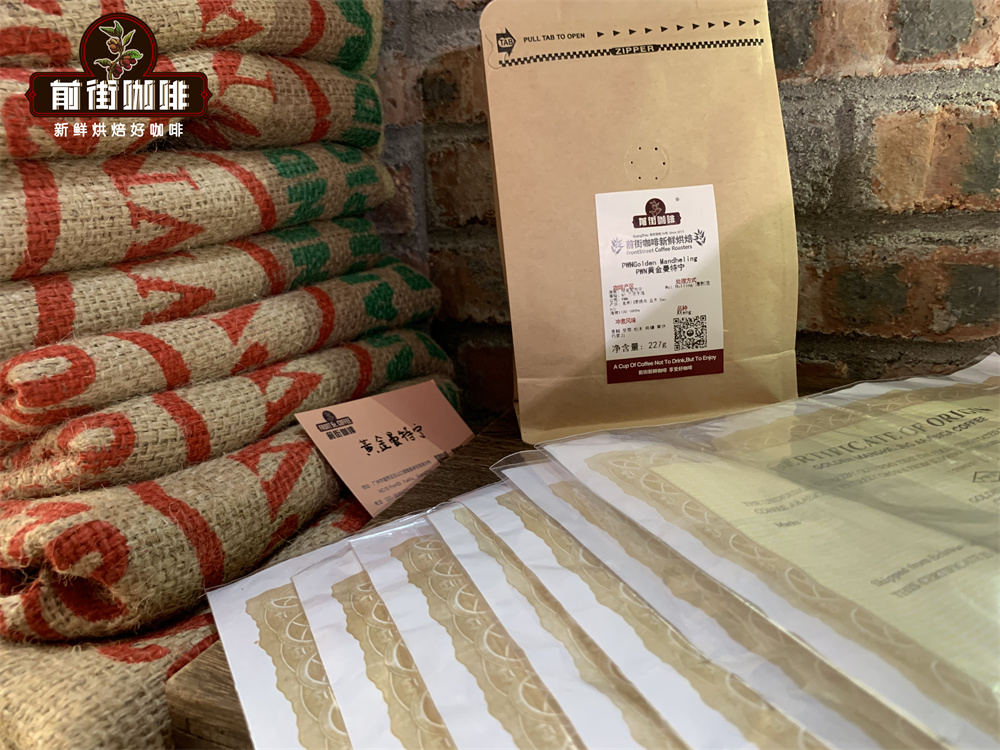
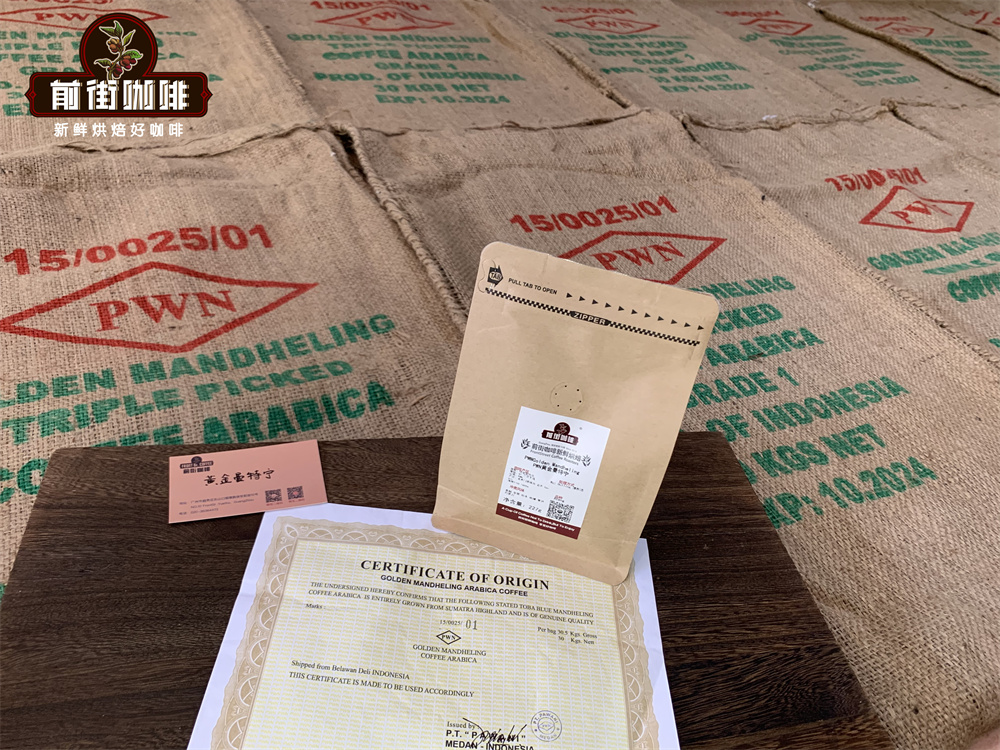
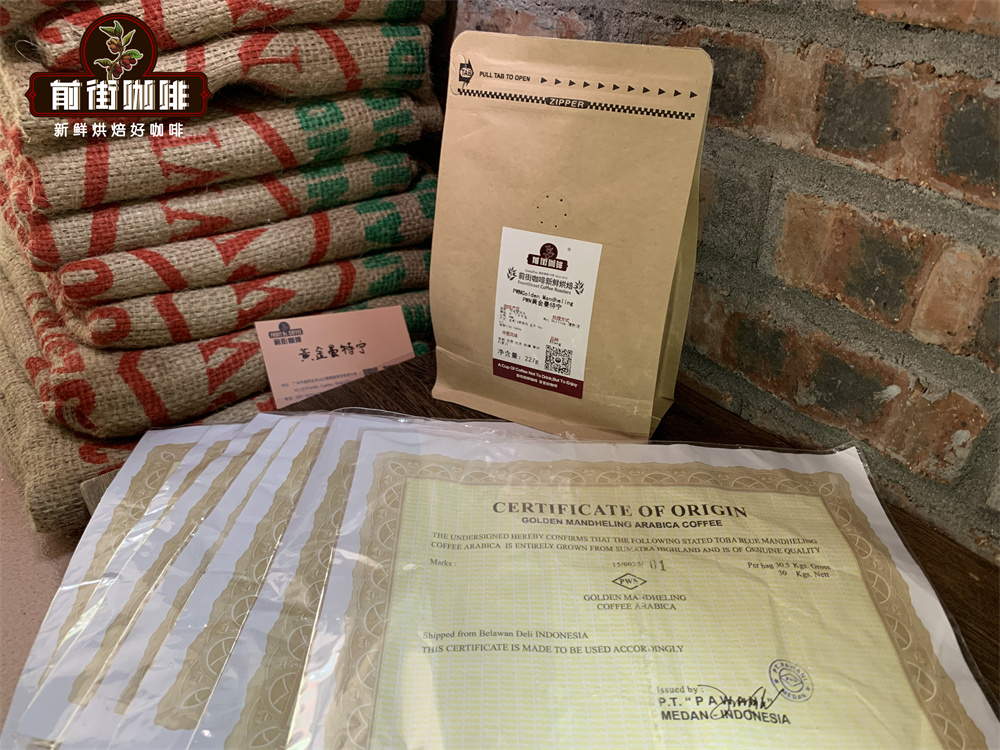
Unlike many Indonesian green bean merchants, PWN is the exclusive supplier of high-grade Golden Mandheling coffee and has contracted Indonesia's finest Mandheling producing areas, so the beans it produces are all of superior quality. The Golden Mandheling coffee that has long occupied the upper right corner of Front Street's bean list comes from PWN, and the Dongshankou store also displays the burlap sacks and certification certificates used for green bean packaging.
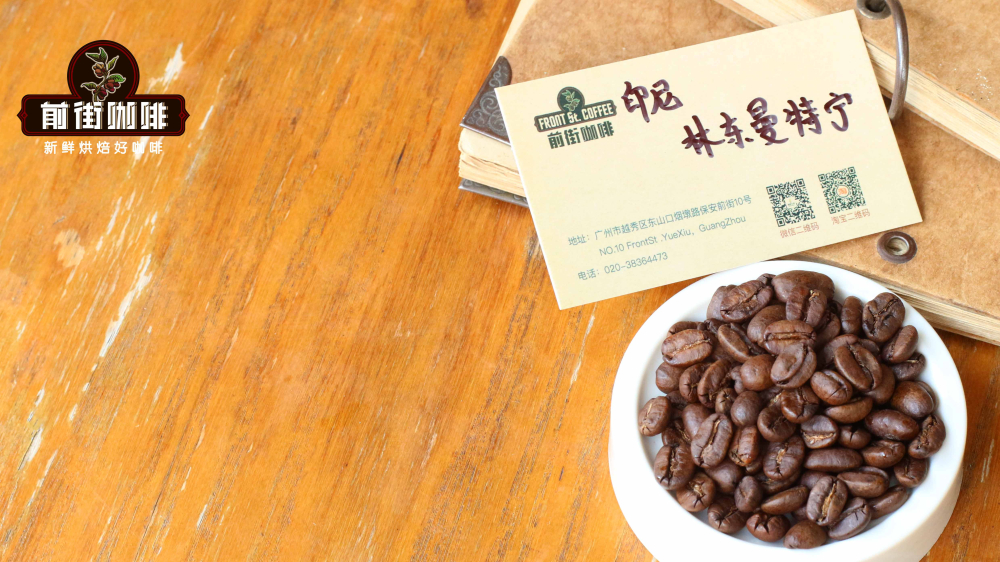
Front Street PWN Golden Mandheling Coffee
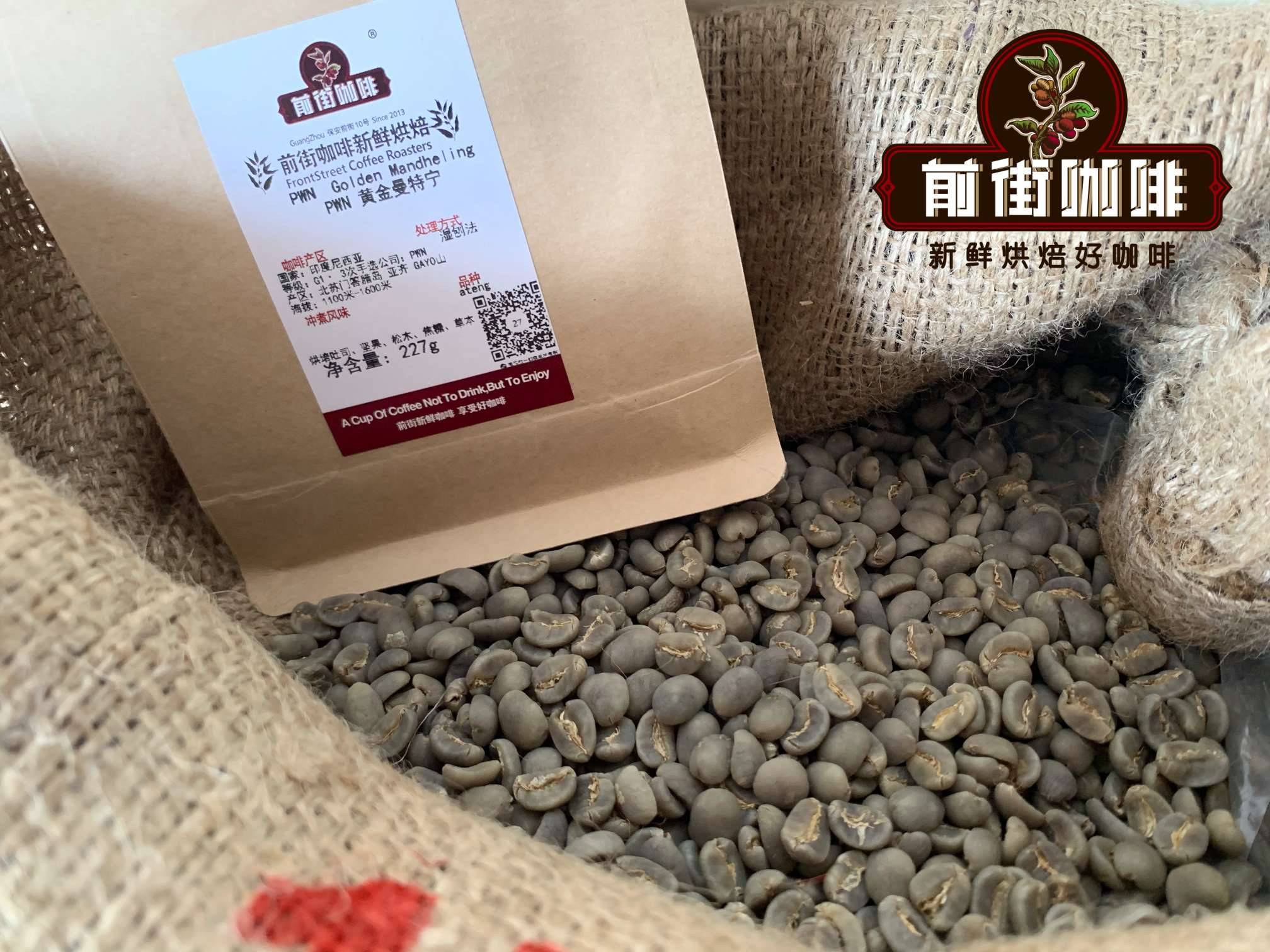
Front Street PWN Golden Mandheling coffee beans come from Lake Tawar on Mount Gayo in northwestern Sumatra. Since discovering Mandheling, the Japanese have always taken special care with this bean. In the process of cooperating with local green bean merchants, they established a strict screening standard: after processing, the green beans are first sorted by density and color, and then manually hand-sorted four times, ultimately presenting Mandheling with uniform color and neat bean shape. It is said that when processing the green beans, Mandheling shines with a golden luster in the sunlight, and the name "Golden Mandheling" comes from this.
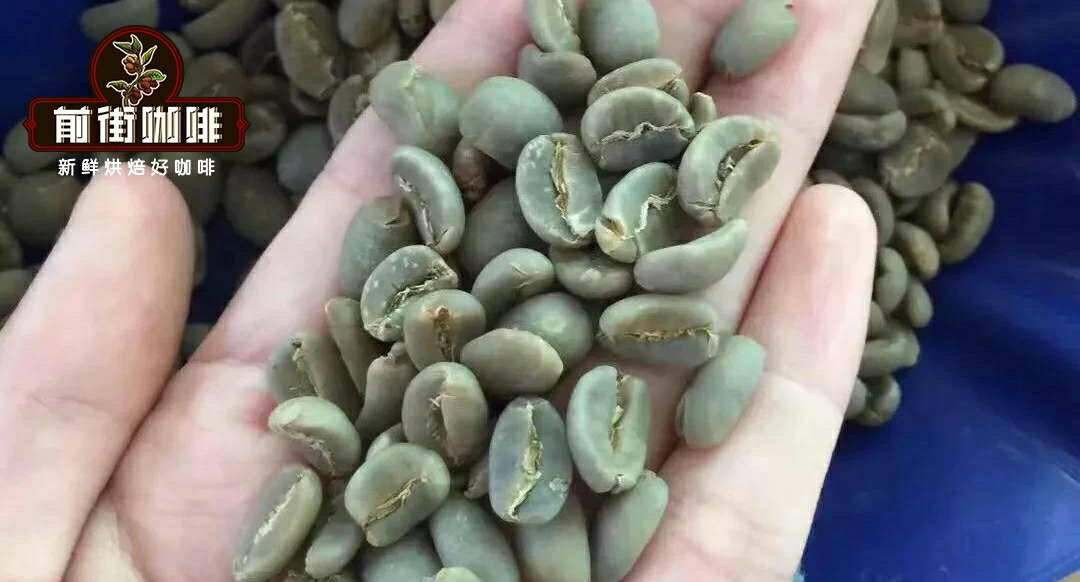
The specifications of Front Street PWN Golden Mandheling are 18 screen and above, with fewer than 3 defective beans (based on a 300g green bean sample), belonging to the highest grade G1, darker green in color, and neat flat beans in shape. After rigorous screening, Front Street Coffee (FrontStreet Coffee) found that Front Street PWN Golden Mandheling coffee beans not only shed the earthy off-flavors common in ordinary Mandheling, but also have a cleaner and more transparent mouthfeel and a stronger sweetness.
However, it was not a Japanese company that registered Golden Mandheling as a trademark, but rather the local Indonesian company that cooperated with Japan in exporting Mandheling in the early period—PWN (Pwani Coffee Company); the Japanese company instead registered "Gold Top Mandheling." Front Street Coffee (FrontStreet Coffee) believes that the difference in flavor expression between the two is actually not great, but because the brands are different and their marketing strategies differ, it is understandable that public opinion eventually diverged. Therefore, which of the two Golden Mandhelings is better depends entirely on personal judgment.
Types of Sumatra Mandheling Coffee Beans
Among the Mandheling varieties currently common on the market and relatively well accepted, the ones that stand out are Lintong Mandheling and Golden Mandheling. Having discussed Golden Mandheling, let us now introduce Front Street Lintong Mandheling. Front Street Lintong Mandheling Lintong Mandheling comes from the Lintong highlands in north-central Sumatra, adjacent to Lake Toba. Lintong Mandheling is the regular version of Mandheling. Front Street Lintong Mandheling also uses the conventional wet-hulling method, so it has low acidity and high body. But wet hulling also brings about a phenomenon: moist green beans that are half hard and half soft are easily crushed when the mucilage and parchment layer are removed, and the beans split open into a goat's hoof shape, commonly known as goat hoof beans. Front Street Coffee (FrontStreet Coffee) considers this a distinctive feature of Mandheling and not something that should be counted as a defective bean.
Front Street Lintong Mandheling does not put much emphasis on screening, but this in no way diminishes the world's love for its rich flavor.
In addition, Front Street also has three other Mandhelings: Front Street Tiger Mandheling, Front Street Aged Mandheling, and Front Street Sumatra Wahana Estate Natural Mandheling. Below, Front Street Coffee (FrontStreet Coffee) introduces them one by one. Front Street Tiger Mandheling The Front Street Tiger Mandheling selected by Front Street Coffee (FrontStreet Coffee) comes from Sumatra Tiger Estate in Indonesia, so it is also called "Mandheling Tiger" or "Sumatra Tiger Mandheling." The northern part of Sumatra Island is relatively high in altitude. Aceh Province, where Lake Tawar is located, and North Sumatra, where Lake Toba sits, are the main Arabica producing areas. Front Street Mandheling Tiger requires a flavor with traditional Chinese herbal medicine aroma, and only Mandheling of 17 screen and above with a defect rate below 4% can be given the name "Mandheling Tiger." Front Street Aged Mandheling Aged coffee beans are not simply green beans left to sit for a long time—this is not feasible, because green beans will also spoil if stored too long, changing from fresh green to white, then to yellow, becoming insipid and even breeding pests. Like aged alcoholic beverages, green beans must undergo proper treatment and long-term storage before they can truly be called aged coffee.
Front Street Sumatra Wahana Estate Natural Mandheling This Front Street Wahana Estate Natural Mandheling is not processed using Indonesia's signature wet-hulling method (described in detail later), but instead uses the more difficult natural process. The natural method first requires manually removing defective beans as well as unripe or overripe fruit, then evenly spreading the coffee fruit on the drying patio and turning it several times a day. The drying process usually lasts 2 to 3 weeks, depending on the local climate, and Indonesia's rainy weather extends this period. When the moisture content inside the coffee beans drops to 11% to 13%, the natural process step is complete. After drying, the husk has already become hard, and it only needs to be removed with a huller.
Special Processing Method: Wet Hulling
As mentioned earlier, Mandheling mostly uses Sumatra's unique wet-hulling method. This is because the local weather is rainy and typhoons are frequent, making it difficult to meet the good weather conditions required for natural drying; in addition, local economic conditions are limited, so they cannot afford higher-cost methods such as the washed process. Thus the highly regional wet-hulling method emerged. Today, Indonesia's coffee industry is no longer the impoverished scene of the past, and there are many estates and companies with the means to use the washed process, but why has wet hulling not been abandoned? Front Street Coffee (FrontStreet Coffee) believes that wet hulling is precisely the key factor that made Mandheling known to the world—whenever Mandheling is mentioned, one thinks of wet hulling, and the two have long formed a relationship of mutual reinforcement.
Wet hulling can be specifically divided into two stages: In the first stage, the skin and pulp are removed with a wooden pulper, followed by 3 hours of fermentation and then drying, reducing the moisture content to a semi-dry, semi-wet 30% to 50%. In the second stage, the mucilage and parchment layer are removed, and drying continues afterward. The drying process takes 2 to 4 days, and the moisture content drops to 12% to 13%.
In addition to the conventional wet-hulling method, there is also an aged wet-hulling method. The coffee beans are first processed by ordinary wet hulling, then sealed and stored in a warehouse for 2 to 3 years. The warehouse environment must be cool and ventilated, and the beans must be turned regularly to prevent mold and spoilage. During this period, the acidity of the coffee beans gradually weakens and converts into sugar, and the color also deepens to yellowish brown or dark brown. The Mandheling coffee beans on Front Street Coffee's (FrontStreet Coffee) bean list that use this processing method are Front Street Aged Mandheling coffee beans.
Wet hulling created Mandheling's special flavor, and it can be said that Mandheling and wet hulling are now deeply bound together. But today's coffee market is no longer satisfied with remaining unchanged. Even if wet hulling is Mandheling's characteristic, there is still room to try other processing methods—as mentioned above, the Front Street Coffee (FrontStreet Coffee) Wahana Estate Mandheling coffee beans use the natural process.
[Characteristics of Five Mandheling Coffee Beans]
[Roasting Suggestions for Five Front Street Mandheling Coffee Beans]
When Front Street Coffee (FrontStreet Coffee) roasts these five Front Street Mandheling coffee beans, it uses medium and dark roast levels in order to eliminate excessive acidity and enhance body and balance. Front Street designed five roasting plans according to the characteristics of each Mandheling, as follows:
Machine: Yangjia 800N, green bean charge 550g
Front Street Golden Mandheling Roasting Record Table
Front Street Lintong Mandheling Roasting Record Table
Front Street Tiger Mandheling Roasting Curve
Front Street Aged Mandheling Roasting Curve
Front Street Wahana Estate Natural Mandheling Roasting Curve
Brewing Suggestions The brewing parameters recommended by Front Street Coffee (FrontStreet Coffee) are: Kono dripper, 88°C water temperature, 15g coffee dose, 1:15 coffee-to-water ratio, and a grind size based on a 70% to 75% pass rate through a Chinese standard No. 20 sieve.
Readers who frequently read Front Street Coffee (FrontStreet Coffee) articles should understand that light-roast and dark-roast coffee beans differ in the choice of water temperature and dripper. The lower water temperature is intended to avoid extracting too many off-flavors—Front Street Coffee (FrontStreet Coffee) believes that during dark roasting, more aromatic substances have already been released, and if the water temperature used for light roasting is still applied, over-extraction is likely. Front Street Coffee (FrontStreet Coffee) chooses the Kono dripper because the V60 dripper has too fast a flow rate and tends to under-extract at low water temperatures; the Kono dripper has fewer ribs and they are located at the bottom, and the filter paper fits closely against the dripper, which can restrict airflow and extend the contact time between water and coffee grounds, allowing the coffee grounds to be fully extracted and thereby enhancing the full-bodied mouthfeel. It is suitable for brewing medium-dark roasted coffee beans, such as Front Street Golden Mandheling and Front Street Jamaica Blue Mountain coffee.
Front Street recommends using freshly roasted coffee beans for brewing in order to experience the coffee's rich flavors to the greatest extent. The coffee beans shipped by Front Street Coffee (FrontStreet Coffee) are all within 5 days of the roast date, because Front Street deeply understands that freshness has a major impact on flavor. Front Street's roasting philosophy is "freshly roasted good coffee," so that every customer who places an order can receive the coffee in its freshest state. The resting period for coffee is about 4 to 7 days, so by the time customers receive it, it is exactly at its best flavor.
Brewing Technique Front Street Coffee (FrontStreet Coffee) uses staged extraction: bloom with 30g water for 30 seconds, then pour in a small stream in circles up to 125g for the stage break, and when the water level drops and is about to expose the coffee bed, continue pouring until 225g and stop. When the water level drops again and is about to expose the coffee bed, remove the dripper. The extraction time (timed from the start of blooming) is 2'00".
Flavor Description [Front Street Lintong Mandheling] Herbal, chocolate, caramel, overall balanced; [Front Street Golden Mandheling] Nuts, spices, herbs, licorice, chocolate, caramel, clean and soft flavor; [Front Street Tiger Mandheling] Nuts, cream, dark chocolate, caramel, traditional Chinese herbal medicine, obvious sweetness, clean and clear flavor; [Front Street Aged Mandheling] Ripe pu'er, caramel, herbs, chocolate, relatively low acidity; [Front Street Wahana Estate Natural Mandheling] Tropical fruit, fermented notes, moderate acidity, smooth mouthfeel, obvious sweetness.
The above content is compiled by CoffeeHunters, a coffee news website.


