







For most households, buying a professional espresso machine poses barriers in both budget and space, making the moka pot a common alternative that balances convenience and flavor. This article begins with the background of the moka pot's invention, traces its origins with early espresso machines, analyzes its extraction principles and flavor limitations, and on this basis offers coffee bean selection recommendations suitable for the moka pot, including Front Street Classic Espresso Blend, Front Street PWN Golden Mandheling, and Front Street Queen Estate Brazil coffee beans. Finally, a complete equipment list and operating procedure are provided for coffee enthusiasts to reference and practice.
Although espresso is widely popular, not every household has the budget and space to purchase an espresso machine. Therefore, more coffee enthusiasts choose to keep a moka pot at home. Its operation is quite hassle-free: simply pour hot water into the lower chamber, fill the middle filter basket with ground coffee, then place it on a heat source and wait for it to heat up, and you can sit back and wait for a cup of coffee to come out.
However, there is still a clear gap between what a moka pot produces and the espresso from today's espresso machines. Looking back at history, the moka pot's original role was precisely as an affordable substitute for the espresso machine. Modern espresso relies on pushing near-boiling hot water through a compacted puck of coffee grounds at extremely high pressure—a pressure level that was only achievable after modern iterations of espresso machine technology.
To understand the origins of the moka pot, one must first return to the historical context of the espresso machine. At the end of the nineteenth century, the first espresso machine appeared in Turin, Italy. In 1905, La Pavoni launched the first commercial espresso machine, enabling baristas to produce espresso for multiple customers in a short time. Thereafter, cafes using La Pavoni equipment gradually increased across Italy.
When these large commercial espresso machines operated, the entire device needed to be placed over a flame for heating. Inside the machine, steam pressure was relied upon to push hot water from the bottom compartment through a pipe leading to the coffee grounds. However, their high cost and large size made it impossible for ordinary households to accommodate such a device at home.
The moka pot would not come into being until the 1930s, invented by Alfonso Bialetti from northern Piedmont. After spending over a decade making his way in the French aluminum industry, Alfonso Bialetti returned home in triumph and founded his own workshop in Piedmont, specializing in aluminum household products.
Legend has it that Bialetti one day saw his wife doing laundry and suddenly got inspired, which gave rise to the idea of the moka pot. The laundry equipment at the time was divided into two layers: the lower layer held soapy water and was heated to boiling, the upper layer held the clothes to be washed, and a tube connected the two layers. The boiling soapy water rushed up through the tube to the upper layer, evenly sprinkling over the clothes. With the assistance of Luigi De Ponti, the moka pot as we know it today was born.
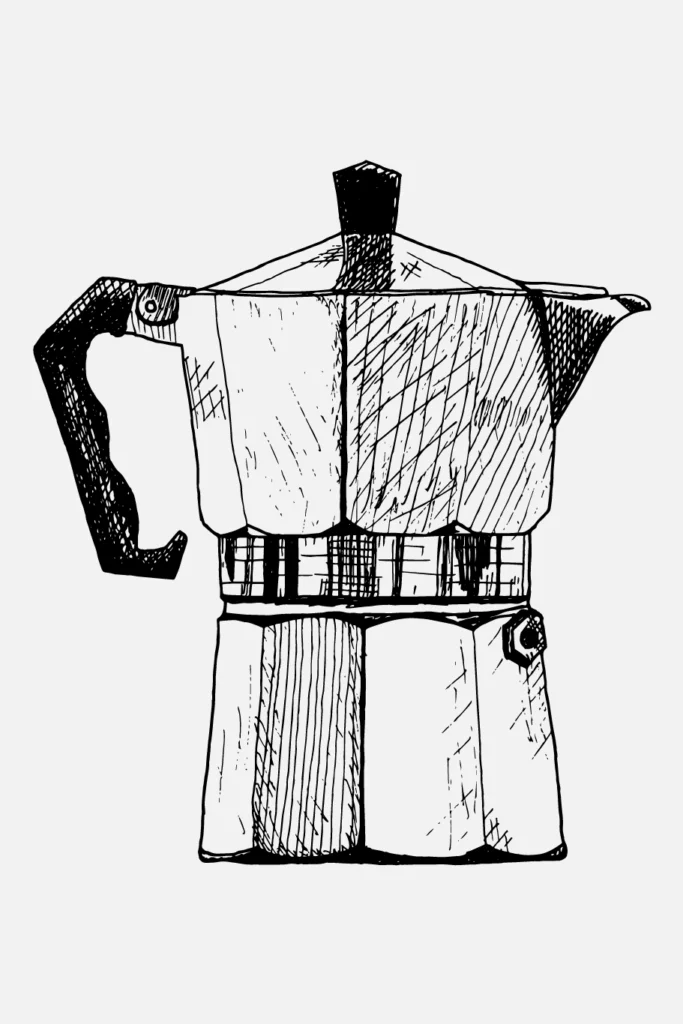
The Bialetti moka pot operates on exactly the same logic as the aforementioned laundry device. The body is octagonal, made of aluminum, and fitted with a bakelite handle for heat insulation. The entire pot can be disassembled into three parts: the bottom container holds water, the top container collects the extracted coffee liquid, and in the middle is a metal filter screen used to hold the ground coffee.
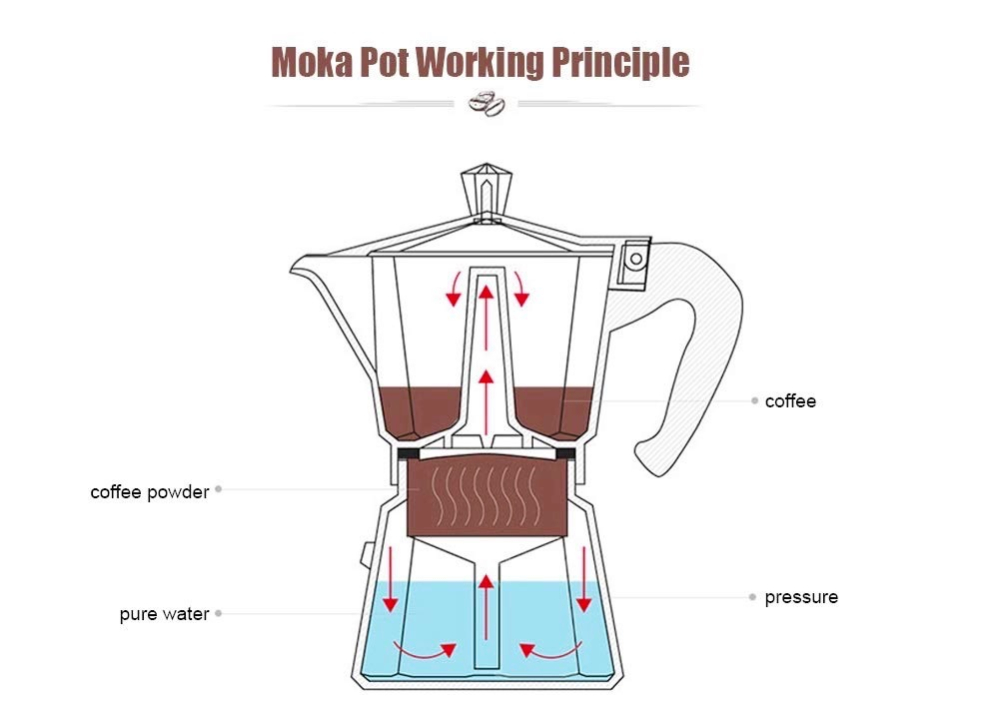
When using a moka pot, first pour a certain amount of hot water into the bottom chamber, fill the middle filter screen with coffee grounds, put the filter screen back into the bottom chamber, then screw the top chamber on tightly, and finally place the entire device on a heating appliance. When the water in the bottom chamber boils, it produces steam. Since the bottom chamber is a closed space, the steam continuously accumulates and raises the internal pressure, thereby pushing the hot water along the bottom chamber's conduit through the middle layer of coffee grounds, and then through the metal filter screen's channel into the top chamber.
The moka pot was born to replace the espresso machines of the late nineteenth and early twentieth centuries, but the manufacturing technology of espresso machines has evolved over decades, and extraction pressure has long far exceeded the ancient level of about 1.5 pascals. In a moka pot, water is pushed up after boiling, which means the water temperature is relatively high. These two points determine that it is fundamentally different from the espresso produced by modern espresso machines. One of the advantages and disadvantages of the moka pot lies precisely here: it cannot form a thick layer of crema. The extraction pressure of modern espresso machines is far higher than that of a moka pot, so the crema from coffee brewed in a moka pot is far less rich than that from an espresso machine.
In addition, the relatively sparse aperture of the metal filter screen is also one of the reasons. The grind size suitable for a moka pot is coarser than that for an espresso machine. The coarser the particles, the smaller the contact area between water and particles, and the correspondingly fewer extractable substances, so the coffee produced by a moka pot also falls short of an espresso machine in terms of body.
Many friends want to make espresso-style coffee at home and have also purchased a moka pot. The question that follows is: what coffee beans pair well with a moka pot for a delicious cup? Since the moka pot's positioning is as a substitute for early espresso machines, and espresso emphasizes rich, smooth, and mellow character, if you want a relatively rich crema, choosing beans with a darker roast level would be more suitable.
Besides trying Front Street Classic Espresso Blend, Front Street PWN Golden Mandheling coffee beans and Front Street Queen Estate Brazil coffee beans are also worth a try.
Front Street Mandheling coffee beans are produced in Sumatra, Indonesia, in Asia, and are therefore also called "Sumatra coffee." Mandheling is mostly grown in highland mountainous areas at altitudes of 750 to 1,500 meters and is one of Indonesia's few Arabica varieties. When it comes to Mandheling, Front Street particularly appreciates its rich aroma, thick body, and intense flavor, while its unique herbal spice flavor is the signature characteristic of Mandheling. In addition to Indonesia's growing conditions, the wet-hulled processing method is also one of the key sources shaping Mandheling's intense flavor.
Front Street Queen Estate Brazil coffee beans
Region: Mogiana region, São Paulo State, Brazil
Estate: Queen Estate
Altitude: 1,400 meters—1,950 meters
Variety: Yellow Bourbon
Processing method: Natural processing
The Yellow Bourbon variety was discovered in São Paulo State, Brazil, in the 1870s. Subsequent research showed that Yellow Bourbon has a thicker pectin layer, and the pectin layer is rich in sugars, making this variety's sweetness more pronounced. Front Street's Yellow Bourbon even uses the most primitive and traditional post-harvest green bean processing method—natural processing—fully retaining the skin and pulp, allowing more sugars to penetrate into the green coffee beans, so the sweetness is qualitatively improved.
Queen Estate has won multiple awards since the first Cup of Excellence Brazil competition in 1999, and even won twelve awards over seven years, fully demonstrating the excellence of its coffee bean quality. The natural processing method itself requires a large amount of manual labor. To avoid undesirable fermentation flavors, Queen Estate deliberately uses small-scale natural processing to ensure the quality of the green beans.
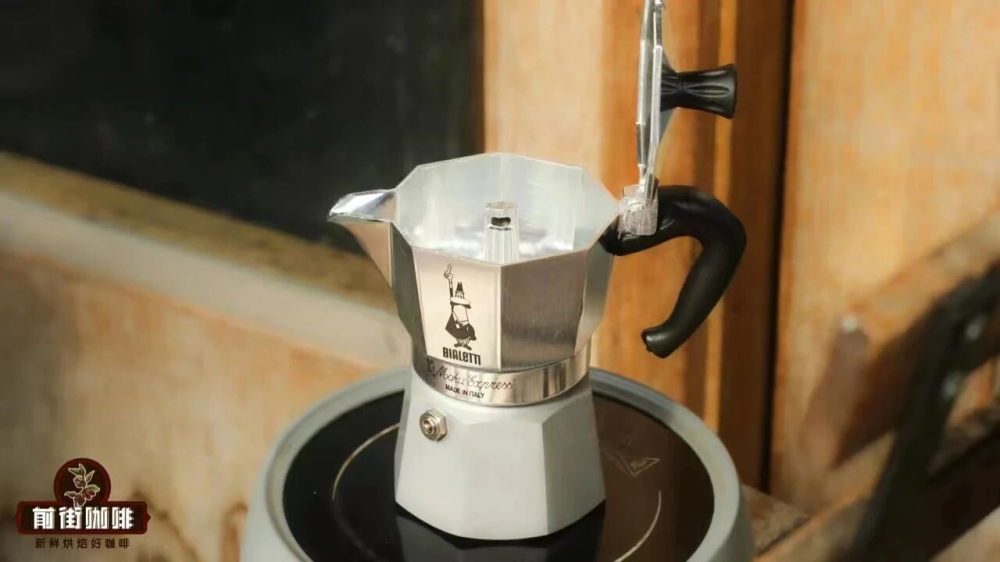
What equipment is needed to make a cup of espresso with a moka pot
1. Moka pot 2. Gas stove and stove rack, or induction cooker 3. Coffee beans 4. Grinder
[Front Street Queen Estate Coffee Beans]
Origin: Brazil
Roast level: Medium-dark roast
Flavor description: chocolate, cream, nuts, butter, caramel, rich crema
[Brewing method]
(1) First, put cold water into the lower chamber.
(2) Put the coffee grounds into the filter basket, filling it to about 90% full, and tap the edges lightly to make the coffee grounds compact and level.
(3) Screw the upper and lower chambers tightly to prevent the coffee liquid from overflowing during the process.
(4) Place the moka pot on a small gas burner or induction cooker for heating. At first, heat over medium heat. When you hear a hissing sound, turn the heat to low, and the coffee will naturally flow out slowly.
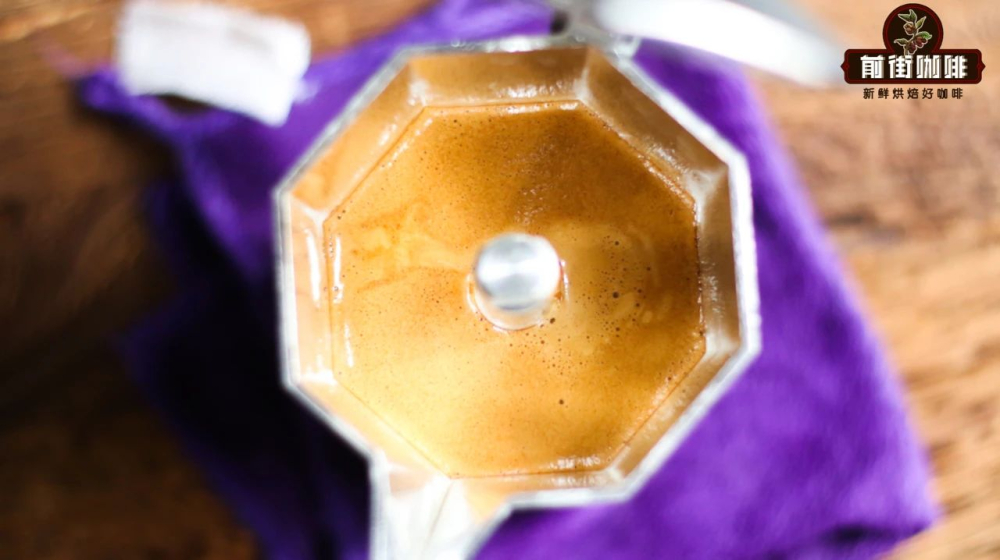
(5) When the sound turns to a faint bubbling sound, turn off the heat to avoid over-extraction. The fragrant, mellow coffee is now ready. You can add half warm water or fresh milk to turn it into a moka pot americano or moka pot latte.
The above content is compiled by CoffeeHunters, a coffee news website.


