







Americano is one of the most common espresso drinks on cafe menus. It has only two ingredients—espresso and water—yet it is the ultimate test of a barista's extraction skills. This article begins with the definition and origin of Americano, sorts out the differences between the traditional drip method and the contemporary espresso-dilution method, compares the order of Americano versus Long Black, and discusses the controversy over pulling a weak coffee with a long water extraction. It then details the ratios for making hot and iced Americanos, Front Street Coffee's extraction parameters, and the effect of keeping or removing the crema on flavor, helping coffee lovers understand the finer points of this basic drink.
For more specialty coffee knowledge, please follow: Front Street Coffee (Frontsteet Coffee)
Americano (English: Americano, Italian: Caffe Americano), by traditional definition, refers to black coffee brewed with a drip coffee maker. Because this extraction process often lasts about four to five minutes, the resulting coffee tends to have a relatively plain flavor profile.
Making an Americano is not complicated; it emphasizes convenience, speed, and ease. Compared with espresso, it has a more refreshing mouthfeel and more easily brings out the coffee beans' original flavors. However, the Americano sold in cafes today has diverged somewhat from the traditional definition. Today's Americano is presented in a different way: it uses espresso as the base and adds a large amount of water, ultimately becoming a drink that no cafe menu can do without.
Since an Americano consists of only two ingredients—espresso and water—the more common methods fall into two categories: one is pouring water into the espresso, and the other is pouring the extracted espresso into water. The former is usually called an Americano, while the latter is mostly called a long black.
The Origin of Americano
Americano appeared after the end of World War II. At that time, after the war in Europe ended, large numbers of American soldiers came to Southern Europe. They were not accustomed to drinking espresso, so they diluted it with warm boiled water. Only when diluted to this concentration could they accept it, which shows that espresso was not something everyone loved from the start. Because this way of drinking mainly came from American soldiers, people named it Americano.
At the time, most Americans were used to making lighter coffee with filter methods. Even today, most American households still use drip coffee makers, which is why drip makers are also called American coffee makers. The popularity of Americano made by diluting espresso with water is owed to the promotional effect of Starbucks opening stores around the world.
So, can you use an espresso machine to run a long water extraction and make a lighter-tasting coffee? Is this method correct? There are two views on this. Those who adhere to the traditional concept of espresso believe it is not feasible, because it over-extracts the coffee. Especially in the later stage of extraction, off-flavors in the coffee grounds and too much caffeine are also pulled out. These people strongly disapprove of this method.
But in today's coffee market, for example, cafes in Australia operate this way, and it is quite common. Their reasoning is: if this counts as over-extraction, then aren't the extraction times of a French press or siphon longer than this? So what is the problem with doing this?
Let us not compare the taste differences between these two methods for now, because once taste comes up, it is easy to disagree. But what you need to know is that a weak coffee extracted over a long time will have a higher caffeine content than a coffee made by diluting a standard espresso with water. Even so, there are still two preparation methods: first making espresso and then adding water to dilute it, and first putting in water and then pouring in the espresso.
How to Make an Americano?
Americano can be said to be the simplest espresso drink, because it consists of only two parts: espresso and water, while an iced Americano has one more thing—ice cubes. But do not let your guard down just because Americano is simple. The simplest step is precisely the one that tests technique the most. Americano is often an espresso drink that tests a barista's espresso extraction level.
Compared with milk coffees such as latte, Americano lacks milk's interference with the coffee's flavor, so it is the best way to taste the coffee beans' own flavors. Many baristas order an Americano when visiting other cafes: first, because it is convenient and quick; second, because it lets them judge the other cafe's quality.
Back to the point. As mentioned earlier, making an Americano is simple—it has only two parts, water and espresso—so you just need to pour the espresso into the water. The espresso part should be extracted according to the characteristics of the beans, and different beans correspond to different extraction parameters. For example, the Front Street Coffee (FrontStreet Coffee) store uses a Warm Sun blend—Sherry barrel coffee beans mixed with natural Yirgacheffe. Baristas adjust it every day according to the condition of the beans. In order to highlight the sherry barrel flavor, they choose 20 grams of coffee beans, extract 40 grams of coffee liquid, and control the time at 27 to 28 seconds.
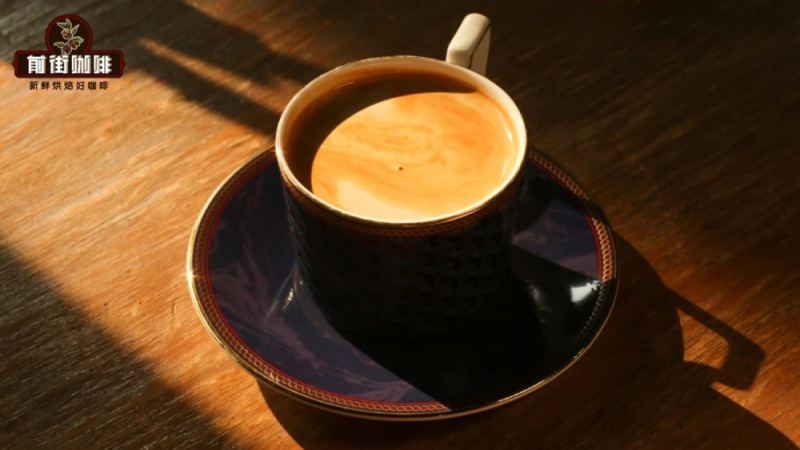
When making a hot Americano, you need to first preheat the cup with hot water, then pour in hot water, and finally pour in the extracted espresso. The ratio for Americano is usually between 1:6 and 1:8, and after many adjustments, Front Street Coffee (FrontStreet Coffee) chose a ratio of 1:6, that is, 40 grams of coffee liquid mixed with 240 grams of hot water.
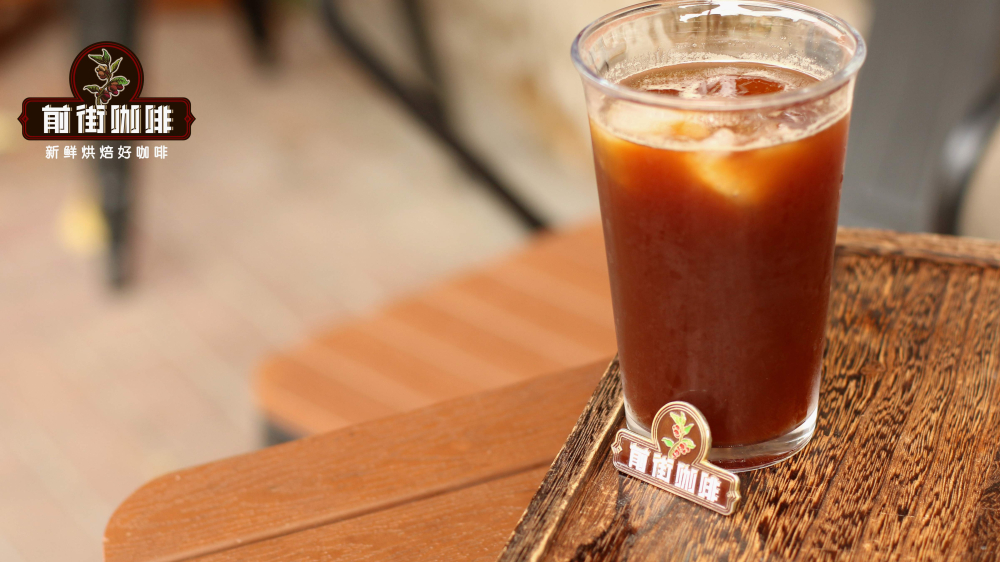
Similarly, when making an iced Americano, first pre-chill the cup with ice cubes, then pour in water, and finally pour in the espresso. Because ice cubes need to be added, Front Street Coffee's (FrontStreet Coffee) iced Americano uses a ratio of 1:7, with 40 grams of coffee liquid mixed with 280 grams of ice-water mixture, of which 180 grams are ice cubes and 100 grams are water.
Americano: Does It Taste Better Without the Crema?
When making a hot Americano, you will notice a layer of foam floating on the surface of the coffee liquid. That is what is commonly called crema. This crema comes from the crema produced when making espresso. We know that espresso is divided into three parts: the core, the body, and the crema. Espresso crema is formed like this: under the high pressure of the espresso machine, carbon dioxide in the coffee grounds is dissolved into the liquid. After extraction ends and the pressure returns to normal, the carbon dioxide in the coffee liquid begins to escape into the air, and at the same time it meets and is wrapped by the fats in the coffee, and crema is thus produced.
What happens if you scrape off the crema? Front Street Coffee (FrontStreet Coffee) once did a comparison, making two cups of Americano, one of which had the crema scraped off as a control. Taking Front Street Coffee's (FrontStreet Coffee) Warm Sun blend coffee beans as an example, the cup with the crema scraped off was cleaner and had a smoother mouthfeel, while the cup that kept the crema had a fuller body. Both cups had obvious dark chocolate flavors and a slight whiskey oak barrel aroma, with soft acidity, and the difference was actually not very big. If you prefer a clean taste, it is recommended to scrape off the crema; if you need to serve continuously, it is more recommended to keep the crema.
The above content is compiled by CoffeeHunters, a coffee news website.


