








Among the many espresso-based drinks, the Flat White has won over a large following with its rich, sweet flavor, and its soul base is precisely Ristretto—a niche coffee often translated as "extra-concentrated" or "refined espresso." It shares the same origin as regular Espresso, yet presents a completely different flavor profile due to the "restrictions" in its extraction method. Opinions on how to make Ristretto vary widely online, leaving many beginners confused. This article, from the perspective of Front Street Coffee, will systematically sort out the definition of Ristretto, its unique position in the espresso family, the coffee bean choices suitable for making it, and the two mainstream extraction approaches currently in use, helping you truly understand the logic behind this shot of espresso and find the method that best suits you or your café.

For more specialty coffee knowledge, please follow our WeChat official account: Front Street Coffee (FrontStreet Coffee)
The Flat White is a refined small-cup milk coffee, rich and sweet on the palate, which is why it has gained a large following in the coffee community. What sets it apart from the Latte and Cappuccino is not just that thin, velvety layer of milk foam, but more importantly the base it uses—Ristretto.
The methods for making Ristretto circulating online are all over the place, often leaving beginners baffled and unable to grasp the essence of this extraction method. So today, Front Street is here to talk about what Ristretto actually is and how exactly it's made.
What is Ristretto?
Ristretto is transliterated as "芮斯崔朵" in Chinese, and just looking at the name, it's hard to imagine what kind of coffee it is. Let's try a different angle—look at its other names: "extra-concentrated coffee" and "refined espresso."
Doesn't that make things much clearer? These names all point to the same thing—espresso. But note: this espresso is not that espresso. Ristretto is quite niche. Although it is extracted from an espresso machine just like Espresso, across dozens of espresso drinks, only the Flat White uses it as a base.
The base for almost all other espresso drinks is uniformly Espresso. The reason is that Ristretto is not an independent brewing method, but rather an extraction mode derived from Espresso.
Ristretto itself also carries the meaning of "restriction." Since it is derived from Espresso and carries a sense of restriction, it can be understood as: imposing a certain constraint during the Espresso extraction process.
This constraint is not aimed at a particular parameter, but rather limits the substances extracted in the espresso. In espresso extraction, the most critical variables are dose and yield, and what can be used to limit the extracted substances is naturally the "yield." Let's now look at how this "yield" is restricted.
What coffee beans are best for making Ristretto?
Before creating a blend, Front Street Coffee (FrontStreet Coffee) first studies the flavor characteristics of different coffee varieties from around the world. Beans have their own distinctive features depending on origin. Different varieties and origins lead to subtle differences in acidity, bitterness, sweetness, aroma, and body. Single-origin beans usually emphasize the unique personality of a particular type of coffee. Blended beans, on the other hand, are mostly used for espresso drinks like Espresso, Americano, Latte, or Cappuccino, offering a more balanced and smooth flavor, more stable quality, and broader appeal.
If you want a cup of Ristretto with a rich body and abundant aroma, Front Street recommends Front Street Coffee's Specialty Blend. This blend uses a dual-origin recipe of Colombian and Brazilian beans, presenting a sweet and fragrant profile after blending, with a medium-dark roast. When used for espresso, it has a soft, slightly acidic, clean and sweet taste, with a nutty finish. Overall it's not harsh, fairly mild, with medium crema.
For those who want to practice latte art at home, you can choose Front Street Classic Blend. This is a three-origin medium-dark roast espresso recipe, inspired by the early popular "Mamba"—that is, Mandheling plus Brazil. To enhance aroma and crema, Front Street Classic Blend also adds a small amount of Robusta to boost flavor intensity, making it easy for beginners to extract espresso with golden crema at home.

How to make Ristretto
Currently, there are two main approaches to extracting Ristretto. The first is to directly limit the Espresso yield, discarding the later-stage substances. For example, Front Street's Espresso recipe is: 20g dose, 40ml yield extracted in 30 seconds.
To make Ristretto, you simply keep only the front and middle stages—extract just 70% of the total 40ml, which is 28ml.
The advantage of this method is that it cuts off the point where bitter substances are released in large amounts during the later stage, reducing the proportion of bitterness while increasing the proportion of sweet and acidic substances, making the coffee's sweetness more prominent.
There are many similar extraction approaches: some cafés take only two-thirds of the total espresso yield, while others use a 1:1 dose-to-yield ratio for extraction. So there's no need to stick rigidly to one parameter—once you understand the principle, any of these methods works.
The second approach is to control the flow rate of the coffee liquid, slowing it down by adjusting to a finer grind, thereby obtaining a more concentrated espresso.
Still using Front Street's Espresso recipe as an example: 20g dose, 40ml yield extracted in 30 seconds. To make Ristretto, you would adjust to a finer grind, and with the same 20g dose and 30 seconds, extract only 70% of the original total—that is, 28ml.
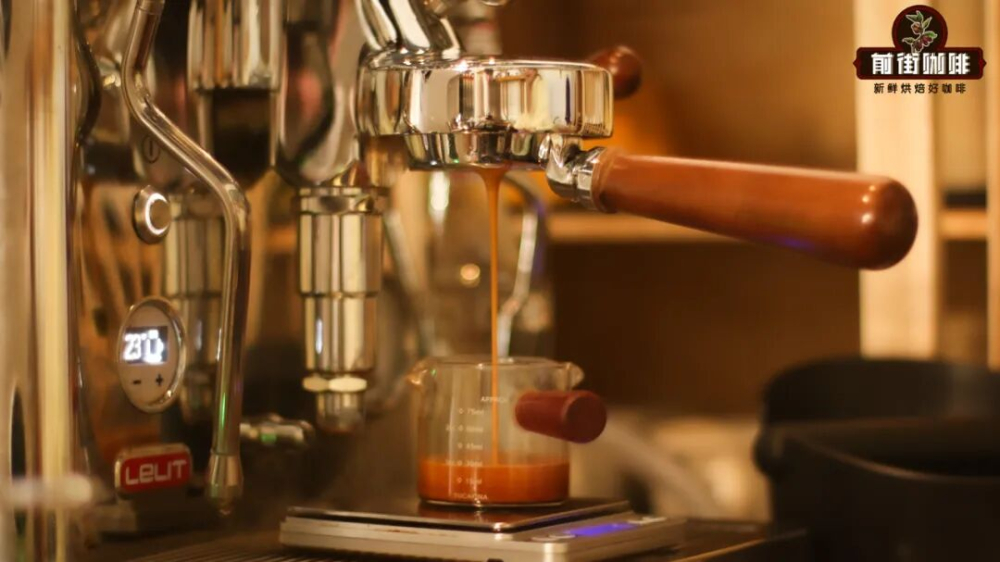
The advantage of this method is that it achieves high-concentration espresso through layering. Compared to the former, it makes it easier to distinguish Ristretto from Espresso, since it essentially means designing a completely new extraction recipe. The mouthfeel is also fuller than the former, with a more robust flavor. But in terms of practicality, the former still comes out ahead.
As mentioned at the beginning, most espresso drinks use Espresso as their base, and Ristretto is currently only widely used in Flat Whites. If the second method is adopted, in order to ensure that other espresso drinks and Flat Whites can be produced simultaneously, the café would need to purchase an additional grinder, plus spend time and materials on dialing in the grind, significantly increasing costs.
It's impossible for a shop to use just one grinder to repeatedly switch between coarse and fine grinds—that's just not realistic (unless you're only making coffee for yourself). So rather than using the latter method to label themselves as "professional," most shops choose the former extraction approach—it's convenient, tastes good, and reduces waste.
The above content is compiled by CoffeeHunters, a coffee news website.


