







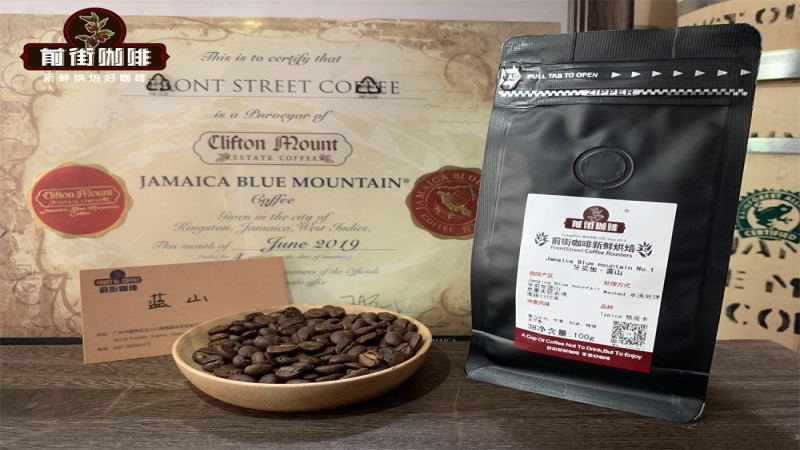
Blue Mountain coffee is one of the most renowned representatives of specialty coffee. It comes from Jamaica's Blue Mountain region and is favored by black coffee lovers for its rich aroma, balanced body, and sweet, lingering aftertaste. This article systematically covers the basics of Blue Mountain coffee, from terroir, variety characteristics, and washed processing methods to green bean grading standards, roasting, and brewing parameters. The Blue Mountain coffee bean variety is the ancient Typica, processed using the traditional washed method, and graded by green bean size into Blue Mountain No. 1 through No. 3 and Peaberry, four grades in total. Front Street Coffee sells Jamaican Blue Mountain No. 1 coffee beans, medium-dark roasted, which present a balanced, smooth flavor of dark chocolate, nuts, and toffee when hand-brewed.
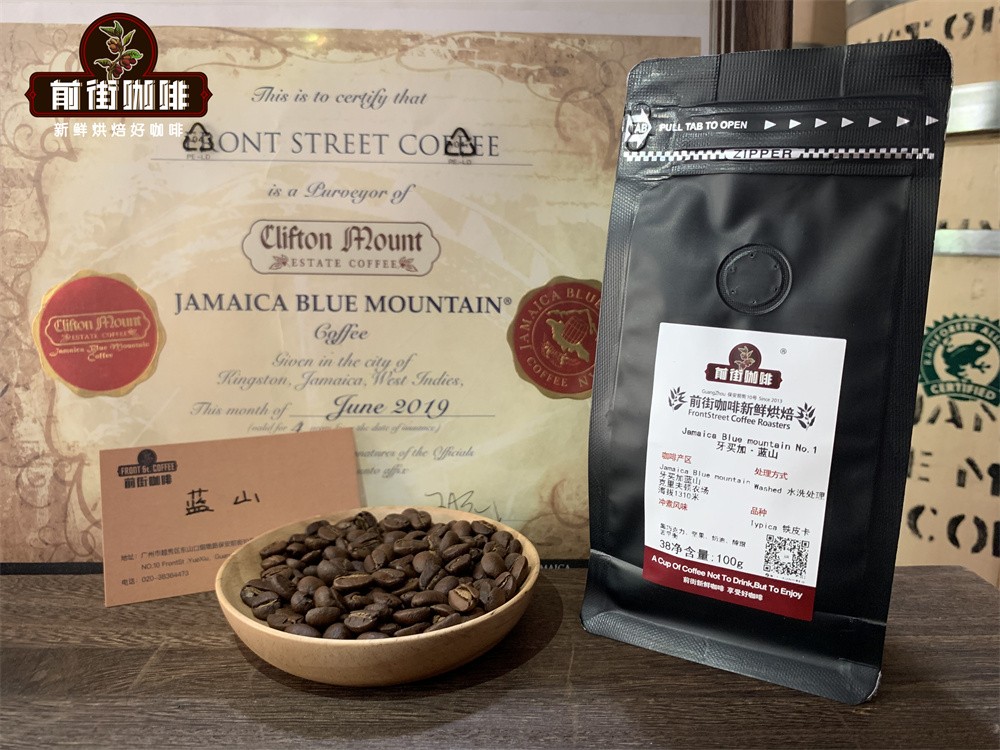
In the lineup of specialty coffee beans, Blue Mountain coffee's fame is nearly unmatched. Authentic Blue Mountain coffee has a full aroma, a rich yet balanced body, and a sweet lingering finish after swallowing—making it well worth trying for those who prefer black coffee.
Blue Mountain coffee comes from Jamaica's Blue Mountain region.
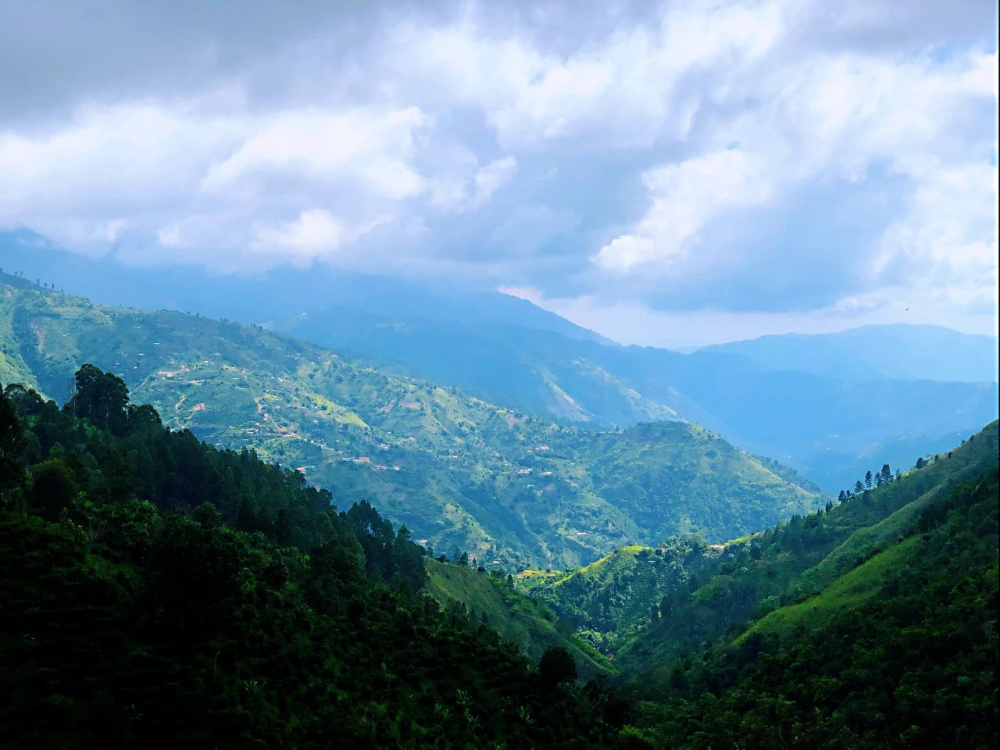
The Blue Mountain range is surrounded by the waters of the Caribbean Sea and has an island tropical rainforest climate, with concentrated rainfall during the rainy season and smooth drainage. Volcanic ash left by active volcanic activity gives the soil rich nutrients, so the coffee trees need little extra irrigation and fertilization. The high-altitude growing areas are often shrouded in mist, with cool, pleasant temperatures—ideal for crop growth. Locals often plant coffee trees together with banana trees on the slopes of the Blue Mountains.
The Jamaican Coffee Industry Board (CIB) has established strict production standards: only Arabica coffee grown in specific areas at altitudes between 910 and 1,700 meters qualifies to bear the name Jamaican Blue Mountain Coffee, mainly distributed across four regions—St. Mary, St. Thomas, St. Andrew, and Portland. Coffee produced in other plots within the Blue Mountain region is classified as Jamaican High Mountain Coffee and Jamaican Prime Coffee.
The variety of Blue Mountain coffee.
The variety used for Jamaican Blue Mountain coffee is Typica, an ancient variety known for its elegant, pure flavor. Those familiar with coffee varieties should know that Typica is the oldest variety, and all Arabica varieties today can be traced back to descendants of Typica and Bourbon.
The reason Typica was not widely planted on a large scale is that it is physically weak, has poor disease resistance, and yields quite low per plant. Typica was introduced to Blue Mountain for cultivation in the 18th century, and more than two hundred years later, Blue Mountain's Typica has gradually adapted to the local island terroir, evolving stronger disease resistance—especially against coffee berry disease, far stronger than typical Typica. Front Street believes that Blue Mountain coffee's refined, clean flavor is inseparable from Jamaica's insistence on carefully cultivating the Typica variety.
Blue Mountain coffee beans are washed processed.
The reason Blue Mountain coffee maintains a clean flavor is also thanks to the traditional washed processing method still used locally. During green bean processing, multiple steps remove substandard coffee cherries, greatly reducing the overall defect rate.
After the coffee cherries are harvested, they are first machine-pressed to remove the skin and pulp, then placed in tanks to ferment overnight. After fermentation, the beans are moved to clean tanks and repeatedly scrubbed, using the friction between the beans and the force of water to wash the coffee beans until smooth and clean. Finally, the parchment beans are spread out to dry for two to three weeks until moisture content drops to 12–14%. Because the pulp and mucilage are removed before drying, there is less influence from excessive fermentation acidity, and the Blue Mountain beans' own aroma appears more balanced and clean. Although the coffee market is increasingly diverse and Blue Mountain coffee has experimented with a small number of natural batches, washed processing remains the most classic representation of Blue Mountain flavor.
The grades of Blue Mountain coffee.
Blue Mountain coffee is divided into four grades based on green bean size: Blue Mountain No. 1 (17–18 screen and above), Blue Mountain No. 2 (16 screen), Blue Mountain No. 3 (15–16 screen), and PB (Blue Mountain Peaberry). Among them, Blue Mountain No. 1 is the highest grade of Jamaican Blue Mountain coffee. (Screen is a coffee measurement unit; 1 screen equals 0.4 millimeters.) The Blue Mountain coffee sold by Front Street is precisely Jamaica's national treasure coffee—Jamaican Blue Mountain No. 1 coffee beans.
Before export, Blue Mountain coffee must pass inspection by CIB-certified professional cuppers to confirm it has just the right acidity, sweetness, bitterness, body, and aroma. Blue Mountain coffee beans that complete quality inspection are shipped in handcrafted wooden barrels to roasters around the world. Compared with the burlap sacks commonly used in other regions, oak barrels have the advantage of absorbing and releasing internal and external moisture while isolating coffee aroma from escaping, allowing the beans to maintain a more stable moisture content and making the roasting process more consistent.
The flavor and taste characteristics of Blue Mountain No. 1 coffee.
Front Street's roasting philosophy is to present coffee's most classic flavor notes—such as the bright lemony acidity of Yirgacheffe and the rich, toasty aroma of Indonesian Mandheling. Blue Mountain naturally should highlight the classic Blue Mountain flavor as well. Front Street uses a medium-dark roast to maximize the coffee's chocolate and nut aromas while preserving soft acidity and sweetness, bringing the overall taste into balance.
When brewing coffees of different roast levels, Front Street selects corresponding brewing parameters. Take today's Blue Mountain No. 1 coffee beans as an example: they are medium-dark roasted, with more caramelization reactions than light-roasted beans, so they release bitter large-molecule compounds more easily. To avoid over-extracting off-flavors, Front Street slightly lowers the water temperature: the brewing temperature for light-roasted coffee is 91–93°C, while for medium-dark roasted coffee beans Front Street recommends 87–88°C.
The finer the grind, the more substances dissolve within the same extraction time. To keep Blue Mountain No. 1's extraction yield from becoming too high and turning strong and bitter, Front Street coarsens the grind a bit, using a medium grind—store EK43s setting 10.5, with a 75% passing rate on the China standard sieve.
Front Street's extraction parameters for hand-brewing Blue Mountain No. 1: Kono dripper, 88°C water temperature, 1:15 coffee-to-water ratio, 15 grams of coffee, grind size (75% passing rate on a No. 20 standard sieve).
In the first stage, gently pour 30 grams of water for blooming, with a blooming time of 30 seconds; in the second stage, pour to about 125 grams, circling outward evenly and steadily. Then wait for the coffee liquid to drop; when it has dropped halfway, pour the final stage of water up to 225 grams. After all the coffee liquid has finished dripping, the total extraction time is generally about 2 minutes.
Front Street's hand-brewed Blue Mountain No. 1 coffee flavor and taste: on the palate there are notes of dark chocolate, roasted nuts, and toffee, with caramel sweetness; the acidity is soft and delicate, all flavors are balanced, and the body is smooth yet rich. As the temperature drops, the aroma becomes clearer and the layers more complex.
For professional coffee knowledge exchange and more coffee bean information, please follow Coffee Workshop (WeChat official account: cafe_style).
For more specialty coffee beans, please add the private WeChat of Front Street Coffee (FrontStreet Coffee), WeChat ID: qjcoffeex.
The above content is compiled by CoffeeHunters, a coffee news website.


