







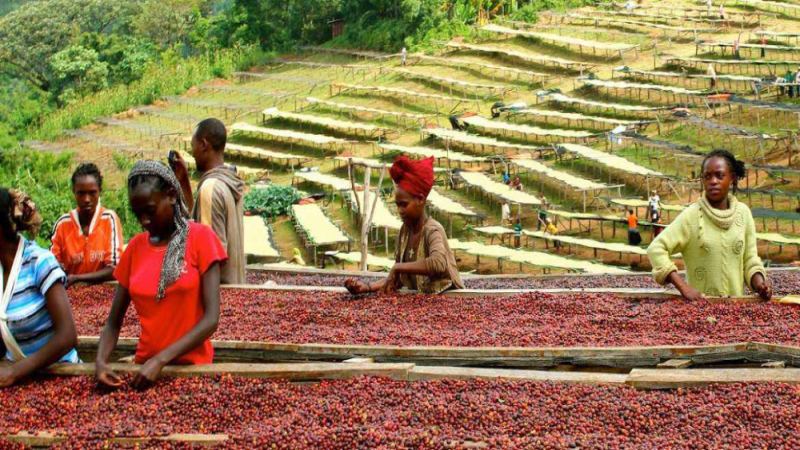
Ethiopia is the birthplace of Arabica coffee and one of the most important coffee-producing countries in Africa, and its coffee beans are often labeled "Mocha." The country has diverse cultivation systems including forest, garden, and large-farm coffee, and its nine major regions each have distinct flavor profiles. Among them, the Guji region has performed impressively since becoming independent in 2010, and Front Street's Huakui comes from here. This article will systematically outline Ethiopia's coffee cultivation models, the flavor differences among representative regions (Yirgacheffe, Sidamo, Guji, Harrar, Limu), the concept of heirloom varieties, and the specific brewing parameters for Front Street Gudingding Cooperative coffee beans, providing coffee lovers with a complete reference on origins and brewing.
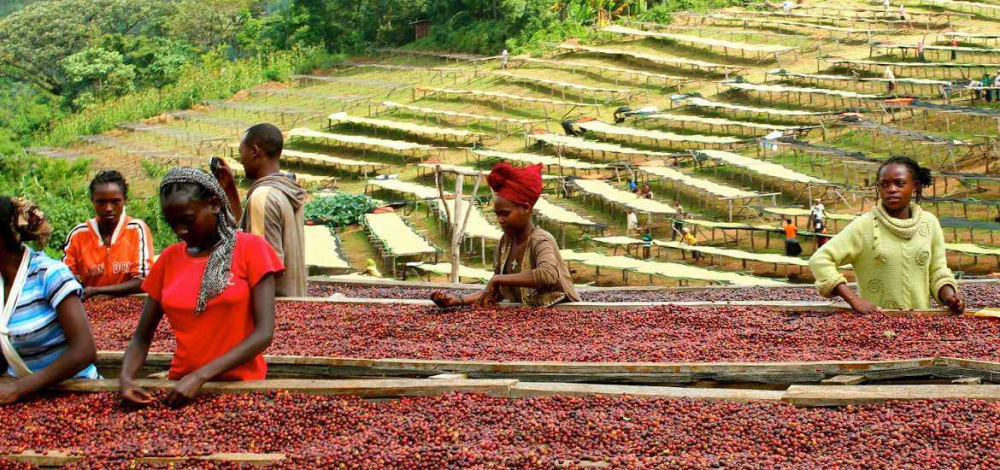
As the birthplace of coffee, Ethiopia is one of the important producers of Arabica coffee beans in Africa, and the coffee produced here is often praised as "the world's finest Mocha coffee beans."
Coffee Cultivation in Ethiopia
The country is located on the East African Plateau in northeastern Africa, and its coffee-growing areas are mainly distributed in the central and western parts and on both sides of the East African Rift Valley. The local natural environment is very well suited to the growth needs of coffee trees: from March to April each year, white coffee flowers bloom on the branches, and then the fruit begins to develop; from September to December, the red coffee cherries gradually ripen and await harvest, and from November to December the new season's coffee enters the export stage. Ethiopia has an extremely diverse coffee cultivation system, covering several major types such as forest coffee, garden coffee, and large-farm coffee.
Forest coffee refers to wild coffee trees growing in primary forests, protected by the government; after the fruit ripens, nearby residents pick it and sell it at market. Forest coffee also includes a semi-forest model, in which some farmers regularly enter the forest to prune shade trees and branches for the coffee trees, preventing damage from insufficient light or excessive exposure. The quality of this type of coffee varies greatly, so its selling price is usually very low.
The most common cultivation method in Ethiopia is garden coffee, also called courtyard coffee. Because coffee cannot provide income year-round, farmers plant coffee trees together with other cash crops in their own backyards, which also makes management convenient. The small amount of harvested coffee cherries is sold to nearby green bean processing plants and ultimately exported and sold under the plant's name.
There is also large-farm coffee, which accounts for a relatively small proportion and is usually invested in and produced by large companies or major brands. This method aims to improve efficiency and implements large-scale specialized cultivation and management, with dedicated workers responsible for seedling raising, pruning, fertilizing, spraying, and harvesting.
Ethiopian Coffee Regions
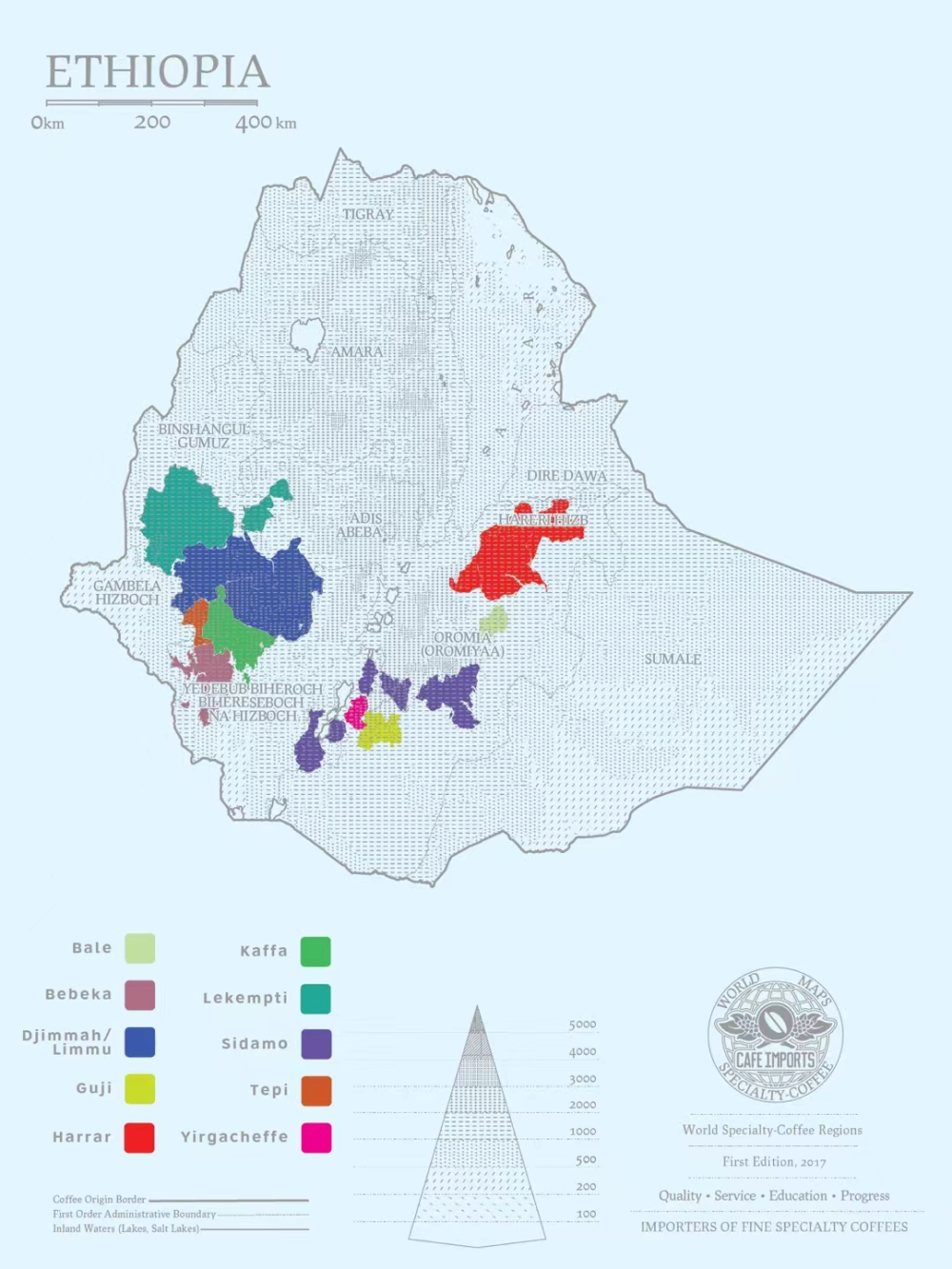
The above cultivation systems are distributed across Ethiopia's nine major regions: Djimmah, Sidamo, Yirgacheffe, Harrar, Limu, Illubabor, Gimbi (Lekempti), Teppi, and Bebeka.
Each region has its own distinctive flavor. Overall, coffee beans from Teppi, Bebeka, and Illubabor in the west and the area around Lake Tana in the northwest are noticeably larger, with a stronger wild character and lower fruity acidity; Limu in the center and Yirgacheffe and Sidamo in the south-central area show rich fruity notes, floral aromas, and bright acidity; Harrar in the east combines both the wild character of the west and the fruity notes of the south-central area. Below, Front Street introduces several of the more representative regions.
Yirgacheffe
Yirgacheffe is a small town at an altitude of 1,700 to 2,100 meters, shrouded in fog year-round, with spring-like weather in all four seasons, cool rather than hot summer breezes, abundant rain without dampness, and no cold damage in winter, creating an exceptionally favorable growing environment for coffee trees. The Yirgacheffe region was originally under the jurisdiction of the Sidamo region, but was later separated out because of its unique flavor. The high altitude creates a pronounced temperature difference between day and night, so the coffee fruit grows and ripens slowly, can accumulate more nutrients, and has a more intense aroma. The so-called Yirgacheffe flavor is bright citrus and lemon acidity, intense jasmine fragrance, and honey-like clean sweetness, with a long, memorable finish.
It is worth mentioning that in order to improve the income of local Ethiopian farmers and coffee quality, the Dutch trading company Trabocca BV launched the "OPERATION CHERRY RED PROJECT" in 2007, mainly targeting high-altitude Ethiopian regions such as Yirgacheffe, improving processing techniques such as washed, semi-washed, and natural, and introducing professional cuppers. During the harvest season, different harvest volumes are set according to different microclimate zones, and only 100% ripe red coffee cherries are picked, with output of about 1,500 to 3,000 kilograms. The financial loans, new hardware equipment, and production technical knowledge provided by Trabocca have greatly improved the quality of coffee beans in the Yirgacheffe region and even throughout Ethiopia, and coffee prices have risen accordingly, thereby increasing farmers' income.
The Yirgacheffe Coffee Farmers Cooperative Union (YCFCU) is composed of 28 small cooperatives, each responsible for an area roughly equivalent to a village. Nearby farmers sell their harvested coffee cherries here, and after processing, the green beans are sold under the cooperative's name.
Front Street believes that washed Yirgacheffe best represents the basic flavor of African coffee, so it launched its washed Yirgacheffe staple bean. Front Street's staple beans are the "representative face" of each region; beginners can use a cost-effective way to taste the basic flavor of a region and then become acquainted with more flavor types.
FrontStreet Coffee: Yirgacheffe Coffee Beans
Region: Yirgacheffe
Altitude: 1900-2000m
Processing Method: Washed
Variety: Heirloom
Flavor: Jasmine, Citrus, Berry
As the number of specialty coffee lovers grows, people's pursuit of single origins is also increasing. The Gudingding Cooperative became independent in 2012 from the Worka Cooperative at the southeastern end of Yirgacheffe. Its more than 300 farmers possess relatively advanced local coffee production skills and use traditional washed and natural processing methods for green beans, and it is known as the last pure land of Yirgacheffe.
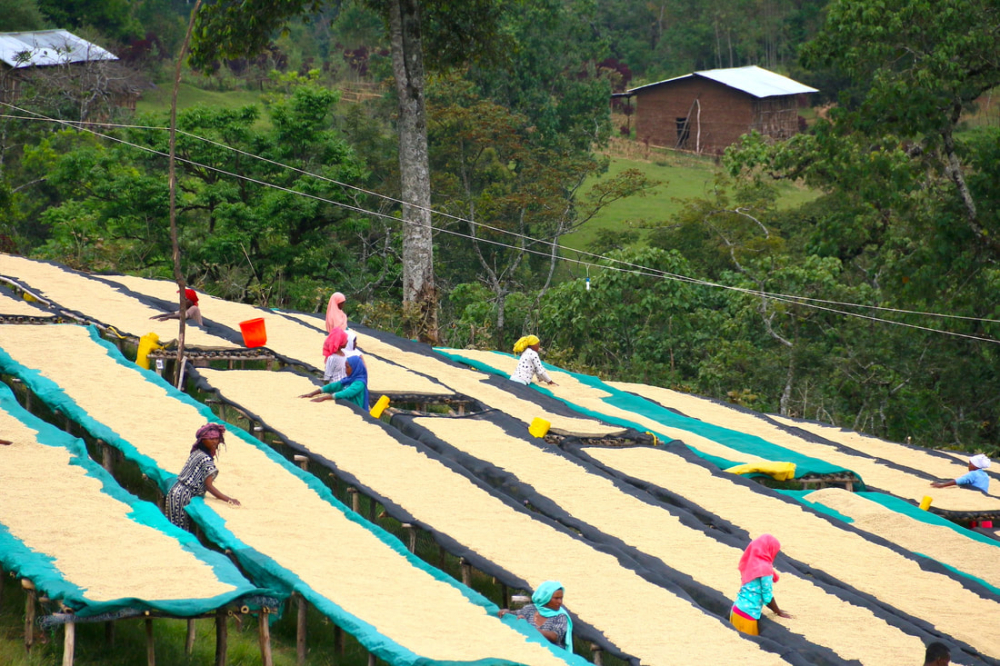
FrontStreet Coffee Gudingding Cooperative coffee beans use the washed processing method. First, the fruit skin and pulp of the cherries are removed with a depulper, then the beans are left to rest in a fermentation tank for 18 to 36 hours to break down the mucilage layer (the specific time depends on local temperature and humidity), after which the parchment beans are scrubbed for 30 to 60 minutes through washing channels.
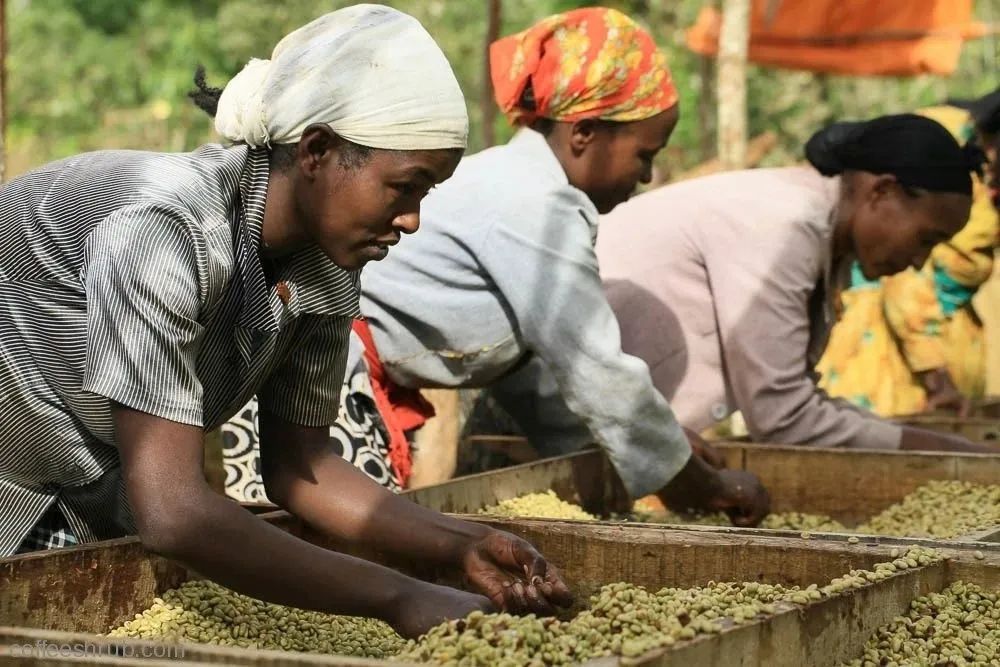
With the help of specially made channels and rushing water, low-density, poor-quality beans can be removed, and then the high-quality parchment beans are placed on African raised beds to dry for about 14 days. After drying is completed, they are first stored in the processing plant warehouse, and before export the parchment beans are transported to the processing plant for hulling.
FrontStreet Coffee: Yirgacheffe Gudingding Cooperative Coffee Beans Region: Yirgacheffe Gedeo Zone Producer: Gudingding Cooperative Altitude: 1900-2300m Variety: Local Heirloom Processing Method: Washed
Grade: G1
Flavor: Citrus, Berry, Lemon, Cane Sugar, Green Tea
Sidamo
Sidamo is located in southern Ethiopia and became an independent region in 2009. The coffee trees grown in Sidamo are distributed on both sides of the East African Rift Valley. The highland soil is fertile, and annual rainfall can reach up to 2,000 millimeters, providing ideal conditions for coffee cultivation.
The Guji region was once part of the Sidamo region, and in 2010, because of the excellent flavor of its coffee beans, it was made an independent new region by the Ethiopia Commodity Exchange (ECX). The Guji region is next to Yirgacheffe and has diverse terrain, with fertile black soil whose depth can reach two meters, allowing plant roots to grow deeper. In addition, the average altitude is above 1,800 meters, and the temperature difference between day and night is relatively large; these are all favorable conditions for Guji to produce high-quality coffee. Coffee cultivation hardly requires chemical fertilizers, because fallen leaves, decaying matter, dead plant roots around the trees, and organic matter in the soil can provide sufficient nutrients for the coffee trees to grow vigorously.
The Huakui coffee on Front Street's bean list comes from the Buku Abel processing plant in Hambela, Guji, and is a naturally processed coffee produced by that plant. The Buku processing plant purchases coffee cherries from different areas near the farm for processing and sale. The processing plant places selected ripe fruit on African raised beds to dry. Because the local day-night temperature difference is very large, farmers shade the sun at noon to avoid excessive fermentation caused by too-high temperatures, and at night cover the fruit with plastic sheeting to prevent sudden rain. The fruit is turned continuously throughout the day, and the coffee cherries are kept from piling too thick, which allows the fruit to dry evenly and prevents sunburn or unpleasant fermentation flavors. After about 18 days of natural processing, the moisture content of the green coffee beans drops to 13%, and the hull can then be removed by machine. Naturally processed Huakui coffee has an intense tropical fruit aroma.
FrontStreet Coffee Ethiopia Huakui 5.0
Region: Sidamo Guji
Altitude: 2250-2350m
Variety: Local Heirloom
Processing Method: Natural
Flavor: Passion Fruit, Berry, Strawberry
Harrar
Harrar is an ancient trading center located in eastern Ethiopia and is also one of Islam's four holy cities. Coffee from the Harrar region is not grown within the city itself, but in the Hararghe Highlands of the Harrar area. Annual rainfall here is only 1,000 millimeters, and sunshine is abundant, so coffee production is almost entirely natural-processed. In flavor, specialty-grade Harrar coffee is similar to the famous Yemen Mocha coffee, with a strong chocolate aroma during roasting, a rich red wine mouthfeel, and dark berry acidity. However, in recent years, affected by various local factors, the grading system has been chaotic, leading to unstable coffee quality, so there is less and less specialty Harrar coffee on the market.
Limu
The Limu region is located in central Ethiopia, with cultivation at altitudes of 1,200 to 2,000 meters. Limu coffee has relatively low output and mainly supplies the European and American coffee markets. The green beans use washed, natural, and semi-washed processing methods. Front Street believes that coffee from the Limu region has lower body, and its floral and citrus notes are not as good as those of Yirgacheffe and Sidamo; in flavor it has bright fruity acidity, but with additional notes of grass and brown sugar.
Ethiopian Coffee Varieties
As the birthplace of coffee, Ethiopia has an enormous number of coffee varieties and can be called a treasure trove of coffee varieties. However, variety identification is time-consuming and labor-intensive, and because most are grown by smallholders, post-harvest mixed processing makes it difficult to classify varieties in detail, so Ethiopian export coffee beans are generally collectively called "Heirloom." This also explains why we often see Ethiopian beans of uneven shape and size.
Brewing Reference
For brewing, Front Street chooses freshly roasted Gudingding Cooperative coffee beans. After roasting, coffee goes through a 4- to 7-day resting period and then enters its best tasting window; after this period, the aroma volatilizes more quickly and the flavor and mouthfeel decline sharply. Front Street deeply understands the importance of coffee freshness, so all shipped coffee beans are freshly roasted within 5 days, and when customers receive them they are just at their peak flavor state and can be brewed and enjoyed directly.
Based on past experience, because Ethiopian beans tend toward floral and fruity notes, Front Street's roaster chooses a light roast in order to retain more floral aroma and fruity acidity. Yirgacheffe coffee grows at a relatively high altitude and has a harder texture; light roasting does not greatly change the internal structure of the beans, so it requires a higher water temperature and a finer grind. Front Street uses a V60 dripper for brewing to better highlight the layers of sweet and sour flavors.
Dripper: V60
Water Temperature: 92°C
Grind Size: 80% passing a No. 20 standard sieve
Coffee-to-Water Ratio: 1:15
Coffee Dose: 15 grams
Use a three-stage extraction: after grinding the coffee, pour it into the filter paper, start pouring 30g from the center and bloom for 30 seconds, keeping a steady circular pour from the inside out with a small stream throughout; in the second stage pour 95g of water, and when the coffee liquid has almost finished draining, begin pouring the third stage of 100g until all the coffee has filtered through, then remove the dripper. The time is about 2 minutes, with an allowance of about 10 seconds.
The washed Gudingding has a fresh white floral aroma, with uplifting lemon and berry acidity on entry, lingering citrus and green tea aromas, an overall clean and translucent cup, and a finish with a hint of honey sweetness.
For professional coffee knowledge exchange and more coffee bean information, please follow Coffee Workshop (WeChat public account cafe_style)
For more specialty coffee beans, please add the private WeChat of FrontStreet Coffee, WeChat ID: qjcoffeex
The above content is compiled by CoffeeHunters, a coffee news website.


