







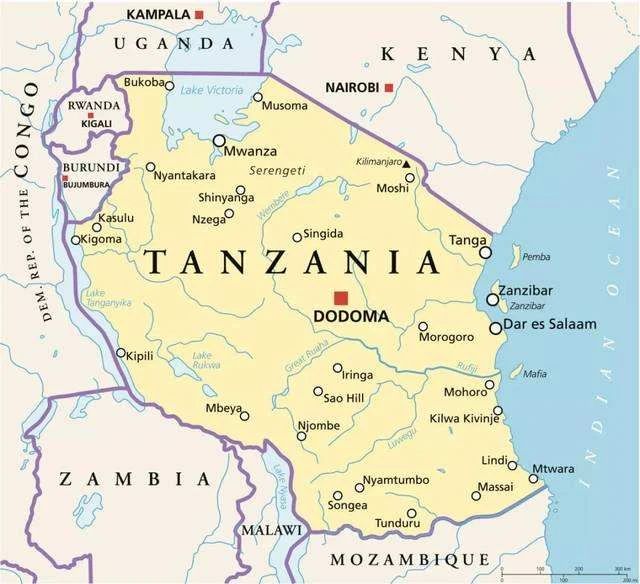
Tanzania and Kenya are both located in East Africa, and each has its own following among specialty coffee enthusiasts, but the former's flavor tends to be softer and more mellow. From Front Street's perspective, this article reviews the introduction history of Tanzanian coffee, the cooperative system, and the terroir conditions of the Kilimanjaro producing region, introduces the local predominantly washed processing method, and provides Front Street's pour-over extraction suggestions for the Kilimanjaro AA lot of Typica it has sourced, including dripper, water temperature, coffee-to-water ratio, and staged pouring rhythm, to help coffee lovers understand why this bean presents interwoven layers of citrus, berry, honey, and tea-like notes.
To learn more about specialty coffee, welcome to follow: Front Street Coffee
Geographically, Tanzania is adjacent to Kenya, and the two places also share many linguistic similarities, with frequent people-to-people exchanges. In the field of specialty coffee, the producing regions of both countries have loyal fans, though Kenyan coffee is clearly more well-known. After actual cupping comparisons, Front Street has noticed that Kenyan coffee often has deep dark berry notes, while Tanzanian coffee shows a softer, gentler mouthfeel, pleasant acidity, accompanied by light sweet aromas, with a long-lasting finish.
The Story of Coffee Planting in Tanzania
Coffee was first introduced from Reunion Island, brought by missionaries from Kenya to be planted in Bayamoyo and Mogoro in Tanzania. Around 1893, coffee trees planted on the slopes of Kilimanjaro benefited from the fertile soil formed by volcanic eruptions and were successfully harvested, marking the official beginning of Tanzania's coffee planting history.
In 1911, the colonial government issued a directive requiring large-scale planting of Arabica coffee trees in the Bukoba producing region. In 1952, the first common cooperative, the Kilimanjaro Native Planters' Association (KNRA), was established, and the number of participating farmers continued to rise. Entering the 1950s, more coffee varieties were gradually introduced from neighboring Burundi, mainly in western Tanzania.
After Tanzania gained independence in 1961, the country shifted its economic focus to the coffee industry and hoped to double coffee production by 1970, but this goal was ultimately not achieved. Through the continued efforts of local practitioners, Tanzania's current annual green coffee production is about 60,000 tons, with Robusta and Arabica each accounting for half.
In the past, Tanzania's coffee industry was mainly based on estate planting and management. Today, more than 80% is grown by smallholders, and many smallholders also join together to form cooperative organizations. Among them, the Kilimanjaro Cooperative Union (KNCU) plays a pivotal role, responsible for supervising and controlling the quality of the coffee produced. Afterward, the coffee is purchased by the Tanzanian Coffee Marketing Board (TCMB), and then sold to private exporters through auctions.
Kilimanjaro
Tanzania is one of the countries in East Africa richest in tourism resources. It is home to three of Africa's major lakes—Lake Victoria, Lake Tanganyika, and Lake Nyasa (Lake Malawi)—all located along its borders. Mount Kilimanjaro, known as the "highest peak in Africa," stands at 5,895 meters above sea level and is renowned worldwide.
Kilimanjaro is a massive mountain whose summit is covered with snow year-round, and it is also one of the highest volcanoes and standalone peaks in the world. Farmland is distributed at the foot of the mountain, while dense rainforest and alpine vegetation cover the midslopes. From the foothills to the summit, Kilimanjaro has several clearly defined vegetation zones: semi-arid scrubland, well-watered farmland, dense cloud forest, open moorland, alpine desert, and a zone where mosses and lichens coexist. Such diverse ecological environments not only provide habitats and breeding grounds for many rare wild animals, but also give many cash crops ideal growing conditions.
The Tanzanian coffee sourced by Front Street comes from Kilimanjaro, and the variety is the heirloom Typica, belonging to the highest grade AA lot and processed by the traditional washed method. When brewed after roasting, the cup presents citrus and honey-like fruity tea notes, along with the fresh aroma of berries, with quite rich layers.
Front Street Coffee: Tanzania Kilimanjaro Coffee Beans
Region: Northern Highlands, Kilimanjaro volcanic area
Variety: Typica
Processing Method: Washed
Grade: AA
Altitude: 1300-2000m
Brewing Flavor: Citrus, berry, honey, tea-like
Main Processing Methods of Tanzanian Coffee
In Tanzania, coffee beans are mostly processed by the washed method. Whenever the coffee cherries ripen, farmers harvest them in a concentrated manner, then pack them uniformly and send them to nearby processing stations.
Washed steps: After the coffee cherries are picked, they are put into water, and immature fruits are removed by buoyancy; then the skin and pulp are removed with a depulper, followed by resting in fermentation tanks for 18-36 hours until the mucilage layer decomposes. After fermentation ends, the parchment beans are scrubbed in channels for 30-60 minutes. Through special channels and the washing of water flow, beans with low density and poor quality are separated out; after the high-quality coffee beans are drained of water, they are spread on African-style raised beds to dry.
Because the skin, pulp, and most of the mucilage have already been removed before formal drying, the aroma of the coffee beans themselves is clearer and more transparent, showing citrus and lemon notes and elegant floral aromas, with an overall bright and delicate flavor.
Pour-over Suggestions for Tanzanian Coffee
When Front Street produces Tanzanian coffee, it uses the pour-over method for extraction. Considering that this Kilimanjaro coffee is a medium-light roast and comes from a high-altitude region, the beans are relatively hard in texture, so Front Street uses a medium-fine grind and a medium-high water temperature in the brewing parameters.
Front Street's Pour-over Parameter Suggestions:
Dripper: V60 Water temperature: 92-93°C Dose: 15g Coffee-to-water ratio: 1:15 Grind size: fine granulated sugar size (78% passes through a No. 20 sieve)
For the first pour, add 30 grams of water for a 30-second bloom, then pour 95 grams (the digital scale shows about 125 grams), finishing the pour in about 1 minute. When the water level drops to 2/3 of the coffee bed, pour the remaining 100 grams (the digital scale shows about 225 grams), finishing the pour in about 1 minute 35 seconds. Dripping is completed at 2'10", then remove the dripper and finish extraction.
Brewing flavor of Tanzania Kilimanjaro coffee beans: berry aroma, soft citrus acidity on entry, nuts in the middle, and a honey-like finish.
The above content is compiled by CoffeeHunters, a coffee news website.


