








In Ethiopia, coffee is not just a beverage, but a cultural ritual deeply embedded in family and social life. From the legend of the shepherd Kaldi discovering coffee cherries to today's world-renowned Yirgacheffe, Sidamo, and Harar, Ethiopian coffee has captivated countless enthusiasts with its intense floral aroma, citrus acidity, and clean mouthfeel. This article sorts through the origin story of Ethiopian coffee, traditional coffee ceremonies, garden cultivation patterns, the distribution of nine major producing regions, and the differences between washed and natural processing methods, and combines representative products from the Front Street bean list such as the Gotiti Cooperative, Red Cherry, and Huakui to give you a complete understanding of the unique charm of this star coffee-producing country in Africa.

Coffee is now an extremely popular beverage worldwide, and in the African country of Ethiopia, it also carries local culture and belief. Regardless of family circumstances, the coffee ceremony is an indispensable part of social and family life. Whenever there is a social gathering, a solemn coffee ceremony will be held.
Traditional Ethiopian Coffee Ceremony
According to legend, on the Ethiopian highlands, a shepherd named Kaldi was grazing his flock when he accidentally discovered that his goats became unusually active after eating certain wild red berries. Out of curiosity, he also picked some and took them home to try. After eating them, he felt energized and especially excited, so he shared the matter with the villagers. The news gradually spread, and coffee beans were subsequently introduced to the Arabian Peninsula, where cultivation and trade slowly developed, thus beginning coffee beans' centuries-long global journey.
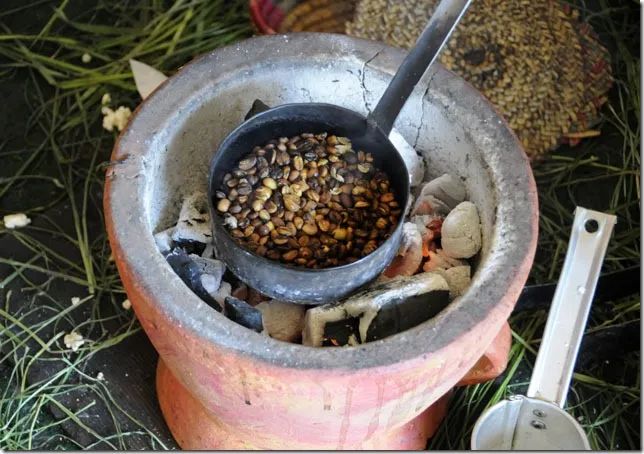
Although this story is not necessarily a rigorous historical record, Ethiopians have had a tradition of drinking coffee since ancient times. Only a cup of strong coffee in the morning can awaken a refreshed day, and the air throughout the villages is always filled with a rich coffee aroma. Here, the Ethiopian people have well preserved coffee's most primitive purity. They use the most primitive iron pestle to grind charcoal-roasted coffee beans into powder, put it into a coffee pot, and the boiling coffee slowly releases its unique aroma, to be enjoyed together with traditional bread.
Ethiopians have a coffee ceremony with a very long history. First, green coffee beans are roasted in a flat pan, then crushed with a pestle and mortar, and then placed into a clay pot called a "Jebena" to brew. When the hot water mixed with coffee grounds comes to a boil, it means the coffee is ready to be tasted. The coffee ceremony is divided into three rounds. The first cup drunk is Abol, and at this time an elder should say blessings; the second cup is Tona, when everyone begins to chat about family matters; the third cup, Beraka, symbolizes joy. Only after drinking this cup does the ceremony truly end.
It is worth mentioning that in the Ethiopian language, coffee is "bunn" or "buna." The origin of coffee is Kaffa. So coffee is sometimes called "Kaffa bunn," or coffee from Kaffa. Therefore, the term "coffee bean" is generally considered to be an anglicization of "Kaffa bunn." The English word coffee comes from the Ethiopian place name "Kaffa."
Ethiopia is mainly dominated by garden coffee cultivation patterns
Ethiopia's elevated terrain forms an excellent climatic environment. It has a tropical rainforest climate, abundant rainfall and misty conditions, and an extremely high altitude of about two thousand meters that creates a significant temperature difference, providing a uniquely favorable growing environment for coffee trees.
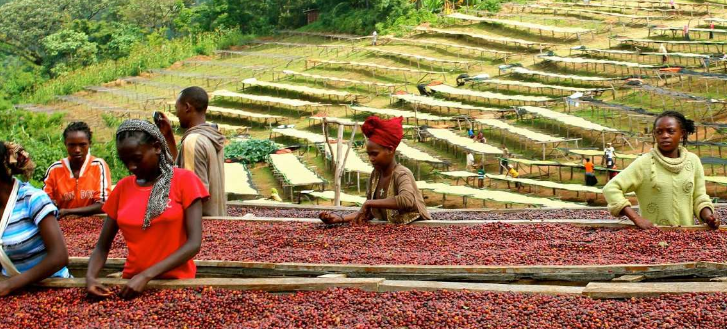
Local coffee production patterns are divided into four types: forest coffee, semi-forest coffee, garden coffee, and large plantations, among which garden coffee is the most common. So-called garden coffee refers to farmers managing coffee trees together with other cash crops in their own gardens, usually planted together with banana trees. It is precisely for this reason that every household forms a unique green landscape in its front and back yards, and this is also Ethiopia's main production method.
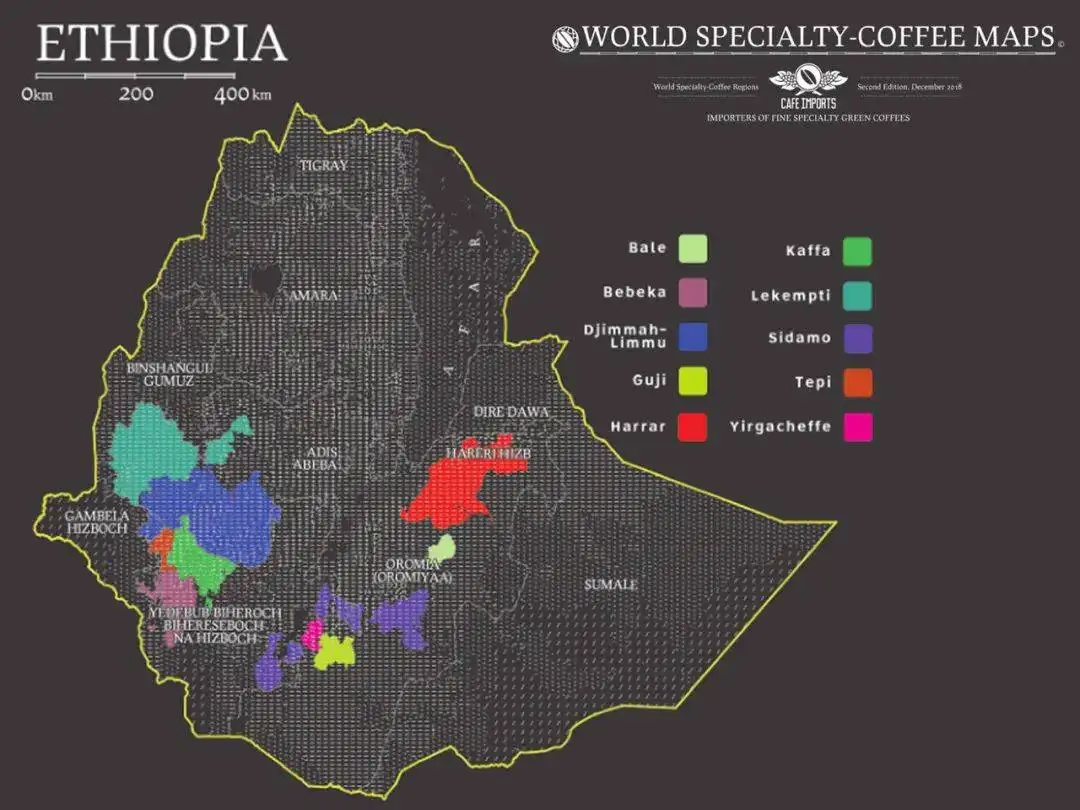
Administratively, all five major regions of Ethiopia cultivate coffee, and the four major cultivation systems are distributed across the following nine major producing regions in Ethiopia: Gimma, Sidamo, Yirgacheffe, Harar, Limu, Illubabor, Jimbi (Lekempti), Tepi, and Bebeka. Yirgacheffe coffee, Harar coffee, and Sidamo coffee are the best known. Among them, Yirgacheffe is a very small town, yet it produces thousands of tons of specialty coffee every year, which shows that the Yirgacheffe producing region holds a pivotal position in Ethiopia.
Because smallholder-grown coffee yields are small, there are coffee cooperatives and processing plants of various sizes locally, mainly responsible for processing green coffee beans in the region. Farmers send the coffee beans harvested from their own homes to nearby processing plants (cooperatives) established near water sources for unified processing, and later the coffee is sold in the name of the processing plant. For example, the Gotiti Cooperative coffee beans on the Front Street bean list are collected from coffee beans grown in the town of Yirgacheffe, sent to the town for unified washed processing, and then produced in the name of the cooperative.
The Difference Between Washed and Natural Coffee
Ethiopia's altitude is generally high, with abundant sunshine, making it quite suitable for sun-drying coffee cherries. Traditional natural processing was too rough. Every coffee farmer could do it in their own small yard, spreading the cherries directly on rooftops or the ground to dry. The rough method brought many unpleasant flavors and also caused uneven coffee quality.
In 1972, the Ethiopian government introduced more advanced washed processing technology and related equipment from Central and South America. Farms using the washed method must build washing channels and be able to introduce a continuous supply of fresh water, so production costs are higher. During processing, fermented beans are placed in the channels and moved back and forth, using the friction of the beans and the force of flowing water to wash the coffee beans until they are smooth and clean. Each step removes impurities and defective beans, so the quality of green beans is more uniform, and the final transaction price is also higher than that of coffee processed by the natural drying method. Washing not only greatly reduces the defect rate of coffee, but also won Yirgacheffe a fresh citrus character and elegant white floral aroma, with an overall flavor that is bright, delicate, and clean.
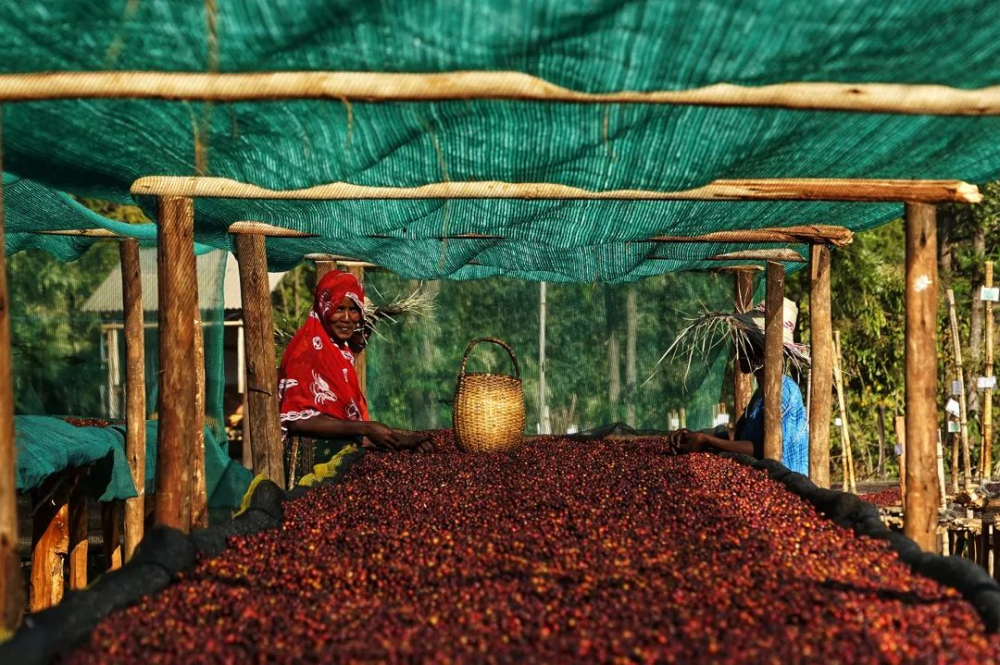
Although washed coffee once became popular, natural processing still occupies the main part of Ethiopian coffee. Unlike in the past, today's natural processing spends more effort on manual sorting and ensuring even drying. Freshly picked red coffee cherries are manually sorted to pick out defective beans and those that are overripe or insect-damaged, leaving the good beans. Then they are sent to a drying site for drying. Of course, different producing regions use different drying racks; some use tarps, raised beds, and so on, and the most common is the African drying bed. The drying time generally requires 27-30 days, until the coffee turns dark purple and the moisture content drops to 11% before it is considered complete.
The Front Street Gotiti Cooperative coffee beans are a classic washed Yirgacheffe, while another Front Street Red Cherry coffee is a Yirgacheffe processed by refined natural methods, with a more intense taste and richer layers, more full-bodied fermentation and tropical fruit flavors, and also higher sweetness.
Flavor Characteristics of Ethiopian Coffee
As a star product of African coffee, Ethiopian beans have become an introductory item for many people because of their intense floral aroma, fresh citrus character, and clear, transparent mouthfeel. As a fan of floral and fruity coffee, Front Street has several Ethiopian coffees on its bean list, among which the most representative are the washed Gotiti Cooperative, naturally processed Red Cherry, Sidamo Huakui, and the washed Yirgacheffe daily drinking beans that serve as the face of Ethiopian coffee.
Among the guests who come to Front Street to drink coffee, if they want a washed fruity coffee, Front Street baristas will give priority to recommending the Front Street Gotiti Cooperative on the bean shelf; if they want a full and rounded fruit sweetness, Front Street believes naturally processed Red Cherry is more suitable; if they want to experience the fermented aroma of tropical fruit, Front Street recommends the Huakui coffee beans from the Hambela region of Sidamo.
Front Street believes that Ethiopian coffee is mainly represented by fruity acidity and is more suitable for medium-light roasting, highlighting sweetness while retaining more floral aroma and fruit acidity.
Cup profile :
The dry aroma of Front Street washed Gotiti Cooperative coffee exudes fresh passion fruit, citrus, and berry acidity. The wet aroma is citrus and berries. On the palate there is citrus acidity, berry sweetness, almond, and tea-like notes, with a honeyed sweetness in the finish. The body is low, the acidity is bright, and it is clean and refreshing.
The dry aroma of Front Street naturally processed Red Cherry coffee shows full berry-like sweet acidity. When slurped at different temperatures, it has soft berry sweet acidity, ripe fruit fermentation, obvious honey sweetness, and a black tea finish, with a smooth mouthfeel.
The dry aroma of Front Street naturally processed Huakui coffee has nuts, honey, berries, and a faint fermented aroma. On the palate it is a full sweet-acidic profile of passion fruit, cream, and strawberry, with a thick body and a cocoa finish.
Recommended Ethiopian-Flavor Coffee Beans
If you are a newcomer just getting into specialty coffee, Front Street recommends starting with this washed Yirgacheffe daily drinking bean. Front Street believes that Yirgacheffe is synonymous with Ethiopian specialty coffee, and washing fully showcases Yirgacheffe's charm, so it is treated as the "face representative" of Ethiopian coffee, allowing everyone to get a taste of Ethiopian flavor.
Front Street's daily drinking bean series allows friends who are just entering the coffee world to taste the basic flavors of the producing region at an affordable price, and the small-package design can also avoid waste from being unable to finish drinking it. If you want to taste the classic aroma of Yirgacheffe, Front Street believes hand-brewed black coffee is most suitable. In order to ensure the freshness of the coffee beans, the coffee beans shipped by Front Street are all freshly roasted within 5 days, and usually can be received in 1-3 days, so that the coffee beans everyone receives are also roughly within the best tasting period, and they can begin to study how to extract them.
Front Street Pour-Over Recommendation
Dripper: V60 Water temperature: 92-93°C Dose: 15g Coffee-to-water ratio: 1:15 Grind size: fine granulated sugar (20号筛碗筛粉到78%)
Three-stage pouring: Wet the coffee bed with twice the amount of water as the coffee grounds to form a dome and bloom for 30s, then pour in a thin stream in a circular motion from the inside out to 125g and pause, wait for the coffee bed to drop to half the height of the dripper, then continue pouring the third stage with the same thin stream to 225g, until all the coffee liquid has finished filtering, then remove the dripper. The time is about 2 minutes.
After the washed Yirgacheffe daily drinking bean coffee is ground into powder, you can smell the fresh fragrance of honey and jasmine. After Front Street pours in hot water, it begins to release hints of berry flavor. The hand-brewed black coffee enters the palate with bright lemon, citrus, and green tea, and as the temperature changes there are berry, cream, and sugarcane notes in the finish, with obvious sweetness returning and a clean, sweet taste.
The above content is compiled by CoffeeHunters, a coffee news website.


