








Ethiopia is the birthplace of coffee and one of the most iconic producing regions on the global specialty coffee map. From ancient coffee ceremonies to garden farming models, from the two major processing methods of washed and natural to the flavor differences of classic regions like Yirgacheffe, Sidamo, and Harrar, Ethiopian coffee is renowned worldwide for its bright fruit acidity, rich floral aroma, and clean, transparent mouthfeel. This article systematically reviews the cultural origins, cultivation systems, and processing evolution of Ethiopian coffee, and combines representative products on the Front Street Coffee bean list such as the washed Konga Cooperative, natural Red Cherry, and Sidamo Hambela, to provide in-depth analysis of each coffee's cupping performance and brewing suggestions, offering coffee enthusiasts a complete introductory and advanced guide to Ethiopian coffee.

For more specialty coffee knowledge, please follow the WeChat public account: FrontStreet Coffee
Coffee has become a widely popular beverage in today's world, but in Ethiopia, Africa, it carries a meaning far beyond a cup of drink—it is culture, and it is faith. There, regardless of family circumstances, the coffee ceremony is an irreplaceable part of social and family life. Whenever there is a social gathering, a coffee ceremony will be solemnly carried out.
Traditional Ethiopian coffee ceremony
According to legend, there was once a shepherd named Kaldi on the Ethiopian highlands who noticed that his flock became unusually active after eating some wild red berries during grazing. Out of curiosity, he picked some and took them home to taste, and immediately felt refreshed and particularly excited, so he shared this discovery with the people in his village. The news gradually spread, and coffee beans were subsequently introduced to the Arabian Peninsula, where cultivation and trade rose accordingly, beginning coffee's centuries-long journey of global dissemination.
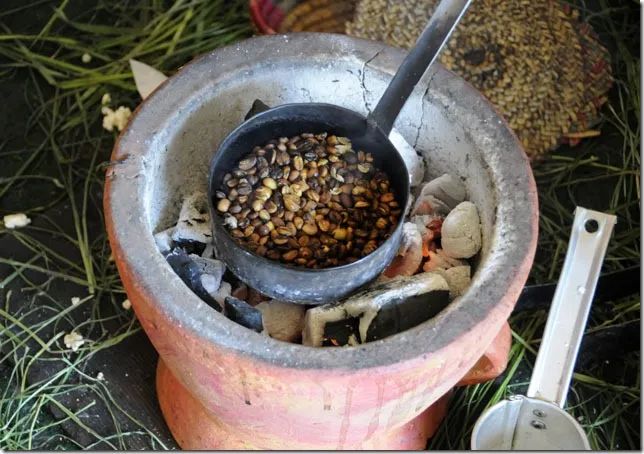
Although this legend may not be entirely true, Ethiopians have a long tradition of drinking coffee. A cup of strong coffee in the morning is the way to start a energetic day. In villages everywhere, the air is always filled with the rich fragrance of coffee. Ethiopians have completely preserved coffee's most authentic and pure flavor—they use the most primitive iron pestle to crush charcoal-roasted coffee beans into powder, put them into a brewing pot, and after boiling, the coffee slowly releases its unique aroma, to be enjoyed together with traditional bread.
Ethiopians also pass down a coffee ceremony with a long history: first roast the green beans in a flat pan, then crush them with a pestle and mortar, then put them into a clay pot called a "Jebena" to boil. When the hot water mixed with coffee grounds rolls and boils, it means the coffee is ready to drink. The ceremony is conducted in three rounds. The first cup is called Abol, and at this time elders need to offer blessings; the second cup is called Tona, and everyone begins to chat about family matters; the third cup is Beraka, symbolizing joy. After drinking this cup, the ceremony finally comes to an end.
It is worth mentioning that in Ethiopian languages, coffee is called "bunn" or "buna", and the birthplace of coffee is Kaffa. Therefore, coffee is sometimes also called "Kaffa bunn", meaning coffee from Kaffa. The English term "coffee bean" is generally considered to be the anglicized result of "Kaffa bunn", and the English word "coffee" originates precisely from the Ethiopian place name "Kaffa".
Ethiopia is dominated by the garden coffee cultivation model
The elevated terrain within Ethiopia creates ideal climatic conditions. The tropical rainforest climate brings abundant rainfall and lingering mist, while the high altitude of about two thousand meters forms a pronounced temperature difference between day and night, providing a superior growing environment for coffee trees.
Local coffee production is divided into four models: forest coffee, semi-forest coffee, garden coffee, and large plantations, among which garden coffee is the most common. So-called garden coffee refers to farmers planting coffee trees mixed with other cash crops in their own fields, usually intercropped with banana trees. Because of this, a distinctive green landscape forms in front of and behind every household, and this is also the main production method of Ethiopian coffee.
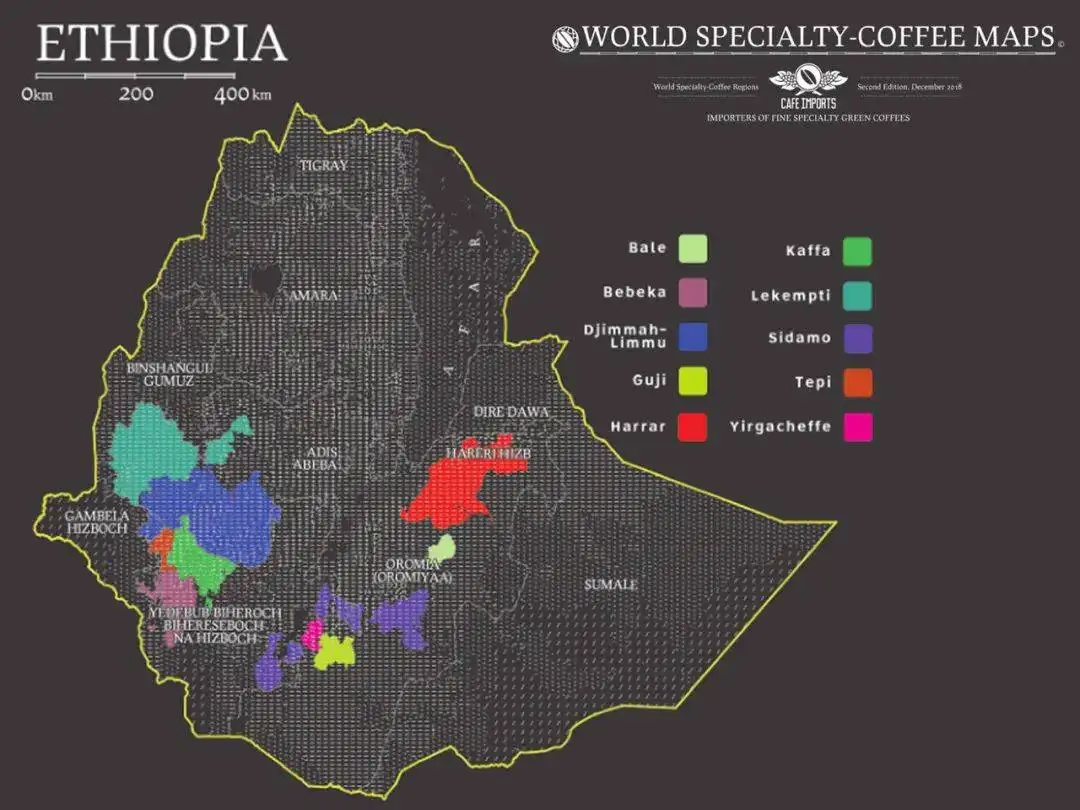
In terms of administrative divisions, all five major regions of Ethiopia have coffee cultivation. The four major cultivation systems are distributed across the following nine major producing areas: Gimma, Sidamo, Yirgacheffe, Harrar, Limu, Illubabor, Gimbi (Lekempti), Tepi, and Bebeka. Among them, Yirgacheffe coffee, Harar coffee, and Sidamo coffee enjoy the highest reputation. Yirgacheffe itself is only a very small town, yet it produces thousands of tons of specialty coffee every year, which fully demonstrates the important position of this producing area in Ethiopia.
Because the coffee yield of smallholder farmers is limited, there are numerous coffee cooperatives and processing stations locally, responsible for green bean processing in various areas. Farmers send harvested coffee cherries to nearby processing stations (cooperatives) built near water sources for unified processing, and then sell them externally under the name of the processing station. For example, the Konga Cooperative coffee beans on the Front Street bean list are made by collecting coffee beans grown in the town of Yirgacheffe, sending them to the town for unified washed processing, and then presenting them under the cooperative's name.
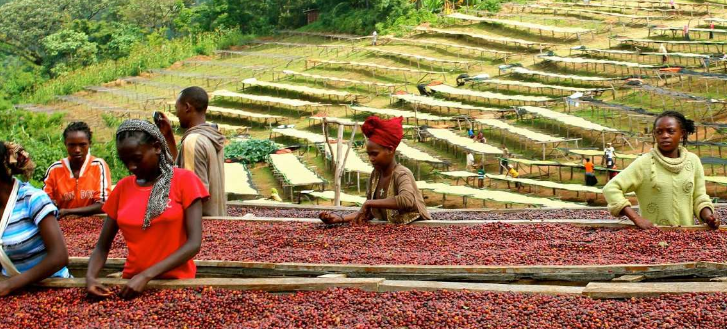
The difference between washed and natural coffee
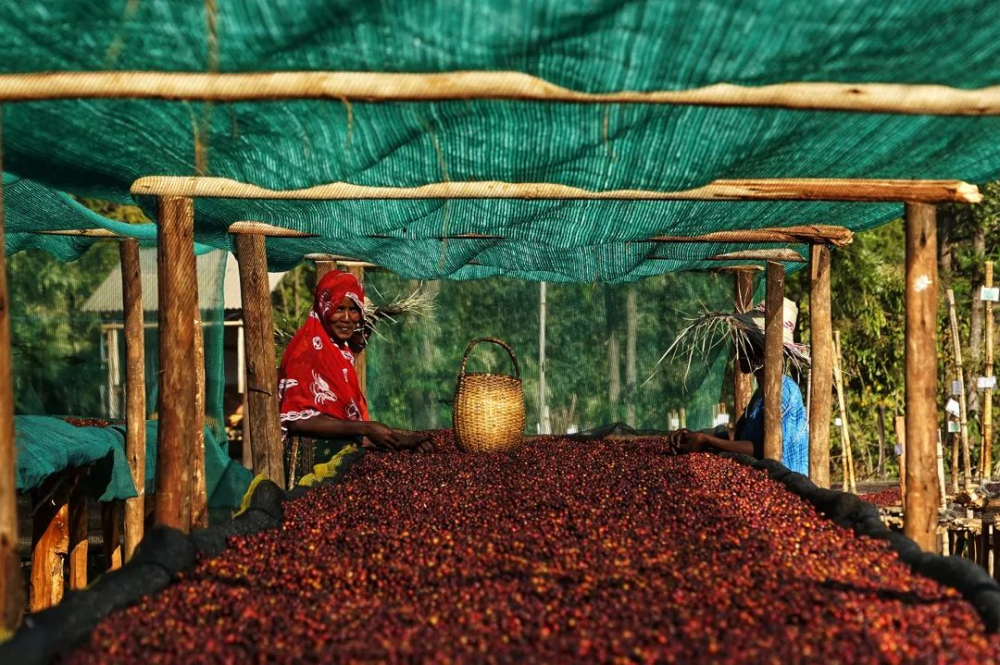
Ethiopia as a whole has a relatively high altitude and abundant sunshine, which is very suitable for sun-drying coffee cherries. The traditional natural processing method is relatively rough. Every coffee farmer can do it in their own courtyard, directly spreading the cherries on the roof or ground to dry. Rough handling easily produces unpleasant flavors and also leads to uneven coffee quality.
In 1972, the Ethiopian government introduced more advanced washed processing technology and supporting equipment from Central and South America. Farms using the washed method must build washing pools and be able to introduce a continuous supply of running water, so production costs are relatively higher. During processing, the fermented beans are placed in the pool and pushed back and forth. With the friction between the beans and the scouring force of the water flow, the coffee beans are washed until smooth and clean. Impurities and defective beans are removed at every stage, so the quality of green beans is more consistent, and the final transaction price is also higher than that of the natural drying method. Washing not only greatly reduces the defect rate of coffee, but also won Yirgacheffe a fresh citrus character and elegant white floral aroma, with an overall bright, delicate, and clean flavor.
Although washed coffee was once all the rage, natural processing is still a major component of Ethiopian coffee. What is different from the past is that today's natural processing invests more effort in manual sorting and even drying. Freshly picked red coffee cherries are first manually selected to remove defective beans, overripe beans, and insect-damaged beans, retaining only high-quality fruit. They are then sent to drying sites for processing. Different producing areas use different drying facilities, including tarps and raised beds, and the most common is the African drying bed. The drying process generally lasts 27 to 30 days, until the coffee turns dark purple and the moisture content drops to 11%, which is considered complete.
The Konga Cooperative coffee beans on the Front Street bean list use classic washed Yirgacheffe, while another product, Red Cherry coffee beans, is finely natural-processed Yirgacheffe. Its flavor is more intense, with richer layers, a fuller fermented feel and tropical fruit notes, and relatively higher sweetness.
Flavor characteristics of Ethiopian coffee
As a star product of African coffee, Ethiopian beans have become the entry choice for many people stepping into specialty coffee thanks to their rich floral aroma, fresh citrus character, and clean, transparent mouthfeel. As a lover of floral and fruity coffee, Front Street has multiple Ethiopian coffee beans on its bean list, among which the most representative include the washed Konga Cooperative, natural Red Cherry, Sidamo Hambela, and the flagship representative of Ethiopian coffee, the washed Yirgacheffe daily drinking bean.
Among the guests who come to Front Street to drink coffee, if they want a washed fruity coffee, the barista at FrontStreet Coffee will first recommend the Konga Cooperative on the bean shelf; if they prefer a full and rounded fruit sweetness, Front Street believes natural Red Cherry is more suitable; if they want to experience the fermented aroma of tropical fruit, Front Street recommends the Hambela coffee beans from the Sidamo Hambela producing area.
Front Street believes that Ethiopian coffee is mainly represented by fruit acidity, and is suitable for medium-light roasting, which highlights sweetness while retaining more floral aroma and fruity acidity.
Cupping flavor :
The dry aroma of washed Konga Cooperative coffee exudes fresh passion fruit, citrus, and berry acidity, while the wet aroma presents citrus and berry notes. On the palate, it has citrus acidity and berry sweetness, accompanied by almond and tea notes, with a honey-like sweetness in the finish. The body is low, the acidity is bright, and it is clean and refreshing.
The dry aroma of natural Red Cherry coffee shows a full berry-like sweet acidity. When sipped at different temperatures, one can perceive soft berry sweetness and acidity, a fermented feel of ripe fruit, obvious honey sweetness, and a black tea finish, with a smooth mouthfeel.
The dry aroma of natural Sidamo Hambela coffee has nut, honey, berry, and faint fermented aromas. On the palate, it presents a full sweet and acidic mouthfeel of passion fruit, cream, and strawberry, with a thick body and a cocoa note in the finish.
Recommended Ethiopian-flavor coffee beans
If you have just stepped into the world of specialty coffee, Front Street recommends starting with this washed Yirgacheffe daily drinking bean. Front Street believes that Yirgacheffe is synonymous with Ethiopian specialty coffee, and the washed process fully releases Yirgacheffe's charm, so it is treated as the "flagship representative" of Ethiopian coffee, allowing beginners to also taste the Ethiopian flavor.
Front Street's daily drinking bean series allows friends who have just entered the coffee world to taste the basic flavors of the producing area at an affordable price. The small-package design also avoids waste from being unable to finish drinking it. If you want to experience the classic aroma of Yirgacheffe, Front Street believes hand-brewed black coffee is the most suitable. To ensure the freshness of the coffee beans, all coffee beans shipped by Front Street are freshly roasted within 5 days, and usually arrive in 1 to 3 days, so that the coffee beans everyone receives are roughly within their optimal tasting period, and they can begin to study how to extract them.
Front Street hand-brewing suggestions
Dripper: V60 Water temperature: 92-93°C Coffee dose: 15g Coffee-to-water ratio: 1:15 Grind size: fine sugar size (20-mesh sieve, 78% passing)
Three-stage pouring: first wet the coffee bed with twice the amount of water as the coffee grounds, form a dome, and let it bloom for 30 seconds, then pour in a small stream in a circle from the inside out until 125g, then pause. When the coffee bed drops to half the height of the dripper, continue pouring the third stage with the same fine stream until 225g, until all the coffee liquid has been filtered. Remove the dripper; the total time is about 2 minutes.
After the washed Yirgacheffe daily drinking bean coffee is ground into powder, one can smell the fresh fragrance of honey and jasmine. When Front Street pours in hot water, it gradually releases threads of berry flavor. The hand-brewed black coffee enters with bright lemon, citrus, and green tea notes. As the temperature changes, it presents a finish of berries, cream, and sugarcane, with obvious sweetness returning and a clean, sweet mouthfeel.
The above content is compiled by CoffeeHunters, a coffee news website.


