








Iced latte may seem like it only takes three steps to make: add ice, pour milk, and add coffee. But to truly make a delicious iced latte, there are quite a few details to consider behind the scenes. From choosing coffee beans and milk, to the ratio between espresso, milk, and ice, and then to the timing of operations during extraction and assembly, every step directly affects the final flavor. This article uses Front Street Coffee's iced latte preparation as an example to break down three key aspects: material selection, milk-to-coffee ratio, and operational details, helping coffee enthusiasts consistently reproduce a balanced, layered iced latte at home.

Espresso can be said to be every barista's signature skill, and it appears on the menu of almost any café. What is usually called espresso is an entire beverage series built on espresso as the base. Today, Front Street Coffee will walk you through making the lowest-barrier milk coffee in the espresso family—the iced latte.
At first glance, making an iced latte is very straightforward: [add ice, pour milk, pour coffee] and it seems done. But the simpler an operation looks, the more it requires repeated deliberation if you want to achieve a satisfying flavor.
Point one: Choose suitable materials
Although the barrier to making an iced latte is low, and almost every coffee bean brand includes this drink on its menu, the taste made by different shops varies widely. One of the core reasons for this difference is that the milk and coffee beans used are not the same. The flavor of the coffee beans directly influences the overall direction of the iced latte: most espresso blends give the iced latte a rich nutty, chocolatey character and a heavier coffee taste; some beans can also make the milk's sweetness and creaminess stand out more.
The choice of milk should not be overlooked either. For whole fresh milk alone, there are more than a dozen common types on the market. Some are rich and thick, while others are as light as water. When choosing milk, it is not that the richer the better or the stronger the milk flavor the better; the key is whether it can pair well with the coffee. Milk that is too rich will overpower the coffee's own flavor, while milk with too much wateriness will make the whole latte bland.
Point two: A reasonable milk-to-coffee ratio
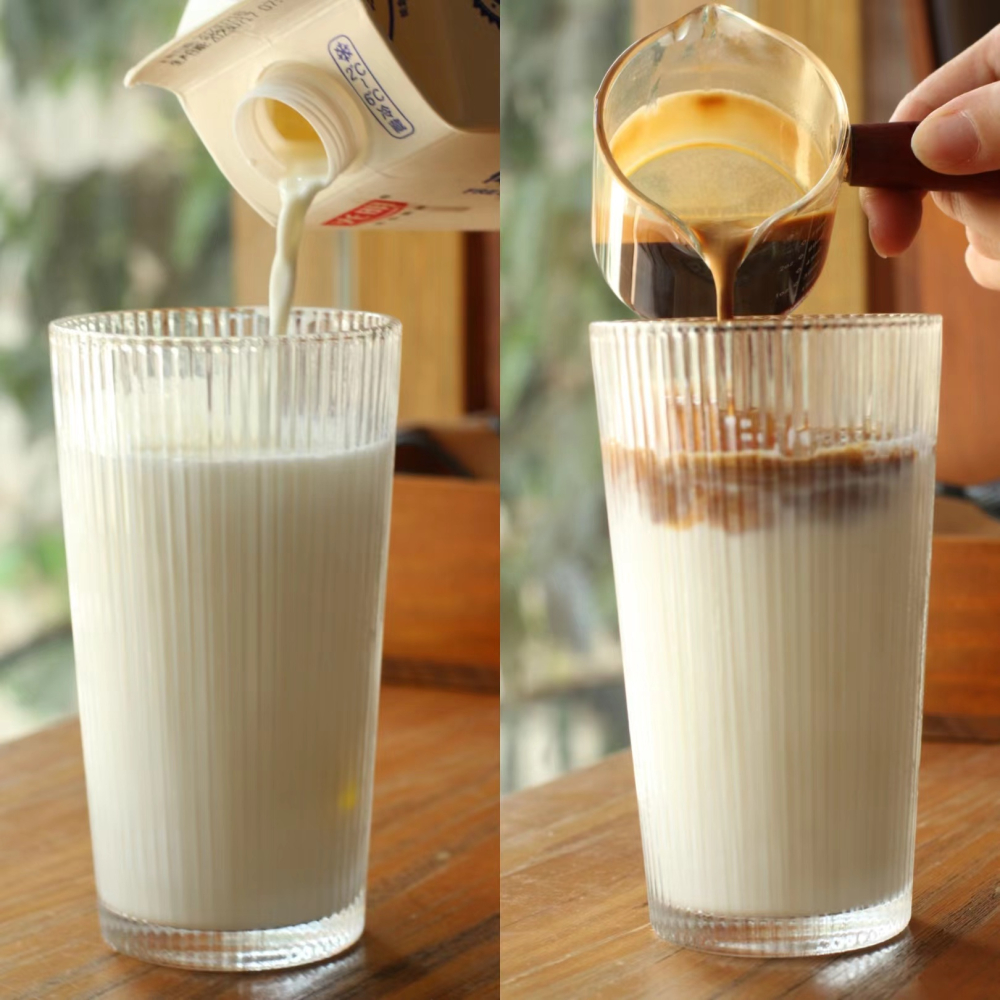
Once you have chosen suitable coffee beans and milk, can you make a delicious iced latte? The premise is that the ratio is well matched. When Front Street Coffee (FrontStreet Coffee) makes an iced latte, it uses Front Street Sunflower · Warm Sun blend coffee beans paired with Bright · Fresh Pasture milk. The ratio of espresso to milk is 1:4.5, that is, 40 grams of espresso liquid corresponds to 180 grams of iced milk and 75 grams of ice cubes, finally served in a transparent glass cup with a capacity of about 300ml.
This ratio is for reference only and is not the golden rule for latte coffee. Front Street Coffee obtained this set of parameters based on the above materials after repeatedly adjusting the ratio and according to actual tasting feedback. Therefore, when making an iced latte, you can also fine-tune it appropriately according to your taste: too much milk will cover the coffee flavor, too little milk will make it bitter, and too much ice will make it dilute.
Point three: Operational details
As Front Street Coffee said at the beginning, the operational process of an iced latte—[add ice, pour milk, pour coffee]—is simple and clear, but there are still some small points to pay attention to in actual operation. The most critical step is the extraction of espresso—whether a latte tastes good depends to a large extent on whether the espresso extraction is on point. Common problems such as channeling and extraction time deviation will naturally also be reflected in the flavor of the iced latte.
The whole process of making an iced latte also emphasizes speed. Speed here means that the time the ice and milk stay in the cup should be as short as possible, and the finished espresso should be poured into the cup immediately. This is also why a freshly made iced latte can show a gradient layering where milk and coffee overlap; if the ice soaks in the milk for too long, the ice will melt, a water layer will appear on the top, and the whole cup of coffee will be diluted when drinking. Espresso is even more sensitive: when just extracted, it is rich in crema, but after 30 seconds the crema will noticeably fade, and espresso lacking crema is also difficult to float on the surface to form a beautiful layer.
The above content is compiled by CoffeeHunters, a coffee news website.


