







In the specialty coffee world, Jamaican Blue Mountain and Ethiopian Yirgacheffe are the ultimate representatives of two styles. The former is renowned for its nutty and chocolate notes and its balanced ratio of acidity, sweetness, and bitterness, while the latter conquers countless palates with its jasmine aroma and bright fruity acidity. Which is better? Front Street believes that drinking coffee is an extremely subjective matter. Rather than competing for superiority, it is better to analyze them one by one from origin terroir, variety characteristics, to processing methods, and then make a judgment based on one's own taste preferences. This article will take you through the unique aspects of these two coffees from产区background, grade classification, variety differences, brewing parameters, and more.
In the specialty coffee field, Jamaican Blue Mountain has always been a household name, and its rich nutty and cocoa notes, along with the balance among acidity, sweetness, and bitterness, are enough to convince most tasters. If one were to look for a coffee known for its floral and fruity aromas, Ethiopian Yirgacheffe would inevitably be mentioned first, as its clear, bright acidity and jasmine-like fragrance have won the hearts of countless coffee lovers. If forced to decide which is superior,恐怕 both beans have their own followers. Front Street has always felt that drinking coffee is a very personal experience, and taste preferences vary from person to person. We might as well first understand the growing conditions and variety characteristics of these two coffees, form a comprehensive understanding, and then judge according to one's own preferences.
Jamaican Blue Mountain
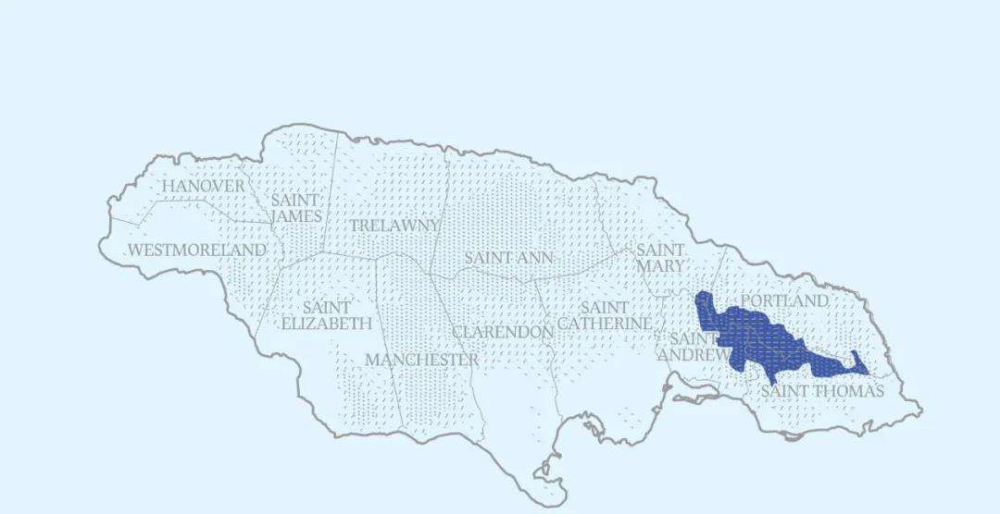
Jamaica is located in the Caribbean region of North America and is a tropical island country. Its coffee-growing history can be traced back to the 18th century, more than two hundred years ago. The Blue Mountain Range is located in eastern Jamaica and is surrounded by the Caribbean Sea. Sunlight shining on the sea surface refracts onto the mountains, casting a blue halo, which is how Blue Mountain got its name. The highest peak of the range reaches 2,256 meters, but coffee-growing areas are concentrated below 1,700 meters, while areas above 1,700 meters are ecological protection zones. The overall environment of the Blue Mountain Range is richly endowed by nature and is a well-known tourist destination, with almost zero industrial pollution and humid air, making it very suitable for coffee tree growth.
In 1932, to promote improvements in coffee quality, the Jamaican government classified coffee produced in the Blue Mountain Range into three grades based on altitude: Jamaican Blue Mountain Coffee, Jamaican High Mountain Coffee, and Jamaican Coffee. Only coffee grown at altitudes between 1,000 and 1,700 meters is eligible to be called Jamaican Blue Mountain Coffee.
In addition, Jamaican Blue Mountain Coffee is further divided into four levels according to the defect rate of green beans: NO.1, NO.2, NO.3, and PB. PB stands for peaberry, referring to round beans. The Blue Mountain No.1 coffee from Front Street uses the NO.1 grade, 17 to 18 mesh, with defective beans controlled at less than 2%. Observing Blue Mountain No.1 beans, the particle size is uniform, the appearance is neat, and the flavor performance is outstanding, with sweetness, aroma, and bitterness in harmonious balance.
Front Street Coffee: Blue Mountain No.1 Coffee Beans
Region: Jamaica Blue Mountain
Altitude: 1310m
Processing Method: Washed
Variety: Typica
Flavor: Chocolate, Nuts, Cream, Cocoa
Ethiopia Yirgacheffe
Yirgacheffe is located in Ethiopia on the African continent and is a small town in the Gedeo Zone. In the word Yirgacheffe, "Yirga" means "to settle down," and "cheffe" refers to wetland, so together it means "let's settle in this wetland." Yirgacheffe has a high altitude, between 1,700 and 2,200 meters, and the average temperature is relatively low. The growth and ripening cycle of coffee cherries is longer, so more aromatic substances accumulate, and the final flavor presented is also more intense.
The Yirgacheffe产区is dominated by smallholder farmers, who plant coffee trees in their own backyards. Because coffee cannot generate income year-round, they intercrop coffee with other crops, and these crops can also provide some shade for the coffee trees. During harvest season, farmers bag the ripe coffee cherries and sell them to cooperatives for unified processing, after which green beans are sold under the cooperative's name. This is why we often see Yirgacheffe coffee beans named after cooperatives.
Yirgacheffe currently has 28 member cooperatives, many of which are already well known to coffee lovers, such as Gedeb Cooperative, Worka Cooperative, and Konga Cooperative. It is worth mentioning the washed processing technique of Yirgacheffe cooperatives. Front Street believes that a large part of Yirgacheffe's flavor expression is due to washed processing.
Coffee farmers first pour the harvested coffee cherries into a water tank, remove floating defective beans, then use a machine to remove the skin and pulp, and then send them to fermentation tanks to ferment for 12 to 36 hours. The acidic substances produced during fermentation help separate the pectin layer from the beans. After that, they must be rubbed and washed with clean water multiple times, drained, and spread on drying beds for sun drying. Washed processing gives Yirgacheffe its clean, transparent acidity and fresh, elegant jasmine aroma.
Front Street Coffee: Gotiti Cooperative Coffee Beans
Region: Yirgacheffe产区
Altitude: 1900-2000m
Processing Method: Washed
Variety: Heirloom
Flavor: Jasmine, Citrus, Berries, Tea-like
Variety Comparison
The variety of Jamaican Blue Mountain Coffee is Typica, an ancient Arabica variety. Typica trees are upright, with bronze-colored leaf tips, making them highly recognizable. This variety has relatively weak disease resistance and low yield, but its flavor is elegant and its aroma is rich. Many coffee farmers in producing countries who pursue yield are unwilling to plant it, which shows how precious Blue Mountain Coffee is.
Yirgacheffe usually uses local Ethiopian heirloom varieties. Because the number of varieties is huge and identification is difficult, and because local authorities intentionally protect variety information and do not disclose it publicly, they are collectively called "Heirloom." It is completely normal for such mixed-variety beans to vary in bean size.
Brewing Suggestions
Customers often ask Front Street: "Why is the coffee I brew at home not as fragrant as in your shop?" Front Street believes there are several key points worth noting. First, before brewing, make sure the coffee beans are fresh. Roasted coffee beans need a resting and degassing period ranging from 4 to 7 days. Only after resting do they enter their optimal tasting period, usually within 30 days after roasting. Once past the optimal tasting period, the coffee aroma will gradually dissipate. The coffee beans sold by Front Street are all freshly roasted within 5 days. We deeply understand the critical role of freshness in flavor, and the beans you receive after placing an order are恰好 in their optimal tasting period.
In addition, coffee beans of different roast levels will present different taste performances depending on grind size, water temperature, and choice of dripper.
Jamaican Blue Mountain No.1 leans toward nutty and chocolate flavors, and the beans are relatively porous. Front Street uses a coarser grind and slightly lower water temperature for brewing to prevent excessive bitterness, and pairs it with a KONO dripper to enhance body.
When brewing floral and fruity medium-light roasted hard beans such as Yirgacheffe, Front Street uses a higher water temperature, a grind similar to fine granulated sugar, and a V60 dripper to make the coffee's acidity and sweetness layers more distinct.
Take 15 grams of coffee powder and use staged extraction. First, bloom with 30 grams of water for 30 seconds, then pour in a small stream in circles from the center outward. Pause the staged pour at 125 grams. Wait until the coffee bed drops to half the height of the dripper, then pour the second stage in the same manner up to 225 grams. Once all dripping is complete, remove the dripper.
The above content is compiled by CoffeeHunters, a coffee news website.


