








What Water Temp for Brewing Coffee Works in Pour-Over?
Pour-over results depend more on extraction parameters than on pouring technique. Water temperature, grind size, and coffee-to-water ratio decide whether a cup tastes balanced or dull, while single-pour, three-stage, and 4:6 methods are mainly different ways of arranging those same settings. Get the parameters right and a simple pour can still produce a sweet, even cup.
The coffee grinding process matters here too, because grind size sets how fast water moves through the bed and how much flavor is pulled out. A flat-bottom or cake filter cup helps: its flat base keeps the coffee bed thinner and more evenly spread, so an imprecise pour still extracts fairly evenly. A bloom followed by one continuous pour keeps the routine repeatable at home.
Many people new to pour-over coffee tend to focus on pouring technique, but Front Street believes that what really determines whether a cup of coffee tastes good is whether the extraction parameters are reasonable. The differences between single-pour, three-stage, and 4:6 methods are essentially differences in parameter configuration. Starting from Front Street's practical experience, this article first sorts out the underlying logic of grinding, water temperature, and ratio, then shares a simplified approach that requires almost no water-control skill—paired with a cake filter cup, you only need to bloom and then pour in all the remaining hot water in one go to consistently get a balanced coffee with prominent sweetness. Using Front Street Ethiopia Hualkui as an example, the article lists in detail the parameter comparisons between the conventional three-stage method and this simplified brewing method, making it easy for everyone to reproduce at home.

Indeed! Front Street has repeatedly mentioned in past content that instead of agonizing over which pouring technique to use, it is better to first spend time understanding the basic principles behind extraction. Because a cup of coffee tastes good often not because the pouring motion is beautiful, but because the parameters are chosen correctly, allowing that pouring method to produce a good result. The real point of divergence among single-pour, three-stage, and 4:6 methods lies in the setting of extraction parameters. Parameters are the foundation that determines the success or failure of a cup of coffee; pouring is merely a manual means of adjusting the extraction rhythm, or rather an auxiliary tool—with it, we can more consistently obtain a delicious cup of coffee, or one that meets expectations.
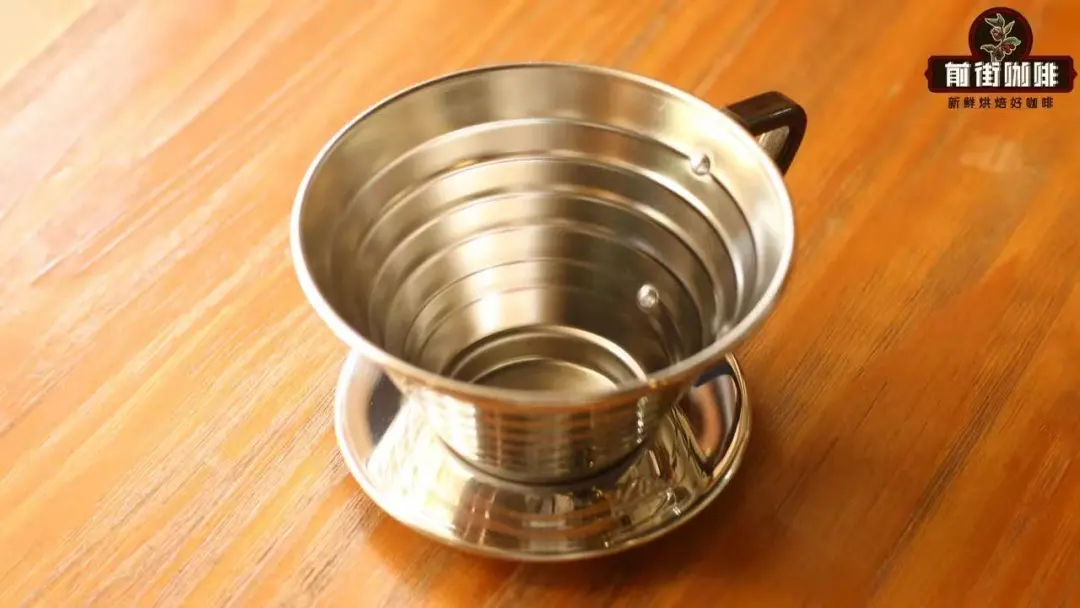
In other words, as long as the parameters are right, even without complex water-control circling, you can still easily brew a good cup of coffee. So next, Front Street will share a brewing method with no "fancy" operations at all—just pour water and you're done. A brewing method where you just pour water and can easily make good coffee Front Street recommends using this method with a cake filter cup or a flat-bottom filter cup. The flat-bottom filter cup has long been known as the "beginner-friendly filter cup." Its bottom is flat, and the diameter difference between the top and bottom is not large. This structure allows the coffee bed formed by the grounds to be thinner and more evenly distributed. Even if water control is not precise, the coffee can still achieve relatively even extraction, and beginners can also brew good-tasting coffee. So everyone is recommended to use a flat-bottom filter cup with it.
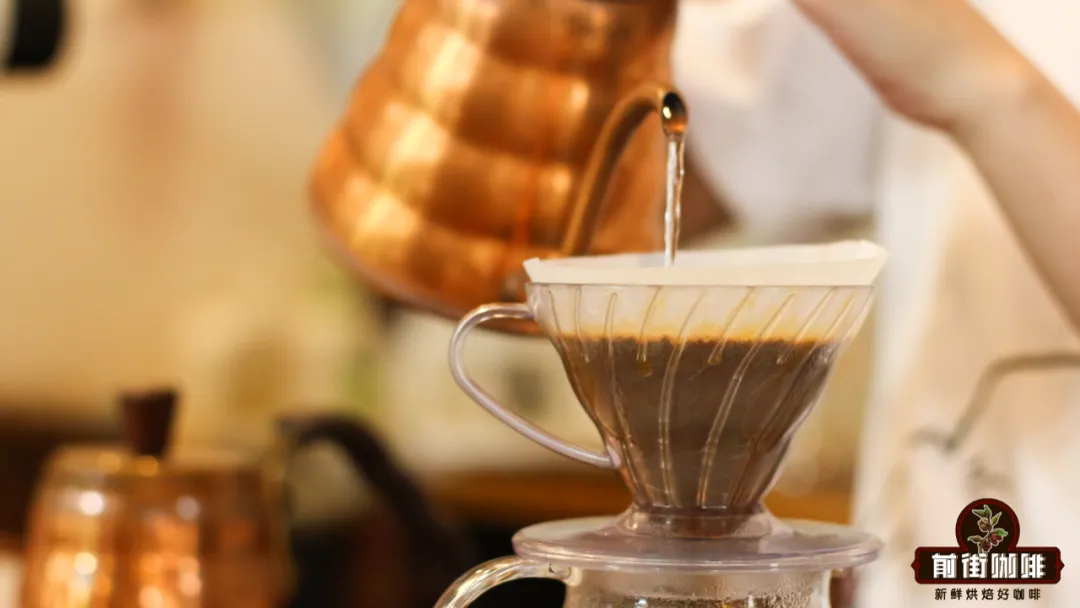
Next, let's talk about the parameters. This brewing method has a slightly higher extraction efficiency than the conventional approach because it has fewer stages and less water-flow agitation, so the grind and water temperature should both be raised appropriately to avoid underextraction due to efficiency being too low. Taking Front Street as an example— The beans Front Street used this time are Front Street Ethiopia Hualkui from the Front Street Tmall flagship store. For regular brewing, the parameters Front Street uses are: 15 g dose, 1:15 coffee-to-water ratio, grind size controlled at a 75%–80% pass rate on a No. 20 sieve, that is, caster sugar coarseness, extraction time two minutes, V60 filter cup, and a three-stage brewing method.
When switching to this "just pour water" brewing method, the parameters are adjusted to: 15 g dose, 1:15 coffee-to-water ratio, grind size at a 90% pass rate on a No. 20 sieve, also caster sugar coarseness, brewing water temperature 92°C, and a cake filter cup. It is very easy to operate, but the blooming step still cannot be skipped. First, as usual, pour in water at twice the dose weight and bloom for 30 seconds.
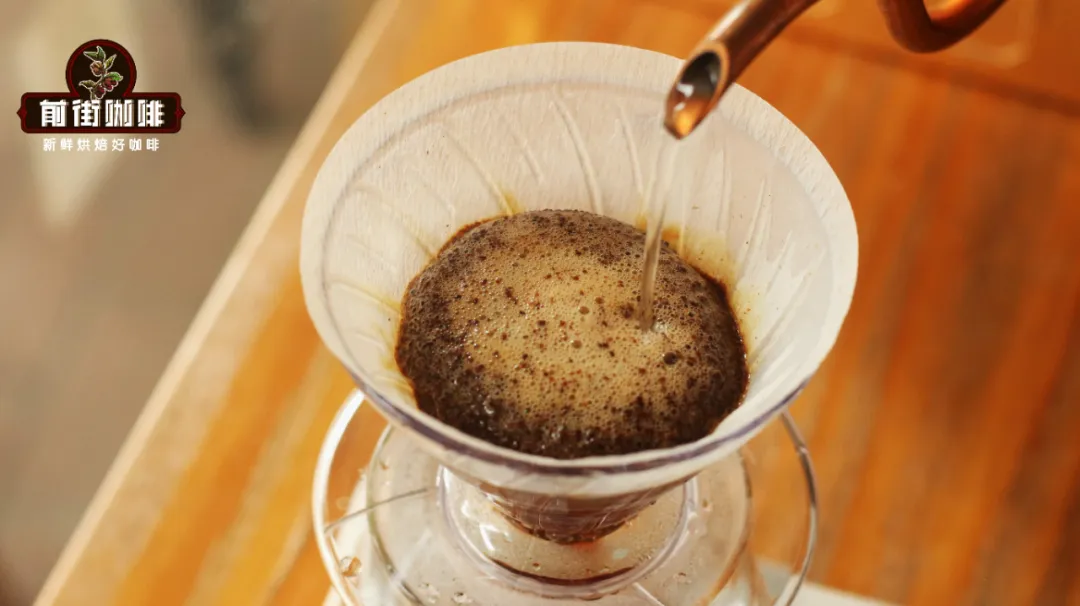
After the bloom ends, first pour in a circle with the water stream to break open the "barrier" on the surface of the coffee bed.
Then, at a fixed point in the center, pour in all the remaining target water amount in one go. If the filter cup capacity is on the small side, the stream can be made a little thinner to avoid hot water overflowing because it cannot fit. After pouring, simply wait for all the water in the filter cup to finish dripping, then remove the filter cup, and extraction is complete. The whole process takes 2 minutes 34 seconds.
Does this brewing method look a little familiar? That's right—strictly speaking, it is a single-pour method, only the hot water is split into two pours, reducing circular agitation. Therefore, the coffee's flavor will naturally also lean toward the balance of a single-pour method. Because the hot water is all poured in at once, the coffee grounds will continue to be steeped in hot water for quite a long period. In this way, the coffee grounds are extracted more evenly, the amount of dissolved substances tends to be consistent, and the taste is therefore more balanced.
Because the extraction is sufficient, the coffee has high sweetness on the palate, and the flavor is quite distinct. We can clearly taste Hualkui's signature classic "Hualkui flavor," including strawberry, guava, cream, and oolong tea! The mouthfeel is full and solid, with a long finish, performing very well. That is all for Front Street's sharing this time. Friends who are interested may as well try it at home—it really is very simple~
- END -
The above content is compiled by CoffeeHunters, a coffee news website.


