








How the Starbucks Playlist Change Fits Coffee Culture
Starbucks stores across China swapped their usual jazz and blues for 2000s Chinese pop, including songs by Jay Chou, David Tao and Jolin Tsai. Staff said the change celebrates the millennium birth of the Toffee Nut Latte and builds momentum for Christmas, not the equity change. The playlist runs until the 17th, with karaoke sessions at 1 p.m. and 5 p.m. daily, and customers are split on it.
The move touches a long-standing habit in the china coffee industry: cafes use quiet jazz, blues or classical music to create a calm setting for work and conversation. Some regulars welcomed the nostalgic tracks, while others said the store felt more like a snack street than a cafe, showing how closely coffee culture ties music to atmosphere.
Starbucks, which has long cultivated a business atmosphere with soothing music like jazz and blues, recently suddenly changed its playlists across stores nationwide, playing a large number of Chinese pop hits from the 2000s, such as representative works by Jay Chou, David Tao, Jolin Tsai, and other singers. This change caught regulars off guard—some found it down-to-earth, while others complained it made it hard to concentrate on work or study. Starbucks employees explained that this move was to celebrate the millennium birth of the Toffee Nut Latte and to build momentum for Christmas activities, and had nothing to do with the equity change. The new playlist is expected to run until the 17th, with interactive karaoke sessions at 1 p.m. and 5 p.m. during this period.
▲
Click to follow | Daily specialty coffee culture magazine Coffee Workshop
When it comes to the atmosphere of a coffee shop, the first image that comes to many people's minds is probably leisurely sipping coffee to the melody of jazz or blues. For a long time, playing blues, jazz, or classical music in cafes has almost become an industry convention, aimed at creating a cozy and relaxed experience for customers.
But in just the past two days, Starbucks, which has always presented itself with melodious and soothing tunes, unexpectedly adjusted its in-store playlist, and what comes out of the speakers has become familiar Chinese pop songs.
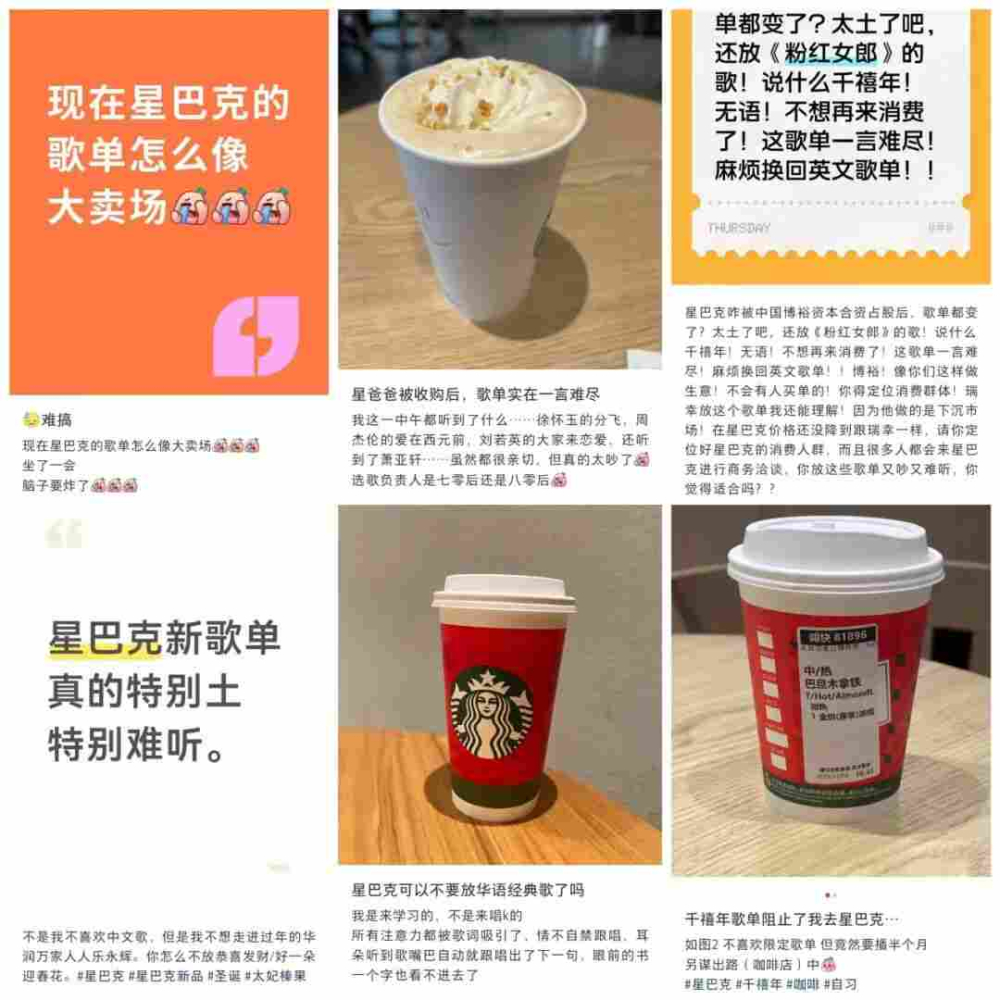
Judging from posts by customers on social platforms, most of the songs they heard at Starbucks were popular Chinese music hits from around the 2000s, including representative works by Jay Chou, David Tao, Jolin Tsai, Mayday, Xu Song, and others, as well as film and television hits like "Dang," the theme song of "My Fair Princess." Many people couldn't help but stop in their tracks when the melodies played, and some even hummed along.
Such an obvious change in stores made Starbucks regulars feel quite surprised. They mentioned that in the past, when drinking coffee and resting in the store, what they heard was mostly soothing English songs or instrumental music, and rarely household Chinese songs like now, so they felt the playlist adjustment came too suddenly.
Many people admitted that when Chinese songs echoed through the store, they felt as if they were not sitting in a comfortable cafe, but in a hypermarket or a snack street. The atmosphere in the store instantly drew a clear line from the previous "business feel," giving people a down-to-earth, immersive sense.
However, unlike fans who were overjoyed to hear songs by their favorite singers, regulars who often study, read, or work at Starbucks had quite a few complaints about this Chinese playlist.
They said that previously, with melodious, soothing songs whose language they couldn't understand, they could concentrate and efficiently finish what they were doing. But after the switch to familiar Chinese songs, they were easily carried away by the melodies and found it hard to focus their thoughts. They admitted that since Starbucks began playing the new playlist, they could only wear headphones to block out the background music in the store, or simply stop entering the store and find another cafe suitable for studying and working.
In response, many onlookers associated this with Starbucks China's sale of equity a few days earlier and joked that "the first fire after Starbucks changed ownership was aimed at the in-store playlist," speculating that this was a new measure by the brand to get closer to the Chinese market and cater to Chinese consumers' preferences.

But this claim was denied by Starbucks workers. According to them, the playlists in Starbucks stores nationwide are controlled by the brand, and switching to a nostalgic 2000s Chinese playlist was "to celebrate the millennium birth of the Toffee Nut Latte" and also to build momentum for the upcoming Christmas activities, with no direct connection to the Starbucks equity change.
In addition, according to screenshots posted by employees, Starbucks stores will play widely known classic pop songs during two time slots, 1 p.m. and 5 p.m., and staff can invite customers to interact and sing karaoke during the playlist depending on store operations. Apart from these two special time periods, Starbucks stores still continue their previous style of song playback.
As for some users' requests to switch back to the original playlist, official customer service, after receiving feedback, responded that the new playlist is expected to play until the 17th.
Image source: Xiaohongshu
Disclaimer: Some images in this article are from the internet. For some content on the website, such as images, we will respect the original author's copyright and indicate the source. However, due to the large quantity, there may be individual images or texts that have not yet been credited in time. Please forgive us. If the original author has any dispute, they may contact the website for handling. Once verified, we will correct it immediately. Compiled and edited by "Coffee Workshop." Please indicate the source when reprinting. If there is infringement, please inform us for deletion. Thank you ~ !
The above content is compiled by CoffeeHunters, a coffee news website.


