







Why Does a Broken Display Cup Stir Coffee Culture Debate?
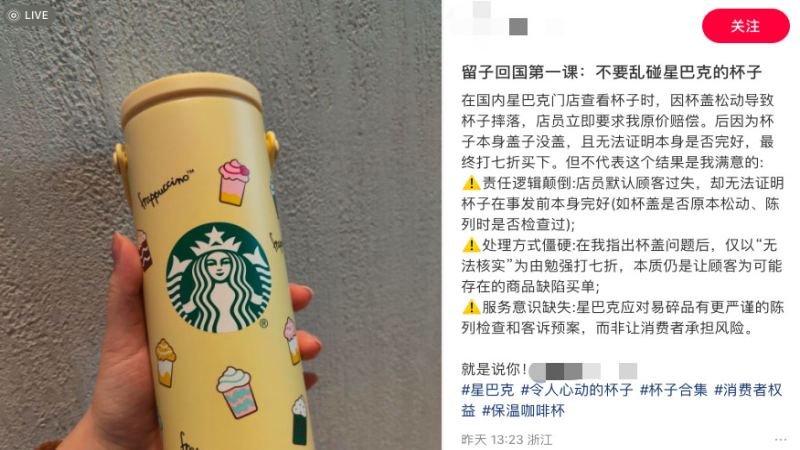
A customer browsing cups on a Starbucks shelf knocked one over when a loose lid let it fall, denting the bottom. Staff asked for full-price compensation, and after negotiation the cup was bought at a 30 percent discount. The story spread online and drew comparisons with how overseas stores reportedly handle similar breakages, where staff check for injury and log the item as damaged.
The argument turns on who carries the risk of fragile display items and whether a cup was intact beforehand. Many commenters said domestic stores sometimes place items where clothing or backpack straps can knock them over. The case has become a talking point in coffee culture circles about balancing store management rules with the customer experience, and where responsibility should fairly sit.
Recently, a netizen shared an unpleasant experience at a Starbucks store on social media: while looking at the cups on the shelf, a loose lid caused a cup to fall, leaving a dent on the bottom, and the staff demanded compensation at full price. In the end, both parties negotiated a purchase at a 30% discount. This incident sparked widespread discussion, with many netizens comparing how overseas Starbucks handles such situations, arguing that domestic stores making customers bear the risk of damaging fragile items is questionable. How exactly should brands balance store management with customer experience? Let's take a look.
▲
Click to follow | Daily specialty coffee culture magazine CoffeeWorks
Recently, a netizen posted on social media with the title "Don't Touch Starbucks Cups Casually," which quickly attracted everyone's attention and discussion.
According to the poster, while browsing cups on the shelf at a Starbucks store, a cup accidentally fell to the floor because the lid wasn't tightly secured, leaving a small dent on the bottom. Upon seeing this, the staff immediately demanded compensation at full price. However, the poster was dissatisfied with this handling. In the end, because the cup itself had no lid and it couldn't be confirmed whether the cup had been intact beforehand, after negotiation between both parties, the customer bought the cup at a 30% discount.
The person involved stated that at the time of the incident, the staff directly concluded that the damage was the customer's fault, yet there was no evidence proving the cup was intact before the incident, nor did they consider whether the display arrangement was reasonable. She believes that making consumers bear the risk of damaging fragile items and pay for products that may have already been flawed is unreasonable.
After the post was published, netizens expressed their opinions one after another. Many netizens with overseas IPs shared the common handling methods at Starbucks stores in their countries: "First, they ask if the customer is injured, then let the customer leave, the staff cleans up the scene themselves, reports it in the system as dropped or damaged, and that's the end of it."
However, domestic users helplessly pointed out that some stores place display items in inappropriate positions, and when customers walk by, their clothes or backpack straps can easily knock over fragile items on the shelves, causing damage to the products.
Once such an accident occurs, staff usually demand that the person involved compensate at full price, or pay for the store's loss at the employee price. "I also encountered this at Xi'an Airport, and they also made me buy it at a 30% discount." "I just dropped one, and also bought it at a 30% discount—I'll never go near that counter again." "My son bumped into one, and they immediately came over and demanded we buy it."
The two completely different handling methods leave many consumers confused: why is there such a big difference in how domestic and overseas Starbucks handle similar accidents? Some overseas users believe that Starbucks stores in their cities usually purchase insurance, so losses accidentally caused by customers during business hours can be directly written off, which is why staff won't insist that customers pay.
But in China, due to different store management methods, if a customer accidentally damages a fragile display item in the store, the loss is either borne by the consumer or compensated by the staff on duty. "It seems that domestic stores can't write off losses, and employees have to pay themselves, so employees need the consumer to buy it."
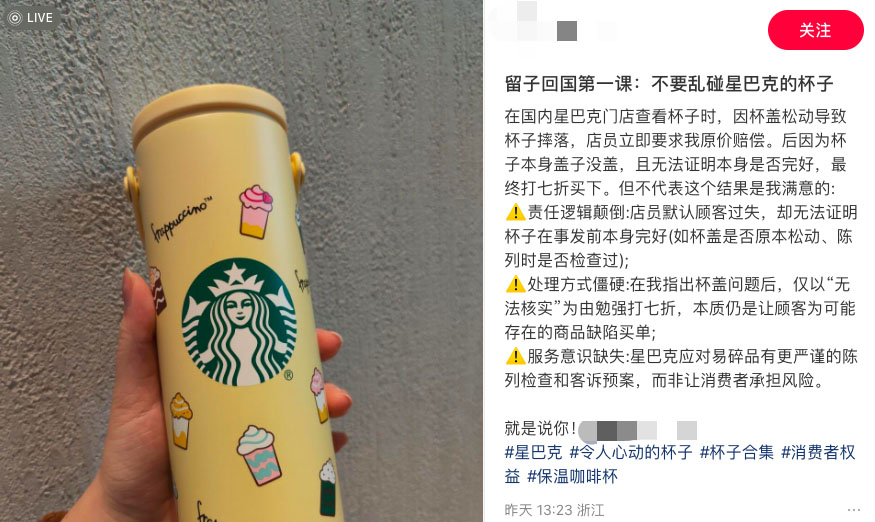
Although some people think this practice can "teach you a lesson" and to some extent reduce the risk of damage to store display items, more users lean toward the poster's view, believing that Starbucks making customers and staff compensate for damaged display items is unreasonable, and they bluntly say that the brand should have more rigorous display inspection and handling plans for products on the shelves.
Image source: Xiaohongshu
Disclaimer: Some images in this article are from the internet, and for some content on the website such as images, we will respect the original author's copyright and indicate the source. However, due to the large quantity, there may be individual images or texts that have not yet been credited. Please forgive us. If the original author has any disputes, they may contact the website for handling, and once verified, we will correct it immediately. Compiled and edited by "CoffeeWorks." Please indicate the source when reposting. If there is any infringement, please inform us for removal. Thank you~!
The above content is compiled by CoffeeHunters, a coffee news website.


