








What Sets the Cappuccino Apart From a Latte or Flat White?
A cappuccino differs from a latte, flat white, piccolo and cortado through three hallmarks: a velvety mouthfeel, a strong coffee flavor, and a fill level that reaches roughly eleven parts out of ten. Espresso, milk and milk foam make up the drink, and the thicker foam layer is what keeps it from overflowing while giving the cup more weight.
Most cappuccinos served in shops are acceptable, but the Italian template is stricter. Milk foam thickness shapes both latte art and the golden ring on the surface, so the ratio of coffee to milk matters. A classic blend bean works well for practising the fuller fill and cloud-like texture behind the national coffee association cappuccino latte difference milk foam espresso comparison.
Cappuccino is not simply a milk-foam coffee; it has three hallmarks that set it apart from lattes, flat whites, and other milk coffees: a velvety mouthfeel, a strong coffee flavor, and being filled to 11/10. Starting from the core characteristics of cappuccino, this article explains in detail the ratio of coffee to milk, the effect of milk foam thickness on latte art and the golden ring, and, using the classic blend beans as an example, provides complete extraction parameters and steps for making the golden ring, helping you make a standard cappuccino at home that is strong but not bitter, with a mouthfeel as velvety as clouds.

Many friends who are just getting into coffee think: "Isn't cappuccino just adding milk and milk foam to espresso? Just pour in the steamed milk foam and it's done?" The principle really isn't complicated, but when it comes to actually making it, there are quite a few finer points in the details. As everyone knows, cappuccino consists of three parts: espresso, milk, and milk foam, and within the framework of Italian coffee, the ways these three elements can be combined are endlessly varied. Besides cappuccino, there are also latte, flat white, piccolo, cortado, and so on.
The reason cappuccino stands out from the many milk coffees is precisely its unique signature characteristics. Once these characteristics disappear, it is no different from other milk coffees, and such a "cappuccino" clearly cannot be considered up to standard. Of course, saying that 90% of vendors make it wrong is an exaggeration. Most cappuccinos served in coffee shops on the market are actually acceptable. You may feel the flavor isn't authentic enough (after all, Italy doesn't use large amounts of robusta beans as it does), but the features a cappuccino should have are basically retained. So the question is: what exactly are cappuccino's signature characteristics?

"Velvety mouthfeel," "strong coffee flavor," and "filled to 11/10"—these three are the core features that distinguish cappuccino from other milk coffees. Compared with other milk coffees, cappuccino has a stronger coffee flavor and an extremely velvety mouthfeel, because its milk foam layer is thicker. The thick milk foam also makes this cup of coffee seem more "substantial," because the surface is all milk foam, so even if it is filled to 11/10, the coffee will not overflow. The cappuccinos that Front Street Coffee has seen online being complained about all, without exception, hit these pitfalls: the milk foam thickness is about the same as a latte, the cup size is the same as a latte, there is exquisite and complicated latte art on the surface, and it tastes very weak in coffee flavor—it is simply like the shop serving you a latte.
So if you want to make a relatively standard cappuccino, there are several aspects to pay special attention to during preparation. The first is the ratio of milk to coffee. Cappuccino is a milk coffee that highlights the coffee flavor, so the milk should neither completely overpower the coffee nor should the two reach a balance. For this reason, precisely controlling the ratio of coffee to milk is crucial. In addition, the foaming time needs to be extended to create thick milk foam. As Front Street Coffee mentioned earlier, the velvety mouthfeel and being filled to 11/10 are both signature characteristics of cappuccino. Usually the milk foam thickness of a cappuccino is between 2 cm and 2.5 cm, about twice that of a latte, and the specific thickness can be adjusted as needed.

If you want to make a cappuccino with simple latte art, the milk foam cannot be too thick; keeping it around 2 cm is more suitable. Because the thicker the milk foam, the worse its fluidity, and the worse the fluidity, the harder it is to pour latte art. So if you want to pour latte art, the milk foam thickness must be restrained somewhat (but even the thinnest cappuccino milk foam can only make simple patterns, such as a large white heart. If you see a cappuccino with very complex and exquisite latte art on it, that means its milk foam is not thick enough and not standard). Conversely, if you want to make a cappuccino with a "coffee golden ring," the milk foam can be a bit thicker, about 2.5 cm. Because making the golden ring does not depend on fluidity, thicker milk foam has little effect; instead, it makes the cappuccino appear more authentic.
Taking Front Street Coffee as an example, when making a cappuccino, the ratio of coffee to milk is 1:4. The coffee beans used by Front Street Coffee are the medium-dark roasted Front Street Classic Blend, and the extracted coffee has rich aromas of caramel, chocolate, and butter cookies, so there is no need to worry about it being masked by the taste of milk. The espresso extraction parameters are as follows: Dose: 20g Extraction time: 30s Extraction yield: 40ml

Since the espresso yield is 40 ml, according to the 1:4 ratio of coffee to milk, the milk should be 160 ml. What Front Street Coffee wants to make is a cappuccino with a coffee golden ring, so the steamed milk foam will be relatively thick, about 2.5 cm. The temperature should also be controlled at around 65°C, which can bring out the sweetness of lactose and make the coffee perform better.
Once foaming is complete, you can begin making the coffee golden ring. First, pour the espresso into the prepared cup. (Note here that it is best not to choose a cup with too wide a mouth, because an overly wide rim will weaken the thickness of the milk foam in the cup.)
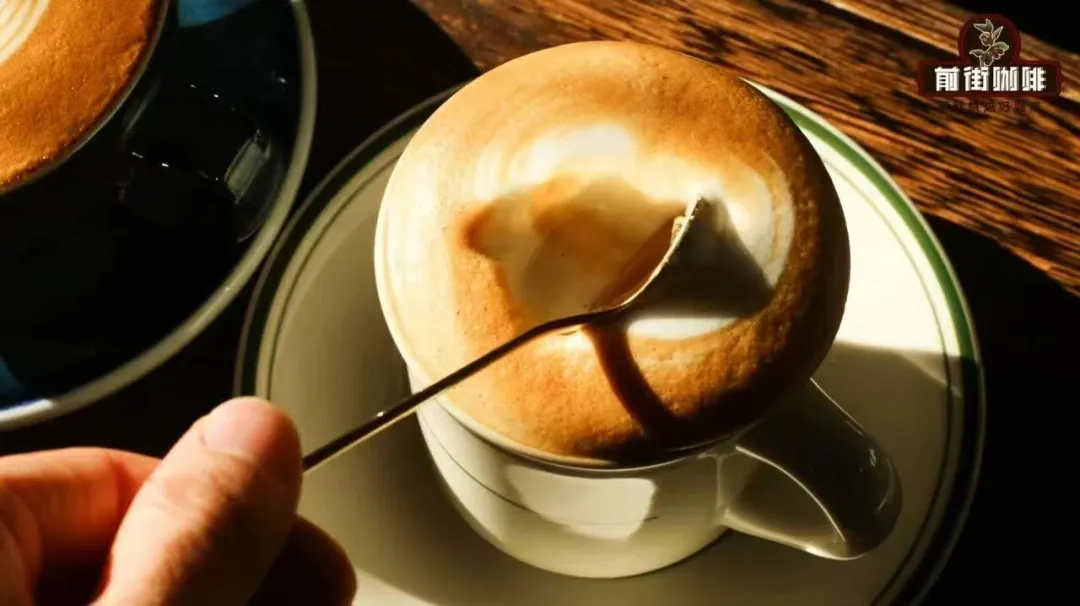
Next, use a spoon to scoop a spoonful of milk foam and place it right in the center of the coffee.
Then shake the milk pitcher so that the milk and milk foam in the pitcher recombine, which can improve fluidity somewhat. Immediately afterward, pour the milk and milk foam toward the center.

As long as the milk foam is thick enough, you can pour directly until it is filled to 11/10. When the milk foam reaches 11/10 full, a cappuccino with a coffee golden ring is complete! If you feel that only having the golden ring is too plain, you can also sprinkle some chocolate powder on the surface as a garnish.
When tasting, you need to take a big sip, because the milk foam is very thick. If you only take a small sip, you will only taste the milk foam and not the coffee. The cappuccino made this way has very distinct characteristics: the first thing you feel on the palate is the cloud-like velvety touch brought by the thick milk foam, carrying the rich aroma of coffee. Then you encounter the milk coffee, and the coffee goes down very smoothly. Unlike a latte, cappuccino's coffee flavor is very rich, but the presence of milk balances the bitterness, so it tastes strong but not bitter, with clear flavors and a hint of sweetness.

The cappuccino made with this ratio by Front Street Coffee has just the right coffee flavor, strong but not bitter. But if the coffee beans you use are not roasted that dark, you can appropriately reduce the amount of milk a little. For example, when using medium-light roasted coffee beans, you can use a 1:3.5 ratio to make it, because the lighter the roast, the easier the coffee flavor is masked by the milk.
The above is how to make a relatively standard cappuccino. Strong coffee flavor, velvety mouthfeel, filled to 11/10—when making a cappuccino, just grasp these three points and that's enough~ - END -
The above content is compiled by CoffeeHunters, a coffee news website.


