







How Do You Make Dalgona Coffee From Powder?
Dalgona coffee, also called 400-times coffee, is made by whipping equal parts instant coffee powder, sugar, and hot water until the mixture turns thick and pale, then spooning it over cold or hot milk. Failures usually come from the wrong coffee type, too little sugar, or a weak whisk, so the foam never stiffens or collapses fast.
Instant or freeze-dried powder with high solids whips more easily than fresh espresso. Keep the ratio at one to one to one, use a bowl with tall sides, and whip until stiff peaks form. The finished drink layers dense foam over milk, giving a strong coffee aroma with a bittersweet, slightly sweet taste.
Dalgona coffee (also known as 400-times coffee) continues to thrive on major social platforms thanks to its cloud-like, dense coffee foam and beautiful layered effect. However, many people find after trying it themselves that the result is far from the tutorial—problems like foam not whipping up, coarse texture, and rapid collapse keep cropping up. This article will break down the key points of making dalgona coffee from three dimensions: ingredient selection, espresso extraction parameters, and whipping techniques, with a focus on analyzing the common reasons why espresso won't foam and the corresponding solutions, to help you make a cup of dalgona coffee with distinct layers and a rich, mellow taste.
When scrolling through social platforms, Front Street's homepage keeps recommending dalgona coffee tutorial videos every few days, and a quick search reveals related content is everywhere. As more and more people try it at home, failures keep piling up too, with many netizens complaining that their dalgona coffee is completely different from the original—they have no idea which step went wrong.
What exactly is dalgona coffee?
At the bottom of the cup is milk, topped with a layer of cloud-like dense coffee foam. It tastes rich and slightly sweet on entry, with a strong coffee aroma. The first sip feels like eating ice cream, and a big gulp lets you experience the bittersweet blend of fluffy foam and the milk beneath—this is the dalgona coffee that sparked the DIY craze. Yes, it's exactly the "400-times coffee" that once flooded the internet.
In terms of composition, the ingredients needed for dalgona coffee are quite simple—just coffee, milk, sugar, and an electric whisk—and the process isn't complicated either. But to make the coffee foam stably float on the milk surface without collapsing while maintaining a fluffy, fine texture, based on Front Street's hands-on experience, you still need to put effort into several details. Next, let's go through the specific steps one by one~
Step One: First make an espresso base
Many versions circulating online directly use 3-in-1 or freeze-dried instant powder, adding water and then whipping, because these products have high solid content, making it actually easier to whip into an ice-cream-like texture.
However, since the core components of this creative specialty drink are coffee and milk, the coffee base inevitably determines the fundamental flavor direction of the entire beverage. So compared to instant products with a relatively one-dimensional taste, Front Street recommends freshly ground and extracted espresso, which can give the dalgona coffee a richer aroma profile.
Espresso beans on the market can be roughly divided into two major categories: one is medium-dark roast beans designed for crema extraction and a rich mouthfeel, such as Front Street Mamba Espresso Blend, which is great for various milk coffees and suitable for those who don't like acidity; the other emphasizes showcasing certain floral and fruity notes in a medium roast, which can be either a blend or an SOE—like Front Street Strawberry Candy Espresso belongs to the former, while directly extracting espresso from single-origin beans falls into the latter. Here, we use medium-roast Front Street Colombia Pink Bourbon for demonstration; the espresso extracted beautifully presents notes of grape, dried fruit, and blueberry gummy candy.
Step Two: Whip the coffee into dense foam
Once the coffee is ready, we enter the most critical and most failure-prone step—whipping the coffee foam. The most common problem people encounter is that no matter how much they whip, the coffee liquid never thickens, shows no sign of stiffening, and the foam is especially coarse. After going through various tutorials online, Front Street has summarized three techniques that can help us easily whip espresso into a silky, fine foam layer.
1. To whip it into a milk-cap-like texture, the water content of the espresso must not be too high. Front Street's approach is to cut off the tail end to increase the espresso's concentration, essentially making a Ristretto. Front Street's original parameters for the Pink Bourbon were 20g coffee grounds, 32 seconds extracting 40g liquid weight; here we adjust to 26 seconds extracting 30g coffee liquid. (If you're using a moka pot, just wait until the coffee liquid reaches a quarter of the upper chamber, then turn off the heat.)
Left is espresso, right is Ristretto
2. Although espresso forms large bubbles under the high-speed operation of the mixer, they quickly revert to liquid due to poor stability. At this point, you can "reinforce" the foam structure by increasing the amount of sugar—Front Street uses 10g of fine granulated sugar here.

3. There's also the situation where freshly extracted espresso is too hot, making it hard to foam when whipping. In this case, just add ice cubes to cool it down quickly.
The conventional approach is to pour the espresso into a cup, add 10–15g of fine granulated sugar, and whip directly, but Front Street first adds 30g of ice cubes and gently swirls a few times to quickly cool the espresso.
Once the coffee liquid is completely no longer hot to the touch, remove the ice cubes, then start the whisk to let the liquid incorporate air and form a large vortex. Stop whipping when it reaches a thick, smooth state—the whole process usually takes 2–4 minutes. When preparing the container, try to choose a taller transparent glass, so it won't easily overflow or splash during mixing, and it's also convenient for observing the whipping state of the coffee.
Step Three: Pour the coffee foam over the milk
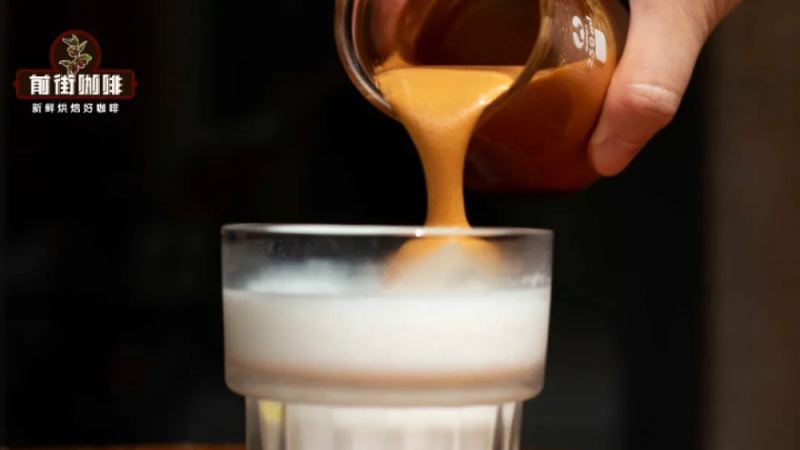
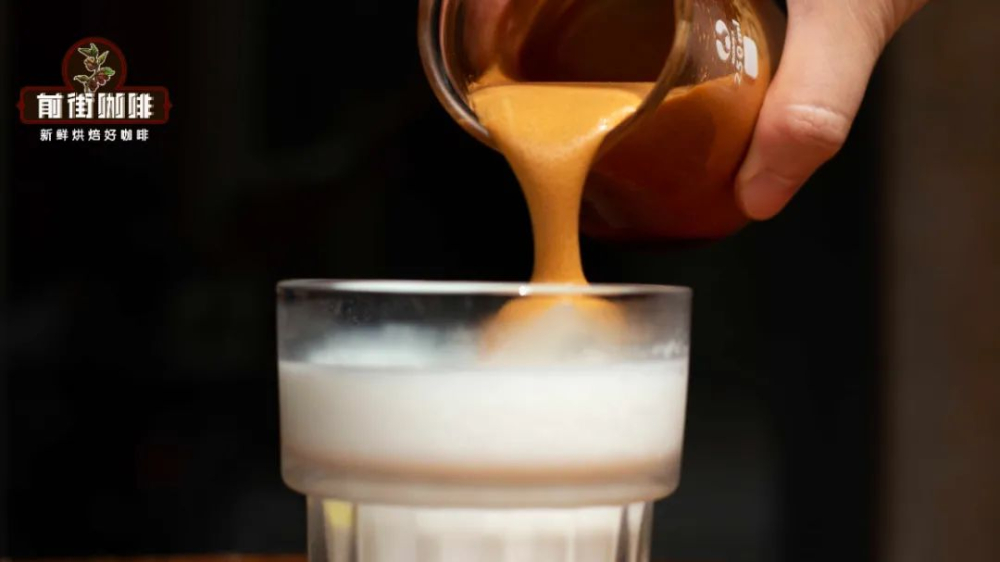
Prepare a nice-looking cup (200–250ml), add 60g of ice cubes and 120g of fresh milk, then without hesitation pour the coffee foam on top—a beautiful layered gradient effect will appear. While the foam still maintains its fine texture, take a big gulp right away.

Dalgona coffee—still not available for sale!!!
I believe those who have visited Front Street's Dongshankou store know that, including today's dalgona coffee, none of the specialty drinks mentioned in the articles are ever put on the menu for sale, whether they taste good or not. Because of this, many customers find it a pity, and some readers are puzzled: "Since you don't sell it, why write about it?"
Coffee is an everyday beverage—some people drink it for the caffeine boost, some enjoy its aroma, and others simply love the pleasure of making a cup themselves.
In Front Street's view, these highly individual specialty drinks aren't anything rare; ultimately, they're just the result of breaking down and reassembling coffee with other ingredients. For most baristas, as long as the ingredients are ready, they can easily replicate them. But for those trying at home, limitations of equipment, differences in coffee flavor from various extraction methods, and unfamiliarity with parameters make it easy to fail when imitating. Front Street writes these articles precisely to help open up your thinking, so you too can "turn things around" and become a coffee expert.
- END -
The above content is compiled by CoffeeHunters, a coffee news website.


