







Why Is Arabica Coffee Pushing Cafes Toward Bean-Free Options?
Arabica coffee futures on the New York ICE broke through 430 cents per pound on February 11, 2025, a 47-year record and a 118.57% gain over the past year. Korea Customs data show the January import price per kilogram of coffee beans rose nearly 70% year-on-year. To ease the cost pressure, a Seoul cafe launched beanless coffee made from 12 ingredients.
The beanless base uses barley, hibiscus, and orange peel through fermentation, drying, grinding, and roasting, and costs 20% to 25% less than regular coffee. Its look and aroma come close to espresso, and reviews are mixed. Falling production of coffee beans in major growing regions drove the price surge, and similar beanless work is underway in the United States, Switzerland, and Singapore.
Declining production in major global coffee-growing regions has caused international coffee bean futures prices to keep climbing. On February 11, 2025, Arabica futures on the New York ICE broke through 430 cents per pound, setting a new 47-year record, with a gain of 118.57% over the past year. Data from the Korea Customs Service show that in January, the import price per kilogram of coffee beans rose by nearly 70% year-on-year, leaving local coffee professionals under enormous cost pressure. In response, a cafe in Seoul took the lead in launching "beanless coffee," made from 12 ingredients including barley, hibiscus, and orange peel through fermentation, drying, grinding, and roasting to produce a base liquid, with costs 20% to 25% lower than regular coffee. The drink's appearance and aroma are close to espresso, and consumer reviews are mixed. In fact, in recent years the United States, Switzerland, Singapore, and other countries have also been exploring beanless coffee technology. For everyday drinkers, beanless coffee offers decent value for money; but in the eyes of tasting enthusiasts, it still cannot replace the rich nuances of real coffee. Front Street Coffee believes that no matter how the market changes, quality and flavor are always the core value of coffee.
▲
Click to follow | Daily specialty coffee culture magazine Coffee Workshop
Recently, affected by reduced production in major global growing regions, international coffee bean futures prices have soared. On February 11, Arabica coffee futures on the U.S. New York Intercontinental Exchange (ICE) broke through 430 cents per pound, setting a new 47-year record high, with a gain of 118.57% over the past year.
Data released by the Korea Customs Service show that in January this year, the import price per kilogram of coffee beans rose by nearly 70% year-on-year, which undoubtedly worries local coffee professionals. Therefore, to ease the pressure of rising raw material costs, a local cafe explored replacing increasingly expensive coffee beans with other ingredients and launched "beanless coffee."
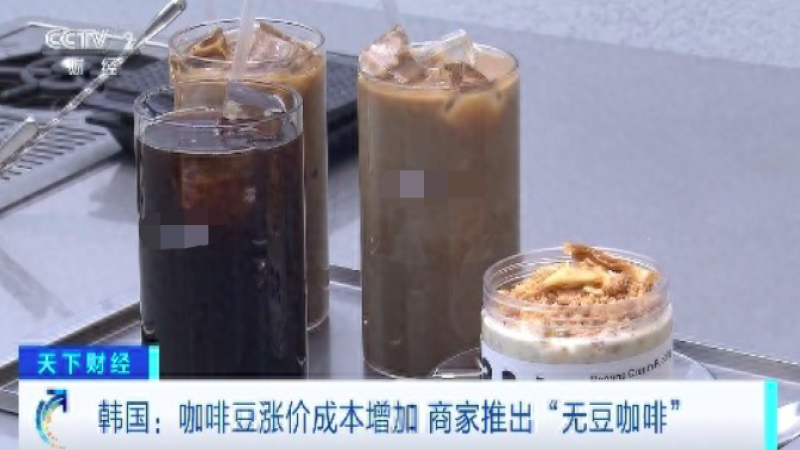
According to a CCTV Finance report, the cafe selling "beanless coffee" is located in Seoul, South Korea. The baristas there do not need to grind coffee beans; they simply place an empty cup under the dispensing outlet of a specific device to receive the drink base, then add water or milk to adjust it into a latte or americano that meets consumers' needs and tastes.
In appearance, these drinks have a color similar to regular coffee, and customers can also smell an aroma similar to espresso. The person in charge introduced that the drink base is not espresso extracted from coffee beans, but is made from 12 materials including barley, hibiscus, and orange peel after processes such as fermentation, drying, grinding, and roasting.
The merchant said that compared with coffee beans whose prices have soared, the raw materials for "beanless coffee" are relatively stable in price and abundant in market supply, and the production cost is about 20% to 25% lower than ordinary coffee on the market. From this point of view, "beanless coffee" can not only provide consumers with an experience similar to regular coffee, but also reduce cafes' raw material costs and ease operators' pressure.
Consumers who visited the store to try this "beanless coffee" said they could accept it: "Compared with regular coffee, there is almost no difference in taste, very similar, and the mouthfeel has fairly rich layers. It's worth a try." But some netizens said that "beanless coffee" is cheap, but it still does not taste like real coffee: "Coffee without coffee beans? Then why would I drink it?"
In fact, as early as 2021, a U.S. company used microbial fermentation technology and synthetic biology to create a basic coffee formula by extracting molecules. The developer said that this "coffee" has a taste, appearance, and smell, and even the same caffeine dose, as traditional coffee.
In recent years, in addition to the United States, companies in Switzerland, Singapore, and other countries have also joined the research on "beanless coffee," using advanced technological means to create drinks whose raw materials are easy to obtain, whose overall cost is lower, and whose taste is close to regular coffee. However, these drinks generally receive mixed reviews from those who try them.
For people who treat coffee drinking as a habit, although "beanless coffee" is not completely identical to regular coffee, it is lower in price, and its value for money is not inferior to the coffee drinks they consume daily. But in the eyes of coffee tasting enthusiasts, they prefer to feel various different nuances from coffee, and this is an experience that "beanless coffee" cannot give them. Therefore, in their view, "beanless coffee" cannot become a "stand-in" for coffee.
Front Street Coffee has always believed that no matter how the market wind changes, the sensory experience and emotional connection brought by a truly good cup of coffee cannot be replicated by any substitute. Choosing freshly roasted coffee beans with stable flavor is still something worth insisting on.
Image source: CCTV Finance
Disclaimer: Some images in this article are from the internet. For some content on the website, such as images, we will respect the original author's copyright and indicate the source. However, due to the large quantity, some images and texts may not have been credited in time. Please understand. If the original author has any dispute, they may contact the website for handling. Once verified, we will correct it immediately. Compiled and edited by "Coffee Workshop." Please indicate the source when reposting. If there is infringement, please inform us for deletion. Thank you~!
The above content is compiled by CoffeeHunters, a coffee news website.


