







How Does Freeze-Drying Change the Coffee Production Process?
Freeze-dried coffee is a type of instant coffee, not a substitute for freshly ground coffee, even though the blocks can look similar to ground beans. Traditional instant coffee uses spray drying, a heat-based method Nestle introduced in 1937, where atomized coffee liquid is dried into powder. Freeze-drying instead removes water from frozen coffee extract.
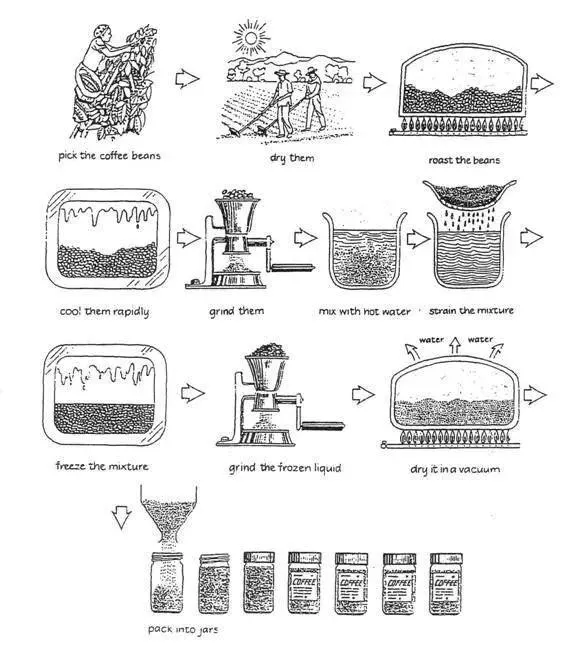
Making either type starts with large-scale industrial extraction, dissolving soluble solids from roasted, ground beans. Because merchants market freeze-dried coffee as close to freshly ground, some consumers brew freshly ground powder as if it were instant. Knowing the coffee production process makes the difference clear: freshly ground coffee is brewed right after grinding, while freeze-dried coffee is a manufactured soluble product.
In recent years, freeze-dried coffee, with its appearance and marketing campaigns, has led many consumers to mistakenly believe it can be mentioned in the same breath as freshly ground coffee. There have even been embarrassing cases where people brewed freshly ground coffee powder as if it were freeze-dried coffee. So what exactly is freeze-dried coffee? What is the fundamental difference between it and traditional instant coffee in terms of production process? And is it truly comparable to freshly ground coffee? This article, from Front Street's perspective, will systematically sort out the definition of freeze-dried coffee, its production process, and its differences from traditional instant coffee, to help coffee lovers clarify the concept and rationally view the relationship between freeze-dried coffee and freshly ground coffee.
For example, the recently frequent cases of mistakenly brewing freshly ground coffee powder as freeze-dried coffee; some also believe that freeze-dried coffee can go head-to-head with freshly ground coffee in every respect.
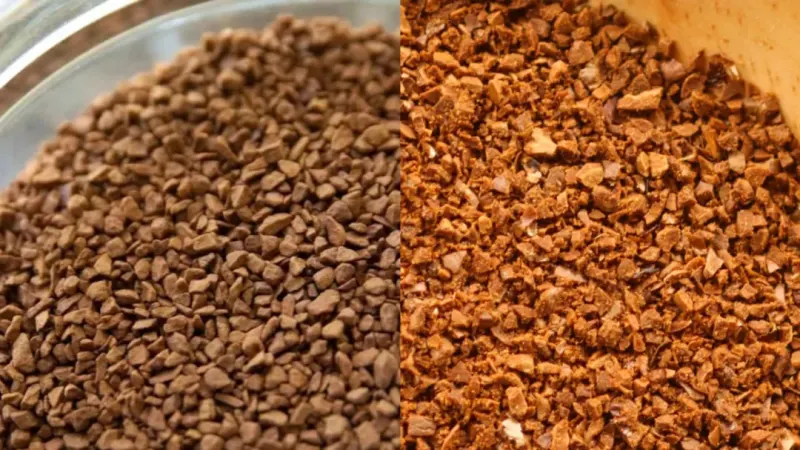
It is actually understandable that friends would have this kind of confusion. Judging purely by appearance, freeze-dried coffee blocks do look somewhat similar to freshly ground coffee powder (as shown in the picture); moreover, merchants often promote freeze-dried coffee with the selling point of being "close to freshly ground," which inevitably leads to misjudgment. But in the final analysis, freeze-dried coffee and freshly ground coffee are fundamentally two different things, and there is no comparability between them at all.
What is freeze-dried coffee?
Everyone is thoroughly familiar with freshly ground coffee. It refers to coffee that is brewed immediately after freshly grinding coffee beans, so Front Street will not elaborate further here, and will focus on freeze-dried coffee. Strictly speaking, freeze-dried coffee belongs to the category of instant coffee, except that its production process differs from that of traditional instant coffee.
Traditional instant coffee is mostly produced using the "spray drying method" invented by Nestlé in 1937! This method relies on the principle of thermal drying to dry atomized coffee liquid into powder. Front Street will briefly explain the process here: first, coffee is extracted in large batches industrially to dissolve the soluble substances in the coffee, then the coffee liquid is atomized through nozzles into countless tiny droplets and sprayed into a high-temperature drying chamber. Because the coffee liquid is fully dispersed, the moisture evaporates very easily, and what remains in the end is powdered solid instant coffee powder.


The above content is compiled by CoffeeHunters, a coffee news website.


