







Why Is Coffee Production Under Pressure Right Now?
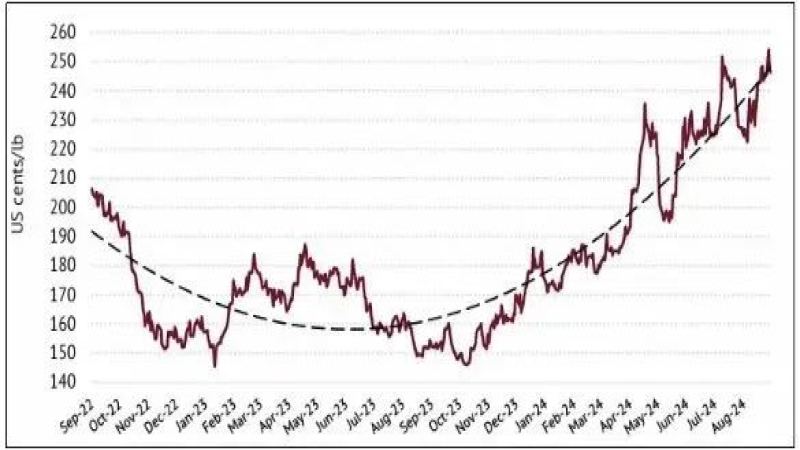
The International Coffee Organization's August report puts the global composite coffee price at 238.92 US cents per pound, up 1% month-on-month and 54.6% year-on-year, with August ranging between 222.58 and 254.12 cents. Robusta spot prices held near 47-year highs for a second month, and futures reached US$5,285 per tonne. The coffee industry faces tighter supply from climate, interest rates and Middle East logistics.
Export data show declines in the Asia-Pacific region, down 8.1%, and Central America, down 7.1%. Vietnam's early-year drought cut its coffee production and export volumes, while fires in South American growing regions and drought in Brazil added pressure. Traders are also stockpiling ahead of the EU's EUDR regulation. The ICO's 2023/24 forecasts look optimistic, but La Niña weather keeps coffee production uncertain.
The latest August industry report released by the International Coffee Organization (ICO) shows that the monthly average of the global composite coffee price reached 238.92 US cents/lb, edging up 1% month-on-month but soaring 54.6% year-on-year, with prices fluctuating between 222.58 and 254.12 cents throughout the month. Robusta spot prices have remained at their highest level in nearly 47 years for two consecutive months, while futures prices broke through a historic record of US$5,285 per tonne in one stroke. Factors such as worsening climate conditions, rising interest rates and geopolitical conflicts in the Middle East have combined to keep supply chains under continued pressure. At the same time, frequent fires in South American producing regions and unresolved drought in Brazil, together with the EU's upcoming EUDR regulation prompting traders to accelerate stockpiling, have jointly pushed up the market. Although the ICO's production and consumption forecasts for 2023/24 are relatively optimistic, the potential impact of La Niña weather has left many industry insiders cautious.
Recently, the International Coffee Organization (ICO) published its August coffee industry report. The report noted that the monthly average composite coffee price index stood at 238.92 US cents/lb, up slightly 1% from July and surging 54.6% compared with the same period last year. The price fluctuation range for the whole of August was 222.58 to 254.12 US cents.
In August, spot prices for all categories of coffee rose to varying degrees, with Robusta coffee prices remaining at their highest level in nearly 47 years for two consecutive months. In the futures market, Robusta also set a record, reaching US$5,285 per tonne.
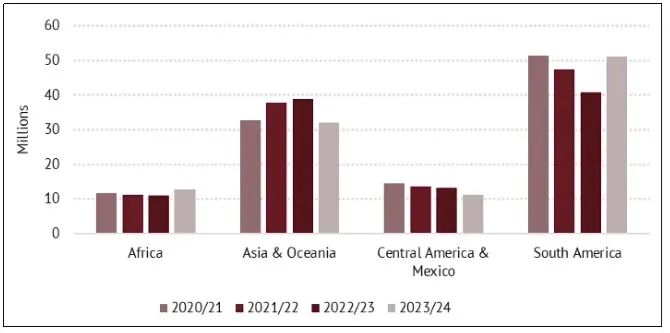
The factors driving the sharp upward surge in prices include: continued deterioration of the global climate causing tight supply, rising interest rates increasing funding costs, and logistics problems triggered by Middle East geopolitics. Looking at export data by region, both the Asia-Pacific region and Central America recorded declines, with the former falling 8.1% and the latter down 7.1%.
Focusing on the Asia-Pacific region, Vietnam reported a severe drought at the beginning of this year, leading to a sharp reduction in coffee production and a simultaneous contraction in export volumes. Data from Vietnam's General Department of Customs show that in August Vietnam exported a total of 1.216 million bags of coffee (60 kg per bag). Although this was higher than the previously estimated 1.16 million bags, it was still down 14.1% from the same period last year. Since the 2023/24 crop year, Vietnam's cumulative coffee exports have reached 23,441,199 bags, a year-on-year decline of 12.71%.
Although South America's coffee exports performed well in August, after entering September, several countries in the region reported severe fires, involving Colombia, Peru, Brazil and Bolivia. The fire-prone areas are precisely the coffee-producing regions of these countries, and combined with the recent persistent high temperatures and dry conditions in South America, the fires intensified further and caused serious impacts.
In Brazil, the harvest of the new crop season was completed by the end of August. However, during the harvest period, reports of drought and scant rainfall kept emerging, resulting in smaller coffee beans and ultimately affecting final output. Since then, many parts of Brazil have continued to suffer from severe drought, water shortages and large-scale fires, with some farmland burned and serious air pollution. These conditions pose a threat to the current coffee growth and flowering period and will also affect production in next year's new crop season.
In addition, this round of sharp price increases is also closely related to the EU. Last year, the EU introduced the Regulation on Deforestation-free Products (EUDR), which will restrict the entry into the EU market of a variety of agricultural products, including coffee, that are linked to deforestation, and is scheduled to officially take effect on December 31, 2024. For this reason, coffee traders in many EU countries have recently stepped up purchasing, even being willing to pay higher prices, to ensure sufficient inventories are built before the EUDR takes effect, and these purchasing activities have significantly pushed up market prices.
However, the International Coffee Organization forecasts that global coffee production in 2023/24 will increase 5.8% year-on-year to 178 million bags. Among this, Arabica coffee production is expected to be 102.2 million bags, and Robusta coffee production is expected to be 75.8 million bags. At the same time, global coffee consumption demand for the year is expected to grow 2.2% to 177 million bags.
However, many industry insiders are not optimistic about this forecast, because La Niña weather may be faced at the end of the year. According to the latest report from the World Meteorological Organization, the probability of La Niña occurring from September to November this year is 55%, and the probability from October to February next year will rise to 60%. Once La Niña materializes, many countries will suffer negative climate impacts, and the risk of production declines will rise accordingly.
To learn more information about coffee origins, please scan the QR code to follow: Coffee Review
Long-press the QR code to follow:
TRANSLATE with
x
English
Arabic Hebrew Polish Bulgarian Hindi Portuguese Catalan Hmong Daw Romanian Chinese Simplified Hungarian Russian Chinese Traditional Indonesian Slovak Czech Italian Slovenian Danish Japanese Spanish Dutch Klingon Swedish English Korean Thai Estonian Latvian Turkish Finnish Lithuanian Ukrainian French Malay Urdu German Maltese Vietnamese Greek Norwegian Welsh Haitian Creole Persian
TRANSLATE with
COPY THE URL BELOW
Back
EMBED THE SNIPPET BELOW IN YOUR SITE Bing Webmaster Portal
Back
The above content is compiled by CoffeeHunters, a coffee news website.


