







How Are Kenya's Coffee Growing Regions Split?
Kenya's coffee areas divide into three main regions: the Central Region, the East African Rift Valley Region and the Western Region. The Western Region is represented by Elgon, Trans-Nzoia and Bungoma at the foot of Mount Elgon, where coffee shows bright acidity, citrus fruit flavors and a mellow body.
Coffee cultivation here depends on high-altitude plateaus averaging about 1,500 meters, volcanic soil and a tropical monsoon climate split by the Rift Valley. Mount Kenya rises 5,199 meters, and Mount Elgon is the country's second-highest peak. The equator crossing Kenya gives coastal areas heat and humidity while highlands stay mild.
Kenyan coffee enjoys a stellar reputation in the specialty coffee world for its layered fruity aromas and full, juicy body. This country in eastern Africa, with its high-altitude mountains, volcanic soil, and tropical monsoon climate, offers exceptional natural conditions for coffee cultivation. Kenya's coffee-growing areas are mainly divided into three major regions: the Central Region, the East African Rift Valley Region, and the Western Region. Among them, the Western Region is represented by the three major producing areas of Elgon, Trans-Nzoia, and Bungoma at the foot of Mount Elgon, producing coffee with bright acidity, citrus fruit flavors, and a mellow body. This article will guide you through the overall distribution of Kenya's coffee regions and take a deeper look at the terroir characteristics of the Western Region.
Africa lies in the western part of the Eastern Hemisphere and is the world's second-largest continent after Asia. Its terrain is dominated by plateaus, which account for more than 60% of the continent's area, with an average elevation of about 750 meters. This continent is rich in natural resources, with mountains, volcanoes, lakes, and rivers widely distributed. In addition, the equator runs through it, and a tropical climate predominates, creating favorable conditions for growing crops such as coffee and giving Africa a pivotal position in the global agricultural market. Kenyan coffee, in particular, is renowned in the specialty coffee field for its complex, varied fruity aromas and abundant juicy character.
According to information reviewed by Front Street, Kenya is located in eastern Africa and has quite diverse landforms, with most of its territory consisting of plateaus and highlands at an average elevation of 1,500 meters. The eastern branch of the East African Rift Valley cuts north to south through the highlands, dividing them into eastern and western parts. Volcanoes are found throughout the country. Mount Kenya, an extinct volcano on the central highlands, stands at 5,199 meters and is Africa's second-highest peak; in the west lies Kenya's second-highest mountain, Mount Elgon.
Because the equator crosses the country, Kenya's climate is highly diverse. The entire country lies in a tropical monsoon zone, with most areas having a tropical savanna climate. The coastal areas are hot and humid, while the highlands are mild and pleasant, and mountains above 3,500 meters are covered with snow year-round. Temperatures remain between 12 and 24 degrees Celsius throughout the year. Influenced by the monsoons, the year is divided only into rainy and dry seasons. High-altitude mountains, volcanic soil, ample sunshine, and moderate rainfall work together to form an ideal natural foundation for coffee growth.
The growth of Kenya's coffee industry is inseparable from government promotion. Although it started relatively late, local agriculture during the British colonial period was controlled by the British. After independence, the government carried out land reform, and only then were Kenyans able to grow their own coffee. Afterward, through measures such as establishing an auction system, drafting a coffee quality grading system, and introducing agricultural legislation, it continuously improved cultivation standards, increased coffee income, and helped farmers achieve self-sufficiency.
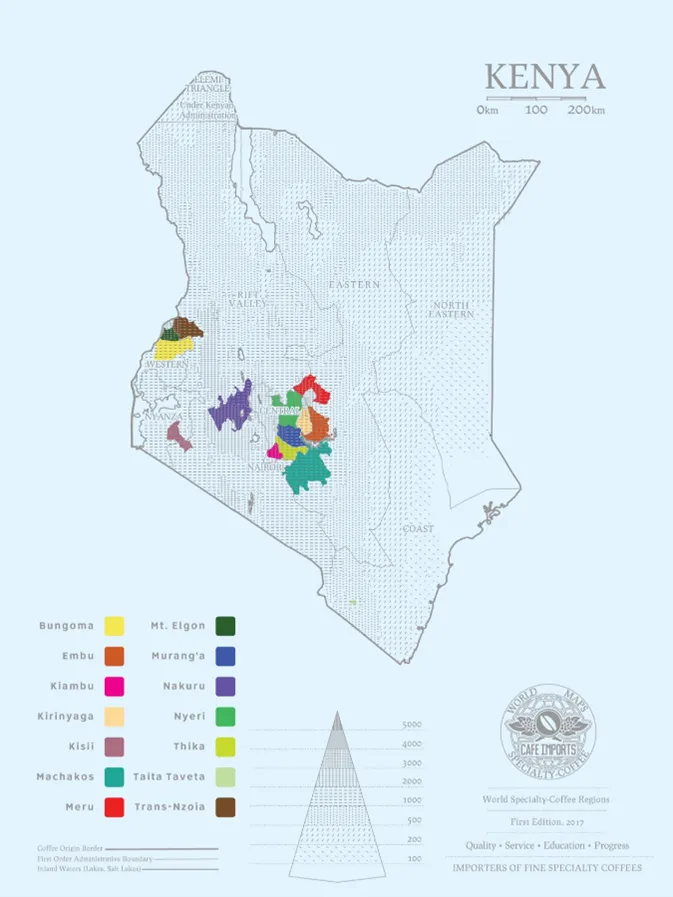
Kenya's coffee cultivation is geographically divided mainly into three major regions: the Central Region, the East African Rift Valley Region, and the Western Region.
Central Region
The Central Region can be called the core production area for Kenyan coffee and other agricultural products, accounting for 60% of the country's total coffee output. This region includes producing areas such as Nyeri, Kiambu, Kirinyaga, Murang'a, and Thika. Farms large and small are scattered across the slopes of Mount Kenya and the Aberdare Range, not far from the capital, Nairobi.
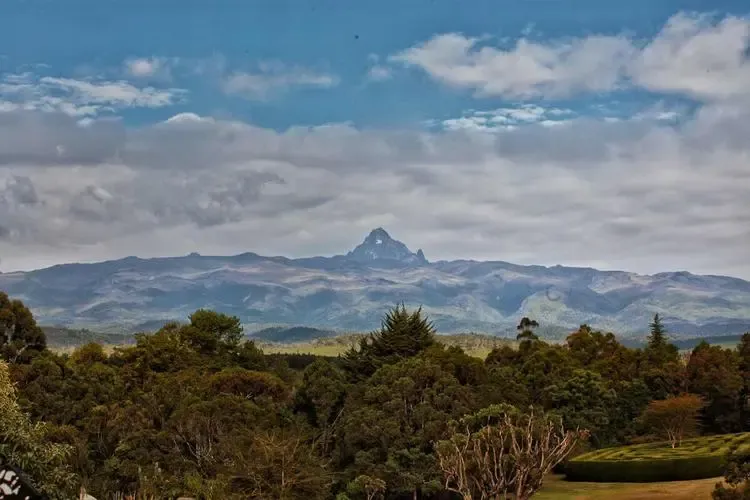
The Central Region is home to the extinct volcano Mount Kenya. Its soil is red volcanic soil rich in organic matter, and coffee trees are grown on hillside areas at elevations of 1,200 to 2,300 meters. Abundant sunshine and rainfall enable these producing areas to yield high-quality coffee. Producers in this region are mainly smallholder coffee farmers who join cooperatives, and the cooperatives provide wet-processing stations where farmers deliver their harvested cherries for processing. FrontStreet Coffee's Kenyan coffee beans are selected from the Asail processing station in the Thika producing area, featuring flavors of cherry tomatoes and smoked plums, with bright acidity, prominent sweetness, a clear juicy character, and a clean mouthfeel.
East African Rift Valley Region
The East African Rift Valley is a 6,000-mile-long rift in Africa's crust, most of which lies within Kenya. This area initially focused on growing corn and developing livestock farming, and only later gradually shifted to coffee cultivation. The main producing areas in this region are Nakuru and Kisii. The Nakuru producing area benefits from the rich natural resources provided by the Menengai volcano and Lake Nakuru, a volcanic lake. Coffee is grown at elevations between 1,850 and 2,200 meters, making it one of Kenya's higher-altitude growing areas. Coffee from these areas has moderate acidity, full fruity aromas, and rich chocolate flavors.
Western Region
The Western Region is mainly composed of the three major coffee-producing areas of Mt. Elgon, Trans-Nzoia, and Bungoma, all located in the foothills of Mount Elgon in western Kenya, with coffee grown on hillsides at elevations of 1,500 to 1,950 meters. The terrain here is steep, with many streams and waterfalls, fertile hillside soil, lush vegetation, and a humid, mild climate with annual rainfall of about 1,279 millimeters, making it an important producing area for crops such as coffee, bananas, tea, and corn. Coffee from this region has bright acidity, citrus fruit flavors, and a mellow body.
The above content is compiled by CoffeeHunters, a coffee news website.


