








Why Does Your Moka Pot Spurt, Clog or Give Thin Crema?
Most moka pot problems come down to three extraction faults: coffee liquid shooting out in a column, no liquid appearing after a long brew, and thin or missing crema. Each traces back to parameters such as dose, grind, tamping and heat. The pot brews under pressure like an espresso machine, so small changes shift the result.
Spurting usually means the puck offers too little resistance, often from too coarse a grind or too small a dose, while a clogged pot points to the opposite. Brew time is a useful signal: if the flow starts late or runs long, adjust grind coarseness first. Fresh medium-dark beans such as a Golden Mandheling blend help produce a steadier, richer crema at home.
The Moka pot uses pressure extraction to produce a strong coffee close to espresso, and with its compact size, portability, and affordable price, it has attracted more and more coffee enthusiasts. However, beginners often encounter problems such as overly forceful flow, coffee liquid that refuses to come out for a long time, or finished coffee with almost no crema. This article analyzes the three most common types of extraction abnormalities with the Moka pot: first, coffee liquid shooting out in a column; second, no liquid coming out after a long brew; and third, thin crema or even no crema at all. For each situation, the article explains the underlying parameter causes and adjustment methods, and recommends fresh medium-dark roasted beans such as Front Street Classic Blend, Front Street PWN Golden Mandheling, and Front Street Dark Cocoa Blend to help you consistently extract rich crema at home.

The Moka pot, like the espresso machine, follows the path of pressure extraction, so it can brew coffee liquid with a concentration fairly close to espresso. For this reason, as coffee culture continues to spread, more and more people are choosing the Moka pot. Besides producing a strong enough result, it is small, convenient to use, and easy on the wallet.
Although it is not too difficult to get started with, beginners with no extraction experience at all can still easily run into pitfalls. So today Front Street Coffee will sort out the three most frequently encountered problems when using a Moka pot, along with the corresponding solutions.
1. Coffee liquid spurts out directly
Under normal operation, the Moka pot should release coffee gently, evenly, and without force. But if the coffee liquid you see comes rushing out with great force, even forming a column, that means there must be a deviation in operation or parameters.
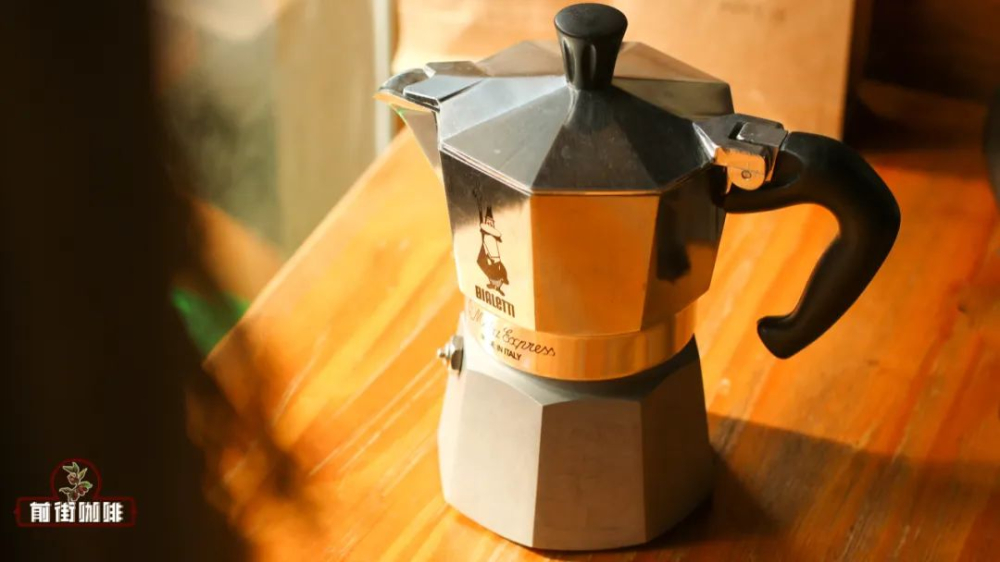
This situation can be divided into two types: one is when the coffee liquid bursts out violently from the very beginning; the other is when, midway through extraction, the flow rate suddenly changes from slow to fast, and the stream can even split into a "twin-tail" shape.
In the first type, the root cause is that the puck never provided enough resistance from the start. The steam pressure is too strong, and the puck cannot hold it back, so the coffee liquid naturally sprays straight out. In this situation, you can increase the dose, make the grind finer, or tamp the coffee grounds to increase the puck's resistance.
The second type is caused by the heat remaining too high throughout extraction. Once the coffee liquid breaks through the puck, the puck's blocking effect on the hot water gradually weakens. As extraction progresses, we need to remove the Moka pot from the heat source; otherwise, the puck's resistance will become increasingly insufficient and can no longer limit the speed at which hot water passes through, causing the coffee liquid to rush out all at once in a column. When the flow rate is too fast, it can easily scald someone, so you must pay attention.
2. Coffee liquid will not come out
Exactly the opposite of the above, this situation is when the Moka pot has been brewing for a long time but still no liquid comes out. A special reminder here: if the Moka pot does not produce liquid for a long time, and the water level already exceeds the safety valve when filling, it is best to stop extraction immediately. Because this can very easily cause the Moka pot to explode.
There are many reasons the Moka pot may fail to produce liquid, such as grinding too fine, using too much coffee, tamping too tightly, and so on. These operations greatly increase the puck's resistance, leaving fewer and smaller gaps for water to pass through, which is why even after brewing for a long time, the coffee liquid still cannot emerge.
Even if liquid finally comes out with difficulty, the coffee will most likely be bitter and over-extracted, since the extraction time is simply too long. So it is best to make adjustments promptly once the problem appears.
3. The extracted coffee liquid has no crema
The Moka pot also belongs to pressure extraction, so it can also produce crema fairly close to that of an espresso machine. Although it is called crema, it is actually bubbles held up by carbon dioxide. Since the Moka pot's pressure is not as high as that of a coffee machine, the crema it extracts will not be as dense and lasting as that from a coffee machine, and it will dissipate quickly, but it should not be completely absent.

If you want Moka pot coffee to have rich crema, you must choose fresh medium-dark roasted coffee beans, with Front Street Classic Blend, Front Street PWN Golden Mandheling, and Front Street Dark Cocoa Blend as the top choices, because they have been heated longer and contain more carbon dioxide, which will release golden foam when meeting water.
If the Moka pot coffee you extract has almost no visible bubbles, then the "culprit" is most likely one of the following three: grinding too coarse, coffee beans roasted too long ago, or using pre-ground coffee for extraction. Of course, the most core issue must be insufficient pressure. So when we find that the coffee liquid extracted from the Moka pot has no bubbles, it is best to first adjust the grind, or increase the dose, and then judge by observing the seepage speed of the coffee liquid whether it is a freshness problem with the beans or the coffee grounds.
The above content is compiled by CoffeeHunters, a coffee news website.


