








What makes Colombia's Narino coffee farms stand out?
Colombia's Narino province, in the Andes, is emerging as a source of complex, floral coffee, and the Santa Ana estate took runner-up at Colombia's 2023 COE. The country ranks third worldwide in coffee output and is a leading arabica coffee producing country, shaped by FNC standardization along with its terrain and climate.
Coffee reached Colombia around 1723 through Jesuit monks and gradually spread. The 1899-1903 civil war cut the growing population and left plantations abandoned; afterward the government divided wasteland into small plots sold cheaply to farmers to restart cultivation. The article also covers Santa Ana and La Bohemia estate Geisha-growing stories and regional conditions.
The Andes Mountains run the full length of South America, nurturing numerous coffee-producing countries, and Colombia is among the most outstanding of them. After years of war and social upheaval, Colombia's coffee industry, through FNC's standardized management and its unique terrain and climate, gradually developed into the world's third-largest coffee-producing country. Beyond well-known regions like Cauca and Huila, the Narino province is emerging with highly complex flavors and floral characteristics, and the Santa Ana estate even secured runner-up in Colombia's 2023 COE. This article takes you deeper into the natural conditions and historical context of the Narino region, as well as the Geisha-growing stories of Santa Ana and La Bohemia estates. Front Street Coffee continues to follow developments in Colombian specialty coffee, bringing first-hand regional information to enthusiasts.
South America is located in the southwestern hemisphere, with a land area ranking fourth among all continents. The Andes Mountains run almost from south to north through the western part of the South American continent. This continent experiences frequent volcanic activity and earthquakes of considerable intensity, and its overall climate is warm and humid, predominantly tropical, with abundant rainfall. Thanks to its rich and diverse natural environment, many South American countries rely on agriculture such as coffee cultivation as an economic pillar, with Ecuador, Peru, Brazil, and Colombia all being typical examples.
Colombia was long mired in war and social instability, and its coffee industry also stagnated for a time as a result. But today, it has risen to become a globally recognized major producer of Arabica coffee beans, ranking third in the world in coffee output.
According to some historical records, coffee was brought to Colombia around 1723 by Jesuit monks and then gradually spread throughout the country. However, between 1899 and 1903, a civil war broke out in Colombia, causing a sharp decline in the coffee-growing population and leaving a large number of plantations abandoned. After the conflict subsided, in order to revitalize the coffee industry, the government consolidated stretches of wasteland and divided them into small plots, selling them to farmers at extremely low prices to encourage them to plant coffee and other crops and start a new life. By 1912, the coffee industry had recovered, accounting for 50% of Colombia's total exports.
However, small coffee farms lacked bargaining power in the international market. In 1920, at the urging of coffee farmers, the Colombian Coffee Growers Federation was established to protect the rights and interests of small farms. The organization continued to grow and in 1927 helped establish the more authoritative and standardized National Federation of Coffee Growers of Colombia, known as FNC. After its founding, the FNC implemented a series of measures, including strictly controlling quality, establishing a national coffee research center, and enhancing the global competitiveness and influence of Colombian coffee.
Colombia's high coffee production is inseparable from its terrain and climate conditions. Three Cordillera mountain ranges run north to south through the country and extend toward the Andes, with coffee distributed across the highlands of these ranges. Fertile volcanic soils are found on both sides of the mountains, and the stepped mountain terrain creates diverse microclimates, enabling harvest seasons throughout the year, with different varieties of coffee ripening at different times.
Colombia has a vast territory and numerous coffee-producing regions, with major ones including Cauca, Santander, Narino, Tolima, and Huila. There are two harvest seasons each year: the main season from October to January and the secondary season from April to July.
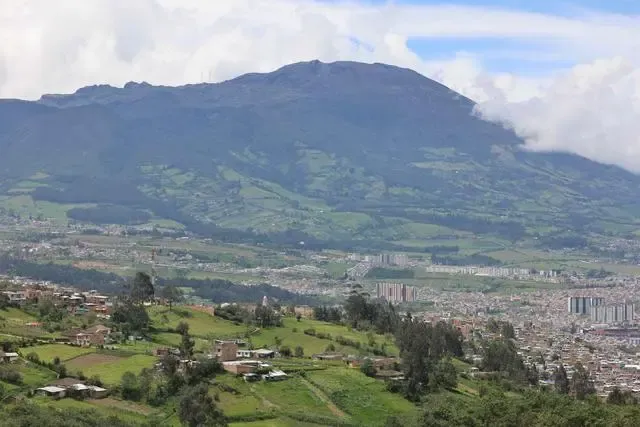
Huila and Tolima are better known, but Narino also produces high-quality coffee beans and frequently appears on COE lists.
Narino, also known as Nariño, is located on Colombia's southwestern coast, adjacent to Ecuador. The area has many rivers and lakes, as well as the Cumbal and Galeras volcanoes, and these natural conditions provide a good foundation for agricultural development. Because it is close to the equator, coffee from the Narino region is known for its complex flavor layers and prominent floral notes. Many well-known estates are located here, such as the Santa Ana estate, which won second place in Colombia's 2023 COE.
The Santa Ana estate is currently managed by the husband-and-wife team Carlos Alberto Belalcázar and Raquel Lasso Muñoz. Raquel Lasso Muñoz is the founder of the FUDAM smallholder producer organization, served as its president for many years, and also manages the La Bohemia estate. Carlos Alberto Belalcázar has about 30 years of coffee production experience and has accumulated extensive knowledge and skill in cultivation and processing. At present, the couple is committed to promoting coffee from the Narino province.
The couple's estates previously mainly grew the Caturra variety, and in recent years they began switching to Geisha. The Santa Ana estate is planted at an altitude of about 1,990 meters, while the coffee at La Bohemia estate is grown at 2,150 meters. They began participating in the COE in 2017. In Colombia's 2023 COE, Santa Ana estate's Geisha won second place with 90.39 points, while La Bohemia estate's Geisha ranked fifth with 87.78 points.
The above content is compiled by CoffeeHunters, a coffee news website.


