








What does the coffee bed shape tell you after pour-over brewing?
The shape of the coffee bed left in the dripper after a pour-over mainly reflects the pouring technique and the state of the grounds, not whether the cup tastes good. Six common forms appear: a deep even pit, an offset pit, a flat bed with a grounds wall, a flat bed without one, a faulted bed, and a mud pit.
A deep pit usually means a large, center-focused stream lifted the whole bed. Grounds quantity sets the pit depth, while lower density makes a pit easier to form, so dark roasts tend to behave differently. Size of coffee bean and grind also shift how the bed settles, so adjust pouring rather than chasing a look.
After pour-over brewing is complete, the coffee bed in the dripper often takes on different shapes—some people can brew a beautiful, even deep pit, while others end up with a flat bed or even a muddy crater. What exactly are these bed shapes telling us? In fact, the appearance of the coffee bed mainly reflects the pouring method and information about the coffee grounds themselves, and has no direct correlation with whether the coffee tastes good. Front Street Coffee will start with six common coffee bed states and explain one by one the causes and meanings of the deep pit, offset pit, flat bed with a grounds wall, flat bed without a grounds wall, faulted bed, and mud pit, to help you better judge whether your pouring is appropriate in daily brewing and make timely adjustments.
Everyone has probably experienced this: after the pour-over finishes, as the water level slowly drops, the coffee grounds layer in the dripper—the coffee bed—gradually becomes exposed. At this point, if the center of the coffee bed shows a deep and neat pit, that really is something to show off.
But I think many people also know in their hearts that what the coffee bed looks like at the end has little to do with whether the cup tastes good. The coffee bed is more about telling us: how your pouring technique is, and what state the coffee grounds themselves are in. At present, there are roughly six common coffee bed forms, and each one can reveal different information. Next, Front Street Coffee will go through them one by one and explain what these different coffee bed shapes are conveying.
1. Deep and even deep-pit coffee bed

The first one to mention is the deep-pit coffee bed that is most often shown off. The appearance of this form indicates that a relatively large stream of water was used during pouring to lift the entire coffee bed, and the water flow was basically concentrated in the central area, which is why it could pile up a pit located in the center and relatively even in size.
Of course, the factors affecting the formation of a deep pit are not limited to water flow. The amount of coffee grounds determines the depth of the pit—the more grounds, the higher the grounds wall can pile up, and naturally the deeper the pit can sink; the density of the coffee grounds affects the size of the pit, and the lower the density, the easier it is to form a pit, so dark-roasted beans usually more easily produce a deep pit; in addition, the number of pulse pours also affects the three-dimensional feel of the coffee bed, and the fewer the pulses, the more obvious the pit often is. So just by looking at the size of this pit, you can read quite a lot.
2. A coffee bed with a very deep pit but offset
Sometimes although the pit is very deep, its shape is not symmetrical—it does not go straight down, but is clearly tilted to the left or right, just like in the picture.
This kind of offset pit appears because the water stream did not remain vertical during pouring. Pour-over kettles designed by different manufacturers have different spout shapes, and the same tilt angle will produce different water streams. For example, with the same amount of water, a downward-curved gooseneck spout more easily produces a vertical stream than a straight spout.
If you use a spout that does not easily produce a vertical stream, then you need to adjust your pouring method accordingly; otherwise the hot water will rush in at an angle, causing the coffee grounds on one side to be over-extracted, and the overall extraction will be uneven. Worse still, if the water flow impact is too strong, it may directly collapse the grounds wall, and the hot water will slip away along the gaps to form bypass water, affecting the strength of the coffee.
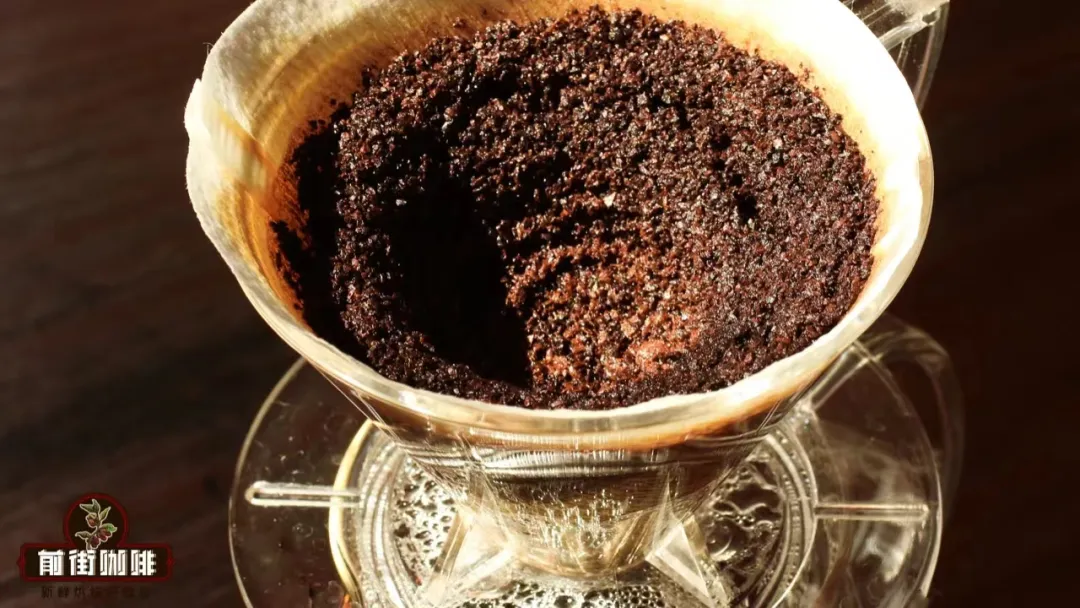
So if you see such a coffee pit after a certain brew, remember to go back and check your pouring motion, and try to avoid repeated uneven extraction.
3. A flat coffee bed with a grounds wall
Sometimes after brewing, the coffee bed does not show an obvious pit, and instead is relatively flat overall, like a piece of flat ground.
The flat coffee bed in the picture that retains a small section of grounds wall mainly has three causes. The first is that the coffee bed was not lifted, and the pouring was mainly done in large circles, so the coffee grounds had no chance to spread out and therefore could not form a pit. The second is too many pulse pours—when there are many pulses, the adhesion of the coffee grounds decreases after they absorb enough water, and as the number of pours increases, the weight of the grounds becomes greater and greater, gradually falling off the dripper wall and sinking to the bottom. By the time the grounds on the dripper wall have basically all fallen off, it becomes like in the picture, with only a small amount of grounds still sticking to the wall and the rest all lying flat.

The third is that the density of the coffee grounds is too high. High-density grounds are not easily carried away by the water flow, and even if they are temporarily lifted, they will quickly sink again, ultimately forming a flat coffee bed.
4. A flat coffee bed without a grounds wall
This type of coffee bed is exactly the opposite of the previous one—the bottom is flat, and almost no coffee grounds can be seen adhering around the dripper wall.
This situation occurs because during pouring the hot water directly hit the dripper wall, washing down all the coffee grounds that had originally adhered to the wall. If you use a dripper with many ribs (such as V60), this pouring method will also encourage bypass water, and the hot water will flow directly away along the channels formed by the ribs, with very strong penetration. The result is that the coffee is diluted, and at the same time, because there is not enough hot water participating in extraction, under-extraction is very likely to occur.
So after seeing this type of coffee bed, you should likewise pay attention to your pouring method to reduce uneven extraction and bypass water.
5. Faulted coffee bed
Whether it is a deep pit or a flat bottom, one situation may appear: there is an obvious separation line around the dripper wall, dividing the grounds wall and the coffee bed into two layers.
The principle of this kind of fault is similar to the second type, the offset pit, and it is also caused by improper pouring, with the hot water concentrated in the edge area for extraction. Likewise, this kind of coffee bed also easily leads to uneven extraction. Be extra careful during brewing, and absolutely do not pour hot water onto the edge.
6. Mud pit
The so-called mud pit means that the surface of the coffee bed looks very muddy, while also having a deep pit, as shown in the picture below.

There is basically only one reason for the appearance of a mud pit: too many fines. Too many fines not only makes the coffee bed look like this, but also easily leads to over-extraction because the brewing time is prolonged.
When this happens, you need to find out the reason why a large amount of fines is being produced and solve it. Grinding too fine or a poor-quality grinder are the two main sources of too many fines. If it is because the grind is too fine, coarsening the grind setting can improve it; if it is a problem with the grinder itself, then you need to use a sieve to sift out the fines, or simply switch to another grinder.
Finally, Front Street Coffee still wants to emphasize once again: there is not much connection between the shape of the coffee bed and whether the coffee tastes good, so never miss a truly delicious cup of coffee because you judge coffee by its appearance.
- END -
The above content is compiled by CoffeeHunters, a coffee news website.


