







Does Starbucks still offer charging ports after outlets were sealed?
Customers in several locations have found wall outlets at some Starbucks stores covered or sealed off. The chain built its reputation on the third-space idea, drawing remote workers and students who stay for hours, and power access has long been part of that appeal, so the closures prompted complaints from regulars who rely on charging while they sit.
Store operators say seats are sometimes occupied by people who charge devices without buying anything, and some branches now require a purchase to sit. The debate turns on whether sealing outlets is a necessary cost and capacity measure or a move that penalizes paying customers, and there is no indication yet of a company-wide policy on charging ports.
Recently, customers in many places have noticed that some power outlets in Starbucks stores have been sealed off, sparking widespread discussion. As a chain brand positioned around the "third space" concept, Starbucks has long attracted office workers, students, and other consumers who stay for extended periods, and amenities such as power outlets and Wi-Fi are among the reasons for its popularity. However, the behavior of some people who occupy seats and charge their devices without making a purchase has forced stores to take countermeasures such as sealing off outlets and requiring a purchase to be seated. Is this move a helpless cost-cutting and efficiency-boosting measure, or does it harm the experience of genuine customers? This article synthesizes multiple perspectives to explore the balance between the operational dilemmas behind Starbucks' outlet closures and consumer rights.
▲
Click to follow | Daily specialty coffee culture magazine Coffee Workshop
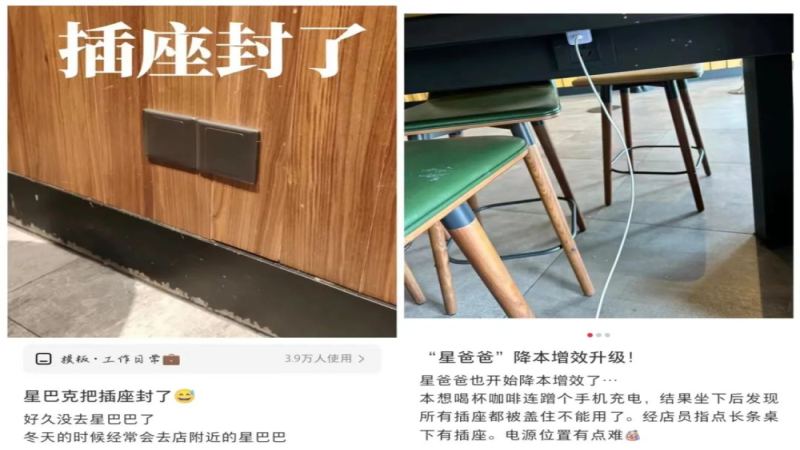
Recently, a customer reported that after ordering and taking a seat at a nearby Starbucks, they discovered that the row of outlets along the wall had all been sealed off. The customer said that when they had visited the store previously, these outlets were all working normally, and speculated that the store had only recently taken this measure. However, at the time, only the wall outlets were sealed off, while outlets in other locations were still usable, and it remains unclear whether this is a widespread policy.
Similar situations have appeared in other areas. Another customer found that outlets in a nearby store were covered and unusable, and only after a staff member's prompt did they find an unsealed outlet beneath the long table, allowing them to charge their phone.
Netizens have differing views on this. At Starbucks, which markets itself as a "third space," one can often see office workers handling work and students attending online classes or doing homework, and their phones, laptops, and other devices drain battery quickly, making outlets indispensable for long periods of use.
Therefore, for these consumers, sealing off outlets is tantamount to a disguised way of driving them away, forcing those who work or study for long hours to leave before their batteries run out. In some people's view, this does no good for store operations.
But some consumers believe the store may have resorted to this measure because too many people occupy seats and charge without making a purchase, leaving it no choice but to discourage "freeloaders" in this way.
Inside the stores, some people plug in their phones and then don't move for half a day, sitting in their seats for hours watching videos and playing games, and asking staff for free hot water when thirsty, spending almost nothing over the course of a day. Others buy a cup of coffee as an "office companion," but the to-go cup bears not the green mermaid but a little blue deer.
This kind of seat-occupying, charging-without-buying freeloading behavior is seen by some as what truly harms Starbucks' operations, and it also leaves customers with genuine needs disappointed when they can't find a seat. Therefore, the store's choice to seal off outlets may be an attempt to tactfully discourage freeloaders and reserve limited seating for genuine customers.
Some also point out that stores may seal off outlets out of consideration for electrical safety.
In the comments section, a netizen reported having witnessed someone at a Starbucks store using public outlets to charge electric bikes, batteries, and the like. Employees also said that at their store, customers had secretly used high-power appliances such as rice cookers and mini hot pots to cook meals and hot pot during peak hours when no one was paying attention, triggering the smoke detector alarm.
These unauthorized uses of electricity not only cause losses to businesses but also pose certain safety hazards. Therefore, if stores prohibit customers from using outlets to avoid safety accidents, it is not entirely unreasonable.
Today, service facilities such as power outlets and Wi-Fi have become one of the factors customers consider when choosing a coffee shop, and Starbucks, which values customer experience, is also popular for its complete facilities. However, when these convenient facilities are occupied by non-paying customers, the brand is forced to adopt countermeasures such as requiring a purchase to be seated and sealing off outlets to deal with freeloading behavior.
Perhaps before long, Starbucks will introduce new measures to maintain normal store operations, reduce resource occupation, and allow paying customers to receive better service.
Image source: Internet
Disclaimer: Some images in this article are from the Internet. For some content on the website, such as images, we will respect the original author's copyright and indicate the source. However, due to the large volume, there may be individual images or texts for which no source has yet been indicated; please forgive us. If the original author has any disputes, they may contact the website for handling, and once verified, we will correct it immediately. Compiled and edited by "Coffee Workshop." Please indicate the source when reposting. If there is any infringement, please inform us for removal. Thank you~!
The above content is compiled by CoffeeHunters, a coffee news website.


