







What is driving global coffee production and prices?
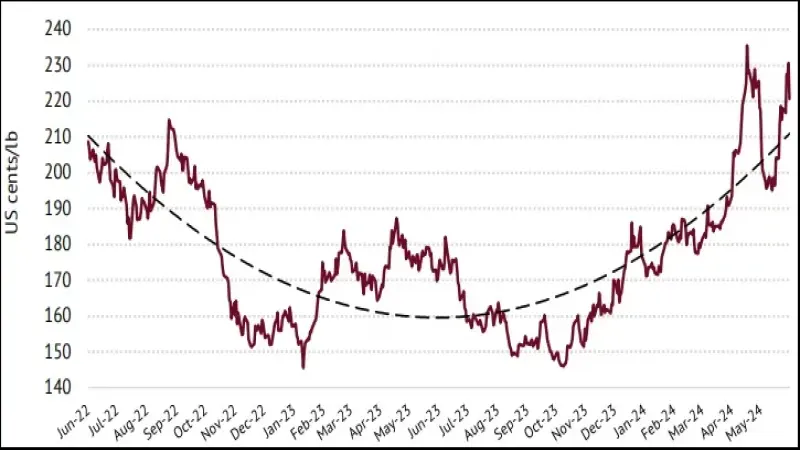
The International Coffee Organization's May report puts the composite indicator price at an average of 208.38 cents per pound, down 3.9 percent month-on-month, within a range of 195.13 to 230.61 cents. The ICO expects global coffee production in 2023/24 to grow 5.8 percent to 178 million bags, while consumption is seen rising 2.2 percent to 177 million bags.
Prices moved on weather and currency. Drought in Vietnam, the second-largest producer, pushed prices up before May rainfall eased grower worries; drier weather in Brazil helped harvesting proceed. Exchange inventories climbed, with the U.S. ICE exchange up 30.3 percent to 840,000 bags and the European ICEU up 24.9 percent to 780,000 bags. Green bean exports in April rose 15.3 percent year-on-year.
The latest monthly report from the International Coffee Organization (ICO) shows that the composite indicator price of coffee averaged 208.38 cents per pound in May, down 3.9% month-on-month. Easing drought in Vietnam and dry weather in Brazil favorable for harvesting, combined with uncertainty over supply from Central America and the depreciation of the real, intertwined to influence price movements. Global coffee inventories rose sharply, with green bean exports in April increasing 15.3% year-on-year, among which Brazil's exports grew strongly by 54.8%. The ICO expects global coffee production in 2023/24 to grow 5.8% to 178 million bags, while consumption demand is expected to rise 2.2% to 177 million bags, showing a market characterized by growth in both supply and demand.
Recently, the International Coffee Organization (ICO) released its monthly report on the global coffee market for May. The report noted that the composite indicator price for the month averaged 208.38 cents per pound, a slight decline of 3.9% from the previous month.
During May, the composite indicator price fluctuated within a range of 195.13 cents to 230.61 cents. At the end of April, Vietnam, the world's second-largest coffee producer, suffered widespread drought, and growers feared irreversible damage to coffee trees, which pushed prices higher.
Entering early May, Vietnam received rainfall, easing farmers' worries about the ongoing drought. At the same time, Brazil reported drier local weather with limited rainfall, which was instead conducive to advancing coffee harvesting operations, so the indicator price began to decline.
However, prices rose again in mid-May, owing to unclear coffee supply prospects in the two major producing regions of Brazil and Vietnam, while dry weather and high temperatures in Central America also sparked concerns. Another source of pressure came from the continued depreciation of the Brazilian real in May.
Coffee inventories at the U.S. ICE exchange and the European ICEU exchange both climbed significantly. Inventories at the U.S. ICE exchange surged 30.3% to 840,000 bags, while inventories at the European ICEU exchange increased 24.9% to 780,000 bags.
The rise in inventories was mainly attributed to growth in global green coffee bean exports. Green bean exports in April totaled 10.77 million bags, up 15.3% from the same period last year.
By region, South American exports grew 44.5% to 5.15 million bags, with Brazil performing especially prominently, exporting 4.24 million bags, up 54.8% year-on-year, setting a record for the highest April export volume in history.
African coffee exports also increased 39.4% to 1.37 million bags, with the main contributions coming from Côte d'Ivoire and Ethiopia. Compared with the same period last year, Côte d'Ivoire surged 202.5%, while Ethiopia grew 103.6%.
At the same time, due to reduced production in Vietnam and Indonesia, coffee exports from Asia and Oceania fell 0.3% year-on-year to 3.78 million bags.
Exports from Mexico and Central America also contracted, falling 12.6% to 1.66 million bags. Exports from Guatemala, Honduras and Nicaragua fell sharply in April, by 12.6%, 26.3% and 22.9% respectively, mainly because Guatemala and Honduras were in the off-season for production, compounded by severe weather that reduced output.
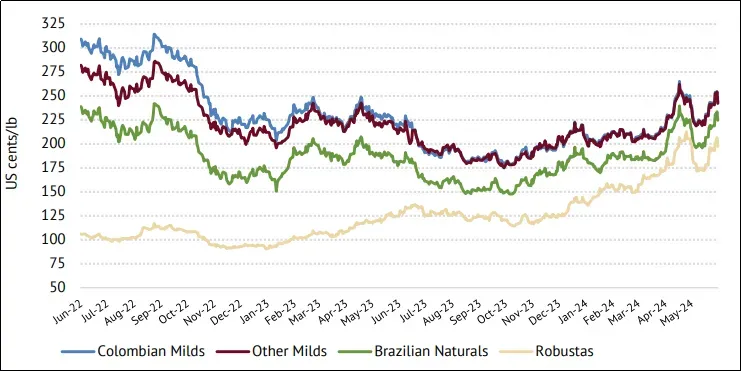
Although exports from Asia and the Pacific declined, exports of Robusta coffee bags increased 13.4%. Reduced production in Vietnam and Indonesia, combined with pressure on Eurasian shipping routes from the Red Sea crisis, caused global demand for Brazilian Robusta to surge. In April 2023, Brazil exported only 120,000 bags of Robusta, while in April this year it soared 448.6% to 680,000 bags.
Based on the above, the International Coffee Organization forecasts that global coffee production in 2023/24 will grow 5.8% year-on-year to 178 million bags, of which Arabica production is expected to be 102.2 million bags and Robusta production is expected to be 75.8 million bags.
Looking back at 2022/23, hit by the COVID-19 pandemic, rising living costs and reduced disposable income led coffee demand to decline 2% to 173.1 million bags. But there are now signs of recovery, and global coffee consumption demand is gradually recovering. It is expected that consumption demand in 2023/24 will grow 2.2% to 177 million bags.
The above content is compiled by CoffeeHunters, a coffee news website.


