








What Is the Piccolo Meaning in Coffee and How Is It Made?
A Piccolo Latte is a small milk coffee, roughly 3 ounces, built on a single ristretto or short espresso shot topped with a little steamed milk. It is often called a mini latte, but the piccolo meaning in coffee is simply "small," and the drink is served in a small glass to keep the coffee flavor forward rather than milk-heavy.
The drink is tied to australian coffee culture, where it ranks among the top sellers at many specialty cafés. The common origin story places it about a decade ago in Sydney, when a barista split a double shot during dialing in, tasting one half straight and mixing the other with a splash of steamed milk to check whether milk masked the bean's flavor.
Piccolo Latte is often called a "mini latte," but is it really just a shrunken version of a hot latte? From the etymology of the Italian word "piccolo," to the method accidentally invented by Australian baristas while dialing in beans, to the crafting challenges behind the 3-ounce small cup, this delicate milk coffee actually has its own unique origins and selling points. This article takes you through the story of Piccolo Latte, its real differences from a latte, and how it has rediscovered its place on specialty coffee shop menus, along with related recommendations from Front Street Coffee.

"Give me a Piccolo Latte."
"No problem, coming right up~" "Boss, isn't this cup a bit too mini??!!"
Many people, upon first seeing a Piccolo Latte, feel that whether in terms of its composition or the flavor on the palate, it closely resembles a shrunken latte—more precisely, about half the size of a regular hot latte. But since it's so small and tastes so similar to a latte, why would cafés still keep this drink on the menu?
How did the Piccolo Latte come to be?
After consulting the materials, Front Street learned that "piccolo" in Piccolo Latte is an Italian word meaning "small flute." In other European languages, the word retains an even more original meaning: small, young. The word "piccolo" didn't appear particularly early—it first showed up in publications around the mid-19th century—and as a beverage, the Piccolo Latte is likewise relatively young compared to other espresso drinks.
The most widely circulated story about the origin of the Piccolo Latte is this: about a decade ago, a barista (or roaster) in Sydney, while testing coffee beans and extraction parameters, came up with this milk coffee method to save on materials.
Dialing in is usually divided into two stages: espresso and milk coffee. The former is for experiencing the bean's own aroma, while the latter checks whether the flavor is masked after adding milk. At this point, the barista would use a split spout portafilter to divide the espresso into two portions—one tasted directly, the other mixed with a small amount of steamed milk to make a small cup of latte for drinking.
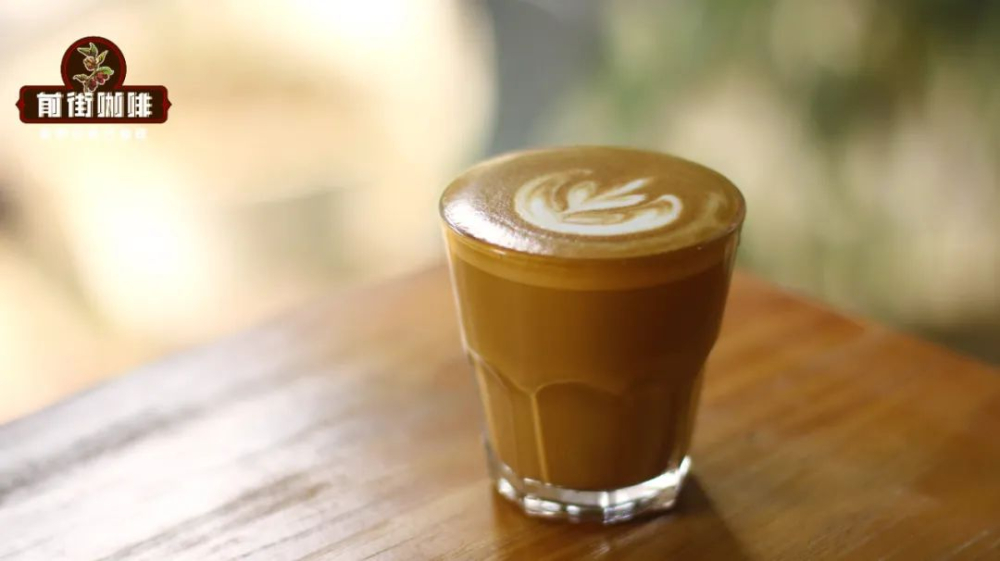
This account isn't entirely unfounded. In Australia, the Piccolo is every bit as popular as the Flat White—it can be found in the top three bestsellers at almost every specialty café. But once you leave Oceania, this delicate milk coffee becomes much harder to come by, replaced by larger drinks like cappuccino, flat white, and latte.
Moreover, the signature characteristics of the Piccolo Latte align perfectly with Australian coffee culture. It has both the intensity and strength of espresso and the subtle milky aroma of a latte; it delivers a quick caffeine fix while retaining the rich crema unique to espresso. Ordering a Piccolo, you can down the entire milky coffee in one go without even pausing what you're doing—perfectly matching Australians' pursuit of coffee that is "fast and refined."
The mini-sized Piccolo Latte is a bit tricky to make
A traditional Piccolo Latte uses a glass of about 3 ounces (90ml), made by combining a single shot of espresso (15–20ml) with 60ml of steamed milk with thin microfoam (less than 0.5cm). Apart from the mini size, the Piccolo Latte isn't structurally very different from a regular latte, but because the serving vessel is half the size, the crafting difficulty is undoubtedly much higher than a latte.
Since it's called a "small latte," the latte art that comes standard with a hot latte is naturally indispensable—but the smaller cup size means more limited space for the barista to create designs. Along with the whole drink shrinking, the barista must also steam just 60ml of milk in the pitcher into silky, dense microfoam and blend it evenly with the coffee, all while maintaining the refined appearance of a regular hot milk coffee. This is why the Piccolo Lattes we see in cafés almost always feature simple patterns like tulips, small leaves, or hearts.
What are the selling points of the Piccolo Latte?
In earlier years, it was nearly impossible to find Piccolo Latte on Chinese-language menus, and some baristas didn't even know what this obscure Australian-style milk coffee was all about.
In recent years, however, as market popularity and scale have grown, baristas have begun learning the stories and characteristics behind different espresso drinks and drawing from one another. Over time, the concept of this mini latte has spread. But in terms of fame, compared to the household names of latte and flat white, the Piccolo Latte remains a "nobody."
These days, though, the market has long moved toward diversification. To give the Piccolo on their menus a more distinctive character and make it stand out from the crowd of milk coffees, some specialty cafés have started swapping traditional blend espresso for SOE, or changing the single espresso to a Ristretto base, and the serving vessels have evolved from clear glass cups to beautifully crafted small cups of various materials.
Beyond à la carte orders, the Piccolo Latte has also successfully entered a more popular coffee category thanks to its compact yet refined positioning: the "Coffee Combo."
- END - Front Street Coffee
No. 10, Bao'an Qian Street, Yandun Road, Dongshankou, Yuexiu District, Guangzhou, Guangdong Province
The above content is compiled by CoffeeHunters, a coffee news website.


