








How Does the WBC Coffee Championship Three-Temperature Method Work
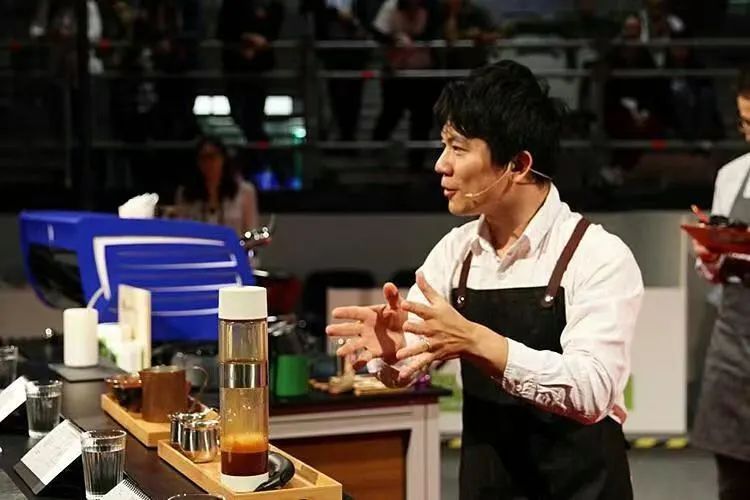
The three-temperature pour-over method was created by Wu Tsering, the 2016 World Barista Championship winner, and it treats water temperature as a tool for staged flavor control. Water is poured at 94°C, then 90°C, then 80°C, so acidity, sweetness, bitterness, and umami are each extracted at the stage where they dissolve most readily. Enthusiasts still use the approach today.
Most brewers treat water temperature as a fixed value, choosing 88°C, 90°C, or 93°C and leaving it there. WBC champion coffee systems instead set two or three temperatures and pour in stages to build an extraction curve. Higher temperatures dissolve flavor compounds faster, while lower temperatures need longer contact time, which is why the final 80°C stage limits bitterness.
Among the many variables in pour-over coffee, water temperature is often regarded as the most conservative one—once a value is chosen, it is no longer changed. However, Wu Tsering, the 2016 WBC champion, turned water temperature into a powerful tool for segmented flavor control. His invented "three-temperature pour-over method" extracts sequentially through three temperature ranges—94°C, 90°C, and 80°C—allowing acidity, sweetness, bitterness, and umami to each find their place. In this article, Front Street will fully replicate this technique, from equipment preparation and segmented pouring rhythm to the final flavor presentation, deconstructing one by one the extraction logic and practical parameters behind variable-temperature brewing, helping you understand why water temperature can become the key lever for adjusting coffee's balance.

In pour-over extraction, setting aside green bean quality, grind size, water temperature, and coffee-to-water ratio are the three most core adjustable variables, and they are also the means most enthusiasts first use when adjusting flavor in daily brewing.
For the sake of reliability, water temperature is usually treated as a "fixed value"—those who prefer lower temperatures use 88°C, those inclined toward higher temperatures take 93°C, or simply choose a compromise of 90°C. In short, as long as it doesn't go wrong, it's fine.
However, in the systems of some competition players, water temperature is precisely the core lever for controlling flavor direction. They set two to three different temperatures and complete pouring in stages, thereby constructing an ideal extraction curve. This type of operation is collectively called "variable-temperature brewing." Among them, the three-temperature pour-over method created by Wu Tsering, the 2016 World Barista Championship winner, is still used by a large number of enthusiasts today, and Front Street also plans to actually replicate it this time.
Front Street has repeatedly mentioned in past content a rule: the higher the water temperature, the faster flavor substances dissolve, and the tastes of acidity, sweetness, and bitterness enter the water at each stage more quickly; conversely, the lower the water temperature, the harder it is for soluble substances to diffuse, requiring longer contact time to obtain sufficient flavor. It should be noted that the water temperature we usually refer to is the reading shown on the thermometer before pouring, that is, the initial temperature in the kettle. During actual brewing, it will gradually decrease in steps with the ambient temperature.
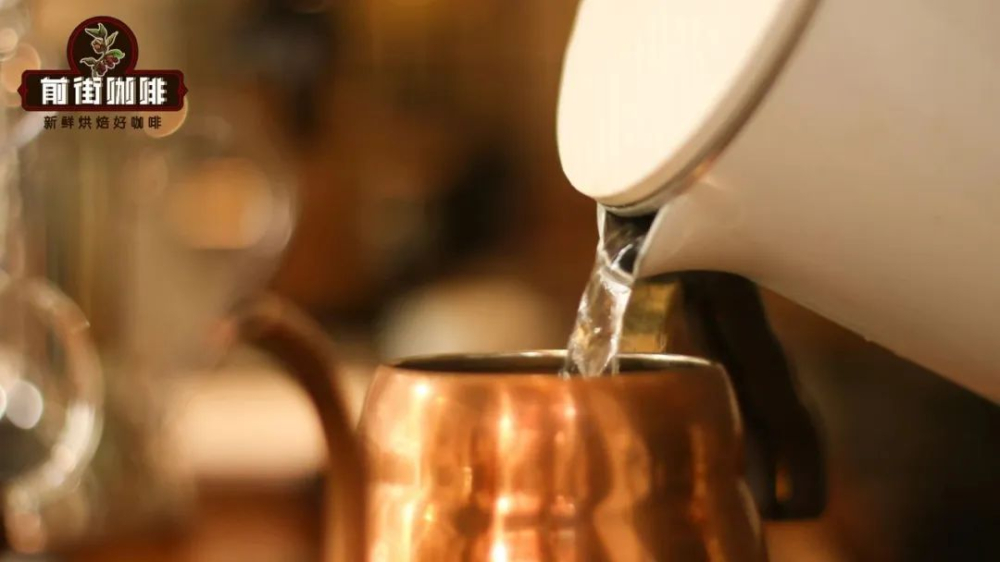
If a relatively high water temperature is used from the start, the coffee bed will continuously release acidic and sweet substances in the high-temperature range, and the coffee's layers and complexity will increase accordingly. But at the same time, some bitter components that bring body will also emerge early. Therefore, if you want to obtain a balanced experience of acidity, sweetness, bitterness, and umami in the final cup, you need to lower the water temperature in the tail stage, thereby inhibiting further precipitation of bitter substances, that is, avoiding over-extraction.
As the saying goes, to do a good job, one must first sharpen one's tools. To practice variable-temperature brewing, the first step is to prepare containers that can provide different temperatures. Wu Tsering's three-temperature pour-over method involves three temperature points: 94°C, 90°C, and 80°C.
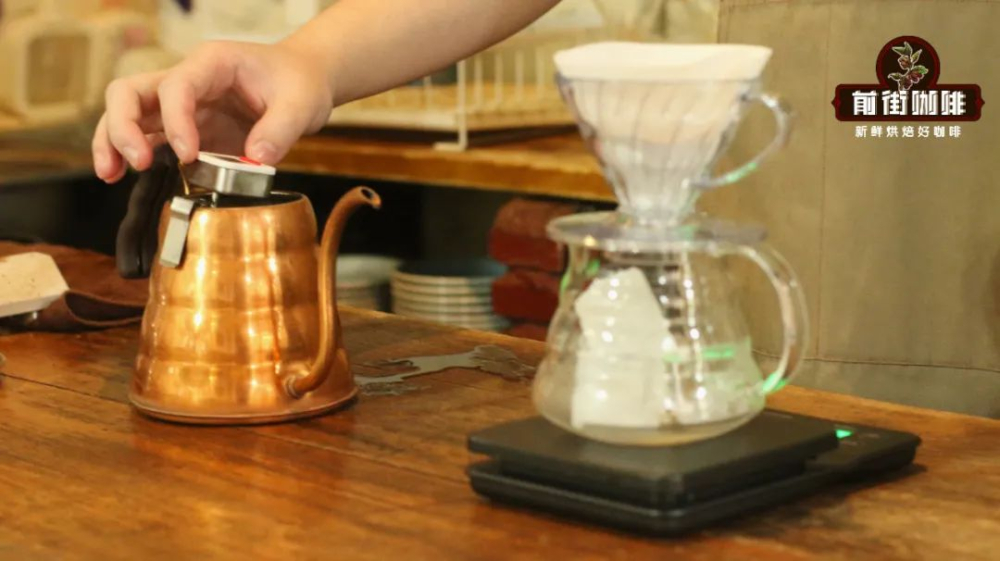
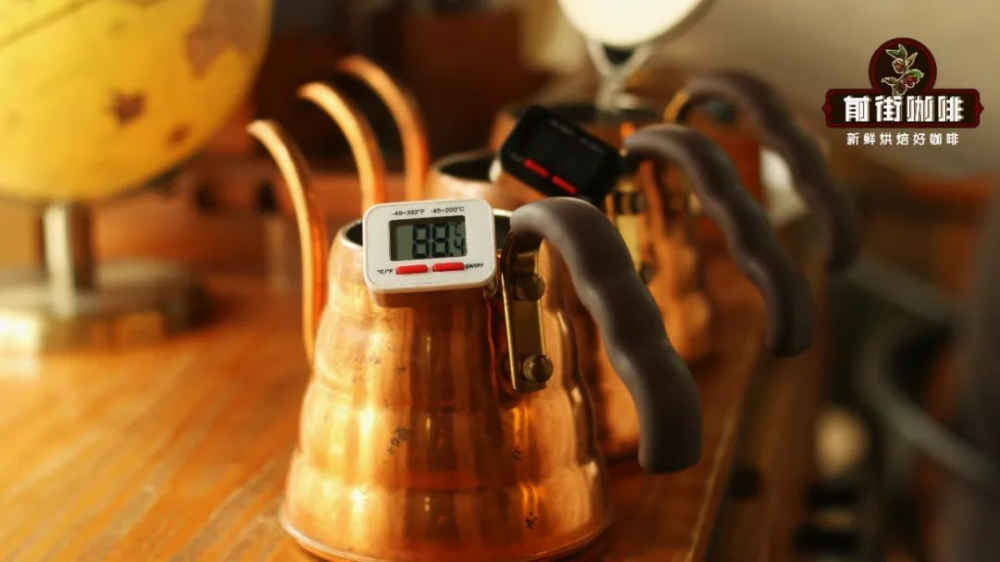
Front Street chose to use two pour-over kettles plus one room-temperature water kettle to achieve this. First, pour boiled water into two pour-over kettles respectively. Leave one kettle uncovered to cool to 94°C for the first stage blooming and the second stage pouring. Cover the other kettle, insert a thermometer, and let it cool naturally until it is almost exactly down to 90°C by the time of the third stage pouring. Then add a small amount of room-temperature water (about 15–50 ml) to the first kettle, bringing the temperature down to 80–85°C, and immediately perform the final stage pouring.
This time Front Street selected a honey-processed Geisha from the New Oriente region of Guatemala, medium-light roast, with flavor leaning toward sweet aromas such as toffee, sweet orange, and cocoa biscuit. For grinding, the store's daily output fine granulated sugar coarseness was used, that is, 80% passing through a No. 20 sieve (EK43s grinder setting 10). For the filter device, the Hero variable-speed cake flat-bottom dripper that Front Street acquired not long ago was used, in order to achieve temporary immersion in the tail stage.
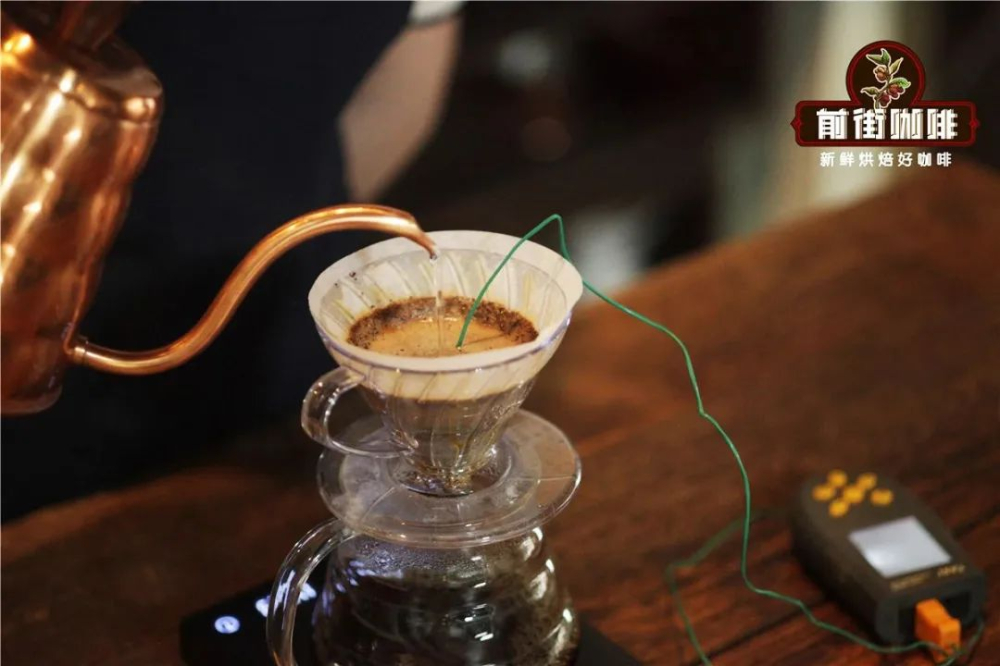
First stage blooming: pour 40 grams of 94°C hot water in a circular motion, with a blooming time of 30 seconds. Before pouring, confirm that the cake dripper is in the drip mode with a steady flow rate.
After blooming is complete, continue using the same kettle of high-temperature water, pouring the second stage of 80 grams with a large stream and slow circular motion, raising the coffee bed to about two-thirds of the dripper's height.
When the coffee liquid in the dripper is about to finish dripping, pick up the other kettle of prepared 90°C hot water and begin the third stage pouring, also pouring 80 grams with a large stream and slow circular motion. After pouring, the liquid level just returns to the height of the coffee bed formed in the second stage.
While extraction is still ongoing in the dripper, add a small amount of room-temperature water to the high-temperature kettle, bringing the thermometer reading down to 80°C, in preparation for pouring the final stage.
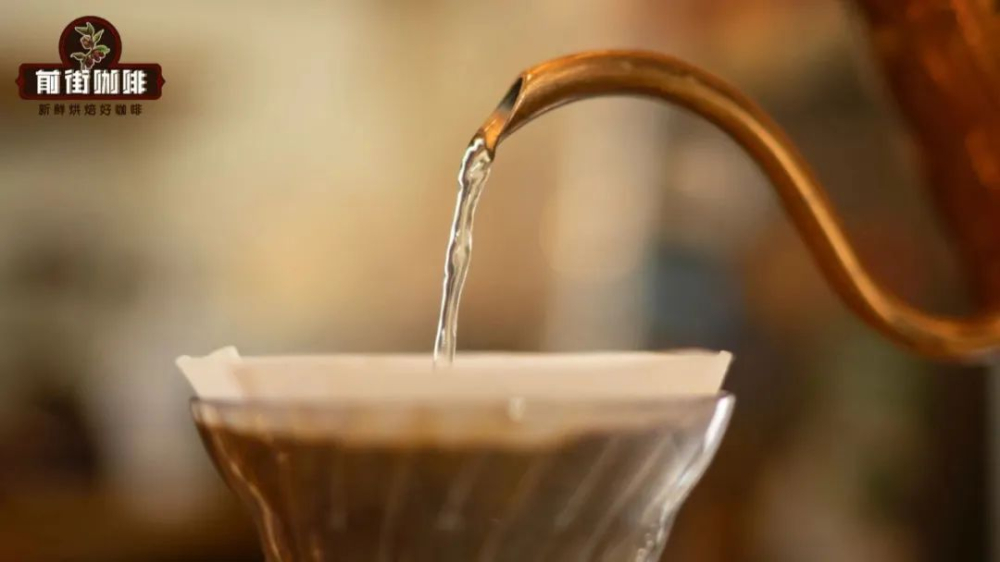
After all the coffee liquid has flowed into the server, switch the dripper knob to immersion mode, pour the remaining 40 grams of water onto the coffee bed, immerse for 20 seconds, then open the valve and let all the coffee liquid flow into the server. The total drip completion time is about 2 minutes 18 seconds.
In the end, from this pot of New Oriente Geisha brewed with the three-temperature method, Front Street experienced a very prominent sweet aftertaste. On entry, there was first a solid and rising citrus acidity, followed by a hint of chocolate aroma and the sweetness of dried cranberries, accompanied by a mouth-watering sensation. It is a cup of coffee that is very comfortable to finish.
Front Street Coffee (FrontStreet Coffee)
No. 10, Bao'an Front Street, Yandun Road, Dongshankou, Yuexiu District, Guangzhou, Guangdong Province
The above content is compiled by CoffeeHunters, a coffee news website.


