







Why is Blue Mountain coffee so expensive and how is it graded?
Jamaica Blue Mountain coffee commands high prices because the Blue Mountains sit 1,000 to 1,700 meters above sea level with volcanic soil and year-round rain and fog, conditions that slow cherry ripening. Only coffee grown in the defined region and meeting legal standards may carry the Blue Mountain name, and grading sorts lots by bean size and defect count.
Coffee came to Jamaica in 1728, when Governor Sir Nicholas Lawes received a sapling from the governor of Martinique and planting began in St. Andrew. Cultivation spread to the Blue Mountains, and by 1800 the island had 686 plantations. After slavery was abolished in 1838, labor shortages and lost trade preferences cut that to 180 by the 19th century, prompting a government decree in 1891.
Jamaica Blue Mountain coffee is renowned as one of the most expensive coffees in the world, its unique flavor stemming from the high altitude, volcanic soil, and year-round rainy and foggy climate of the Blue Mountains. This article traces the history of Jamaican coffee from its introduction in 1728 to the present, explains the legal definition and grading standards of Blue Mountain coffee, and focuses on the Clifton Mount Estate Blue Mountain No. 1 coffee beans selected by Front Street Coffee, including their producing region, variety, processing method, and brewing flavor performance.
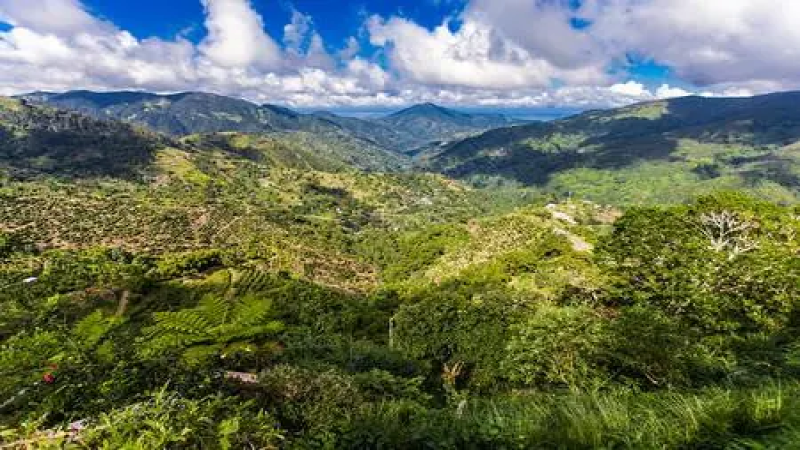
Jamaica is located in the Caribbean Sea and is the third-largest island in that sea. The island nation has diverse terrain: coastal plains, hills and limestone plateaus in the central and western regions, and mountains extending in the east, where the famous Blue Mountains are situated. Jamaica has a tropical rainforest climate, with rainy seasons from May to June and September to November each year, and an average annual temperature of about 27°C. The Blue Mountains range from 1,000 to 1,700 meters in altitude, covered with volcanic soil, and are rainy and foggy year-round. It is precisely these exceptional natural conditions that have earned coffee produced in the Blue Mountain region worldwide acclaim and made it one of the most expensive coffee categories.
The history of coffee cultivation in Jamaica can be traced back to 1728. During the British colonial period, Governor Sir Nicholas Lawes received a coffee sapling from the governor of Martinique (then a French territory), marking the beginning of coffee cultivation on the island. Coffee was first planted in the St. Andrew district in southeastern Jamaica, but production was quite limited. Entering the late 18th century, cultivation gradually expanded from St. Andrew to the Blue Mountain area. By 1800, the island had 686 coffee plantations.
However, after the actual abolition of slavery in 1838, plantations faced a severe labor shortage. Combined with poor management and the cancellation of Britain's preferential trade policies for the colonies, the coffee industry gradually declined, leaving only 180 plantations by the 19th century. Coffee quality at the time was also unsatisfactory, so the government enacted a decree in 1891 to teach producers cultivation knowledge and improve infrastructure in order to enhance quality. In 1944, the Central Coffee Clearing House was established, requiring all exported coffee to be certified by that institution. In 1950, the Jamaica Coffee Industry Board was created, and in 2018 it merged with other commercial institutions to form the Jamaica Agricultural Commodities Regulatory Authority, or JACRA. When the authority was established, it simultaneously enacted the Coffee Industry Supervision Act, which clearly defined the "Blue Mountain Coffee Growing Region," and since then every barrel of Blue Mountain coffee beans has been subject to JACRA's quality supervision.
Legal Definition of Blue Mountain Coffee
According to the Coffee Industry Supervision Act, the cultivation area for Blue Mountain coffee is limited to four districts: St. Andrew, St. Thomas, Portland, and St. Mary. Only Typica variety coffee grown in this area at altitudes between 915 and 1,700 meters qualifies to be named Jamaica Blue Mountain. Typica was introduced to the Blue Mountains for cultivation in the 18th century and is one of the oldest coffee varieties in the world, but because of its weak plant constitution and poor disease resistance, it is no longer widely planted. However, the local Typica in the Blue Mountains adapts well to the climate and soil and has evolved strong disease resistance, which is inseparable from Jamaica's years of commitment to and careful cultivation of the Typica variety.
In addition, Blue Mountain coffee is the only coffee in the world exported in wooden barrels. Only Jamaica Blue Mountain (No. 1, No. 2, No. 3, PB) and Jamaica High Mountain (High Mountain Supreme, High Mountain PB) qualify to use wooden barrels, in specifications of 70 kg, 30 kg, and 15 kg. Among them, the highest grade, Blue Mountain No. 1, must meet a screen size of 17 or above, with defect beans not exceeding 2%, and moisture content controlled at around 10% to 12.5%. Other grades of Jamaican coffee are all exported in 60 kg burlap sacks.
FrontStreet Coffee Clifton Mount Estate Blue Mountain No. 1 Coffee Beans
Producing Region: Blue Mountain Region
Estate: Clifton Mount Estate
Altitude: 1,310 meters
Variety: Blue Mountain Typica
Processing Method: Washed
Flavor: Mild citrus acidity, nutty and chocolate notes, silky mouthfeel, overall balance
Front Street selected Blue Mountain No. 1 coffee produced by Clifton Farm. Clifton Mount is the oldest coffee estate in Jamaica still in normal operation; as early as the mid-18th century, the farm had already begun cultivating and producing coffee. The selected Blue Mountain coffee undergoes washed processing, which gives Blue Mountain No. 1 a clearer flavor and higher cleanliness while maintaining consistent quality. Front Street presents Blue Mountain No. 1 with a medium-dark roast, preserving both its richness and its gentle fruit acidity. For brewing, Front Street uses a KONO dripper and extracts at a 1:15 ratio, allowing a faint floral aroma to be detected, with mild citrus acidity on the palate accompanied by nutty and cocoa notes, a silky mouthfeel, and overall balance.
The above content is compiled by CoffeeHunters, a coffee news website.


