








What does bright acidity meaning have to do with the 4:6 method?
Tetsu Kasuya's 4:6 method splits one brew into five pours of 60 milliliters each, using 20 grams of coarse coffee and 92°C water. The first two pours make up 40 percent of the water and set the sour-sweet direction; the last three make up 60 percent and build body. That is how the method controls the balance behind bright acidity meaning in a cup.
The formula needs no advanced pouring skill, which is why beginners can still get a good result. Kasuya designed it so anyone could brew well, and its high fault tolerance comes from dividing water by function rather than technique. Understanding that logic, rather than copying numbers alone, is what lets a brewer adjust the bright coffee meaning of the final cup.
Some works shine so brightly that they overshadow their creators—like the Mona Lisa for Da Vinci, or the 4:6 method for Tetsu Kasuya. The core goal of this method, invented by the 2016 World Pour-Over Champion, is simple: to let anyone brew a delicious cup of coffee. It breaks a single brew into five pours, each using three times the water of the coffee dose. The first two pours make up 40% of the total water and determine the sour-sweet direction, while the last three pours make up 60% and shape the full-bodied mouthfeel. This article will fully break down the segmentation logic of the 4:6 method and the origin of the 45-second pouring interval, then use Front Street Coffee's Ethiopian Santa Vini beans for a real test to verify why this formula has such a high fault tolerance, and how to break free from the formula and grasp its extraction philosophy.

There are many times when a work's fame far exceeds that of its creator—like the Mona Lisa and Da Vinci, or the 4:6 brewing method and Tetsu Kasuya. So whenever we talk about Tetsu Kasuya, we almost always start by saying: he is the creator of the 4:6 method. And today, what we are about to unfold is exactly the 4:6 brewing method designed by this 2016 World Pour-Over Champion.
The 4:6 Brewing Method
As mentioned at the beginning, the 4:6 method comes from Tetsu Kasuya. The reason this method spread so quickly after he shared it is that both its extraction idea and operating steps are straightforward and easy to understand. It not only sparked a lot of offline discussion, but even many competition baristas brought it onto the stage. When designing brewing methods, Tetsu Kasuya always centered on one belief—letting everyone brew a delicious cup of coffee—and the 4:6 method is naturally no exception. Since it emphasizes "everyone," does that mean that as long as you copy the formula parameters, even a complete beginner can get a tasty cup? In practice, that is indeed the case.
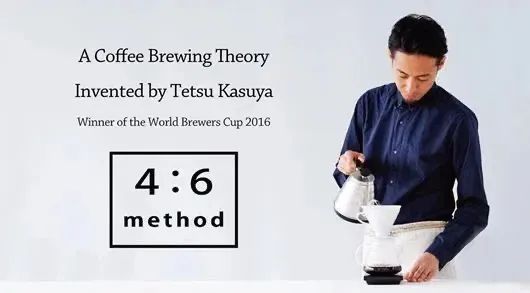
Take 20 grams of coffee beans, grind coarse, use 92°C water, and split the entire brew into five pours, each pouring 60 milliliters. You do not need fancy techniques, you do not need a stable water-control skill, and you do not even need deep knowledge of these beans. As long as you plug in the formula, you can get a good cup of coffee.
Why does the 4:6 brewing method require pouring hot water in five stages?
Everyone knows that the 4:6 brewing method requires pouring 60 milliliters of hot water five times. This sounds a bit like the jokes "the Four Heavenly Kings have five members" or "the moon on the fifteenth is round on the sixteenth," so calling the 4:6 method "5:6 brewing" also seems to make sense. But in fact, the 4:6 brewing method does not mean pouring four stages of 60 milliliters of water.
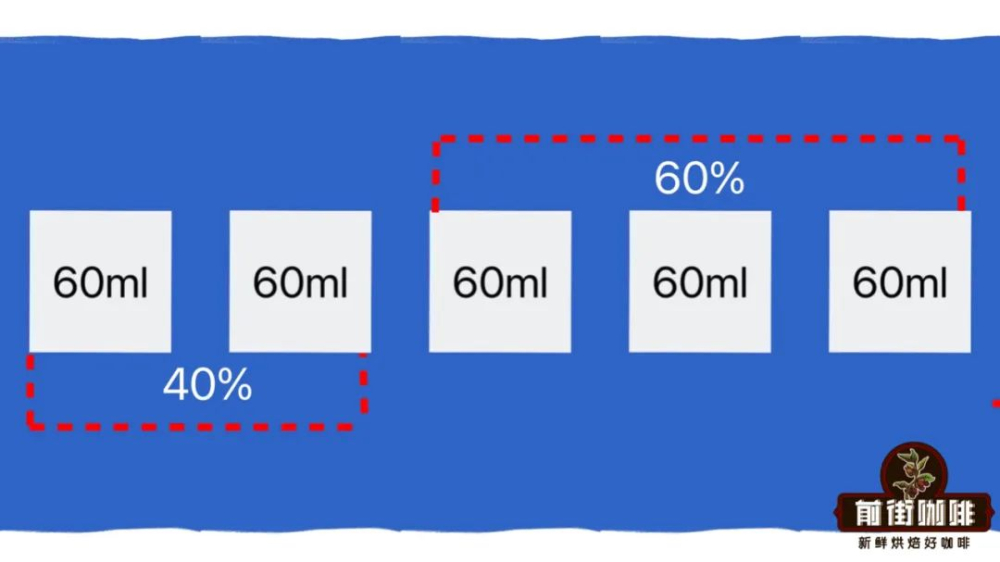
Tetsu Kasuya's explanation of the 4:6 brewing method is this: divide a single brew evenly into five pours, with each pour being three times the coffee dose; the first and second pours together make up 40% of the total water, and they influence the flavor direction of the coffee, that is, the balance between acidity and sweetness. The third, fourth, and fifth pours together make up 60% of the total water, and they determine the coffee's mouthfeel strength, that is, its body.
In other words, the name "4:6 brewing method" combines the total water of the first and second pours with the total water of the third, fourth, and fifth pours. Because these two parts are meant to present different things, Tetsu Kasuya named this brewing style the "4:6 brewing method."
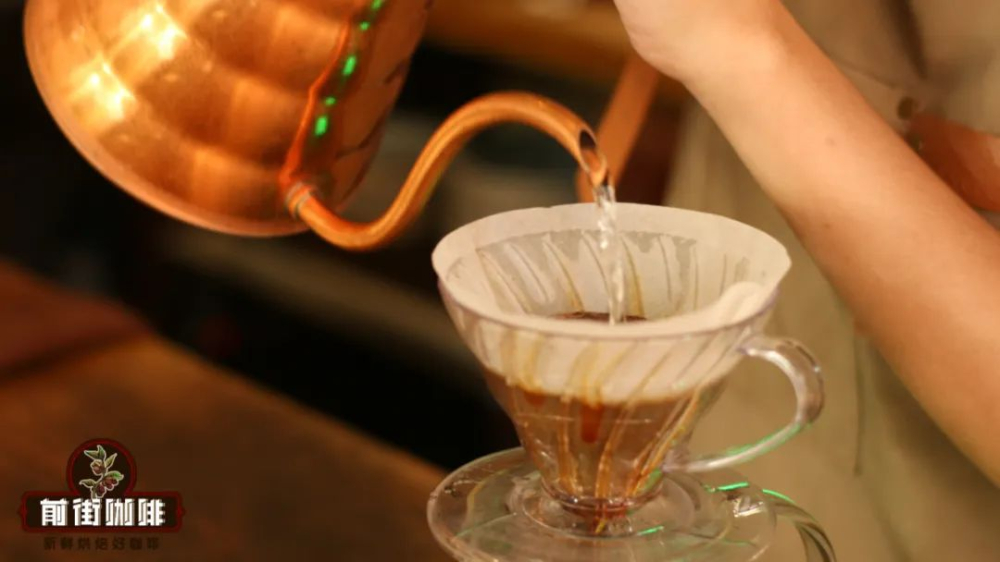
Next, Front Street Coffee will use the 4:6 brewing method to make a pour-over and see what kind of coffee it produces.
Brewing Experiment
Bean used: Ethiopia Santa Vini, with flavors of pineapple, citrus, and guava
Bean dose used: 20 grams
Grind level: extremely coarse, 50% passing through a No. 20 sieve
Coffee-to-water ratio: 1:15, meaning 300 milliliters of hot water
Brewing water temperature: 92°C
Brewing method: 4:6 brewing method
Dripper used: V60
As mentioned earlier, pouring is divided into five stages in total, each with 60 milliliters. Between every two pours there is an interval of 45 seconds. This interval includes the pouring time, and each pour takes about 6 to 8 seconds. In other words, from when you start pouring to the next pour, there is a total interval of 45 seconds. The starting times of each pour are: 0 seconds, 45 seconds, 1 minute 30 seconds, 2 minutes 15 seconds, and 3 minutes.
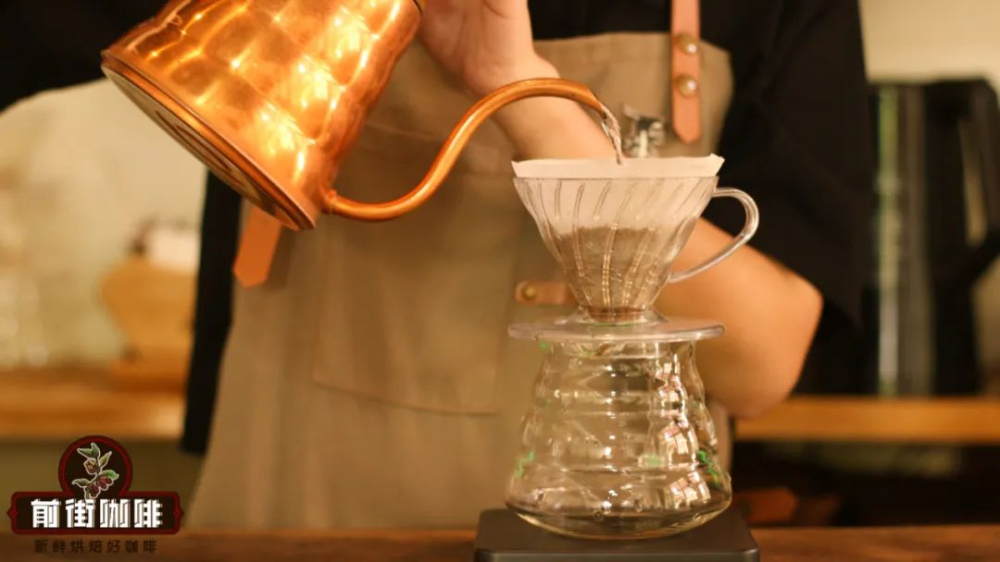
Dripping is completed in about 3 minutes 40 seconds. In taste, it is fuller-bodied than Santa Vini brewed with a conventional method, and flavors such as pineapple and citrus are expressed very well. In addition, there is a fairly noticeable tea-like note, and the overall style leans balanced.
The reason copying the formula can produce such a taste is that the extremely coarse grind particles increase the margin for error. Many people easily over-extract because they grind too fine, so Tetsu Kasuya thought of making the grind coarser and combining it with a longer extraction time. This way, the highest fault tolerance can be exchanged for a good cup of coffee.
As for why each pour should be spaced 45 seconds apart, it is because under this grind level and coffee dose, 60 milliliters of hot water happens to need 40 to 45 seconds to finish dripping. Waiting until the water has drained before pouring the next stage naturally makes the result quite stable, provided the parameters are correct.
In addition, the 4:6 method is not limited to this one extraction formula. You can absolutely follow its extraction philosophy and freely divide the pouring method and water amounts. Do not be trapped by the formula on the surface; the extraction philosophy behind a brewing method is what deserves the most attention.
Front Street Coffee (FrontStreet Coffee)
No. 10 Baoqian Street, Yandun Road, Dongshankou, Yuexiu District, Guangzhou, Guangdong Province
The above content is compiled by CoffeeHunters, a coffee news website.


