







What Does Costa Coffee History Tell Us About Its China Retreat?
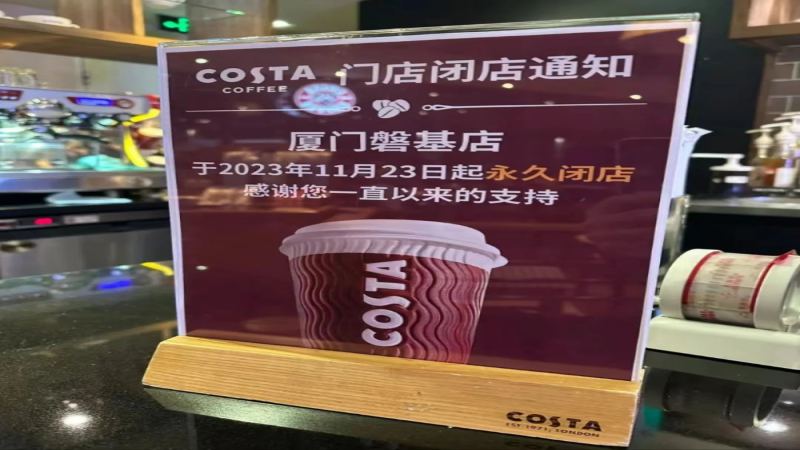
Costa closed a store in Xiamen permanently on November 23, 2023, leaving few outlets in the city and renewing concern about the brand's condition. The British chain opened its first Chinese store in Shanghai in 2006 and once positioned itself directly against Starbucks. Coca-Cola acquired the brand in 2018. Today its store count in China is less than one-tenth that of Starbucks, and closures have become a familiar pattern.
The last round of widespread closures came in 2020, when Costa shut stores in Beijing, Hangzhou, Qingdao and Nanjing, including all Qingdao locations; nearly 20 Beijing outlets closed, more than 10 percent of its China total. The company attributed it to foot traffic changes and business optimization. Costa coffee history in China now reads as a steady retreat rather than expansion.
COSTA, which once opened stores close to Starbucks and made a high-profile entry into the Chinese market, is now becoming less and less visible in many cities. After a store in Xiamen permanently closed on November 23, 2023, few COSTA stores remained in the local area, sparking concerns among netizens about its business condition. Looking back at COSTA's development history in China, from its first store in Shanghai in 2006 to its acquisition by Coca-Cola in 2018, and now to having fewer than one-tenth the number of stores as Starbucks, at which step did this veteran British coffee chain brand slow down? This article reviews COSTA's ups and downs and strategic adjustments in the Chinese market, and retains the related recommendation information for the Front Street brand.
▲
Click to follow | Daily specialty coffee culture magazine Coffee Works
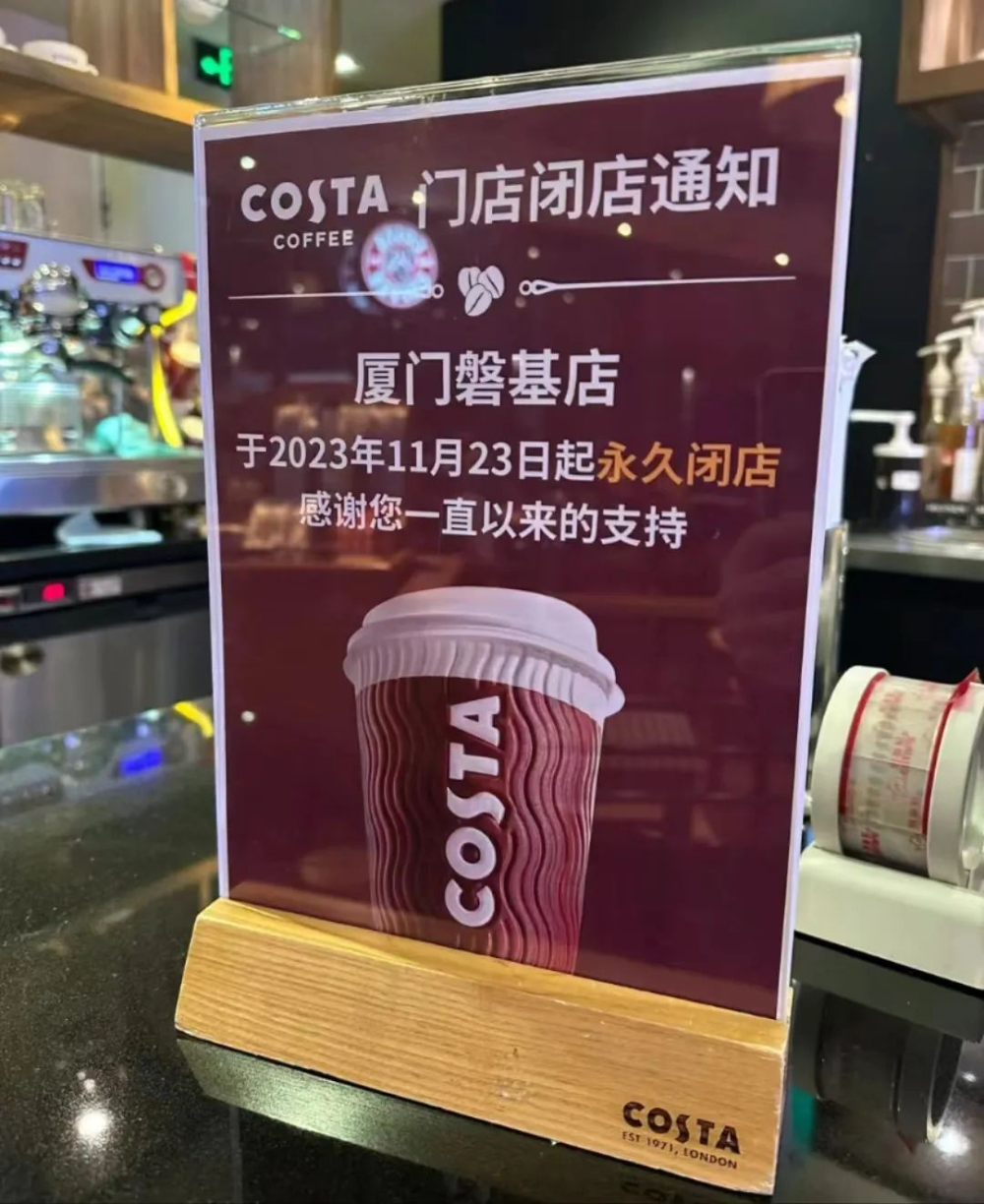
Recently, some netizens noticed that a COSTA in Xiamen had posted a store closure notice, permanently closing from November 23, 2023.
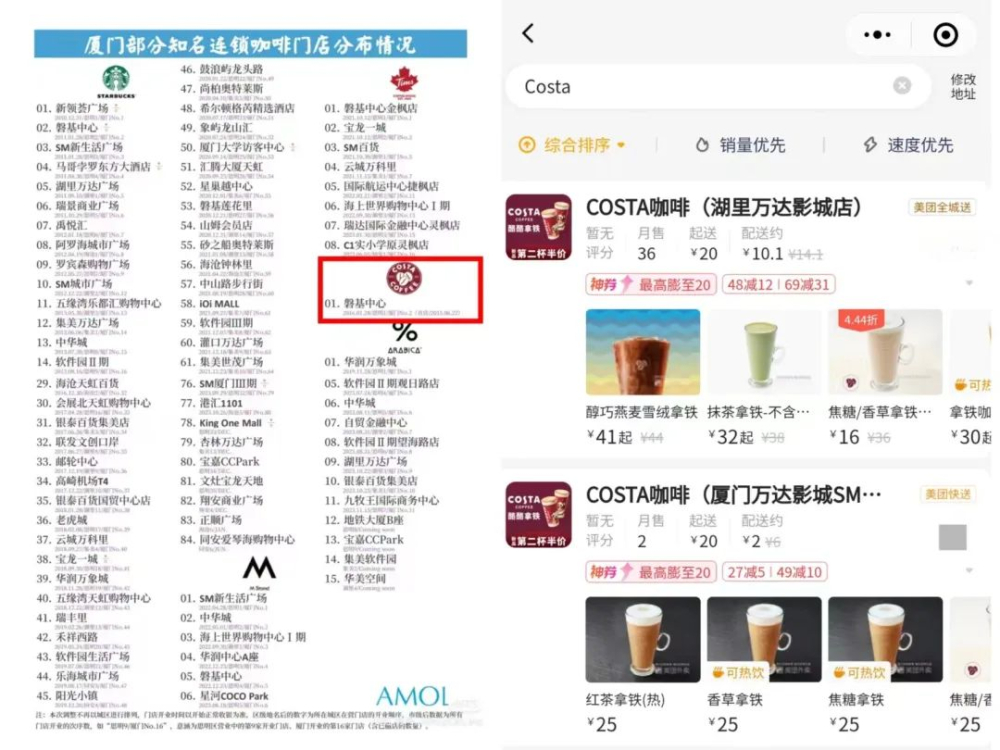
Some netizens voluntarily compiled the distribution of some well-known chain coffee stores in Xiamen, among which only the COSTA store closing on the 23rd of this month remained. On delivery apps, only 2 COSTA coffee stores can be found in Xiamen. Whether one or two remain, compared with other coffee brands, COSTA, with extremely few stores, inevitably makes people worried.
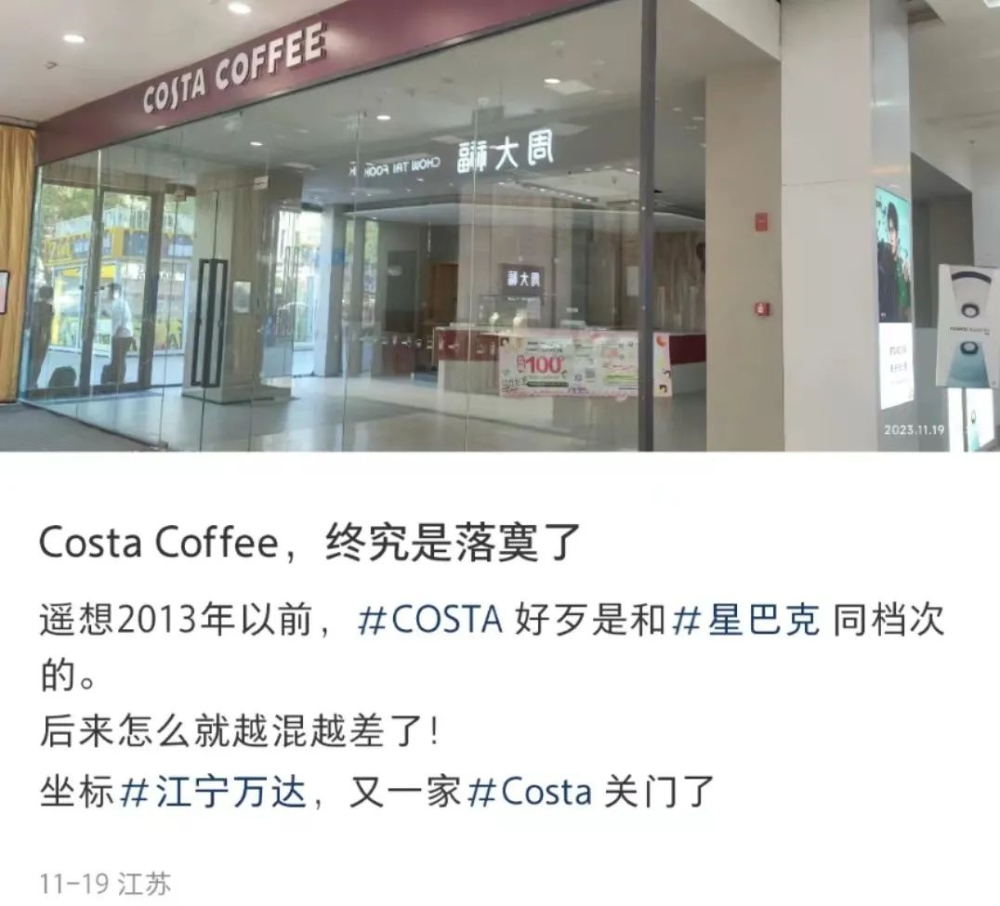
In fact, this is not only the case in Xiamen. Netizens in various places have gradually realized that COSTA stores in their cities seem to be increasingly rare, and that touch of red has been silently replaced by green and blue. Some netizens were very puzzled: "Thinking back to before 2013, COSTA was at least on the same level as Starbucks. How did it get worse and worse later?"
The last time COSTA was associated with the word "store closure" was in 2020. According to relevant media reports, COSTA closed multiple stores in Beijing, Hangzhou, Qingdao, Nanjing, and other places that year. Among them, all stores in the Qingdao area were closed, and nearly 20 stores were closed in the Beijing area, with the number of closed stores exceeding 10% of its total number of stores in the Chinese market. At that time, COSTA responded that, "affected by changes in store foot traffic and economic operations," closing stores was only "part of business optimization and adjustment," and also expressed full confidence in the Chinese market and said it would not slow down the pace of continuing to open stores in China.
However, as more and more stores closed, consumers' confidence in COSTA was clearly insufficient. No one expected that COSTA, which had once been paired with Starbucks as a "CP," would "fall" to such an extent. In 2006, COSTA, already among the leading coffee brands in the UK, entered the Chinese market and opened its first COSTA store on Nanjing East Road Pedestrian Street in Shanghai. Since then, COSTA and Starbucks Coffee, which had entered the Chinese market 8 years earlier, began a "love-hate rivalry." Interestingly, just like Luckin & Cotti today, COSTA at the time adopted a tactic of "close-quarters combat" with Starbucks, sparing no expense to open stores next to Starbucks. Near core business districts in city centers, this pair of green and red coffee shops always appeared together, which brought one biggest advantage—with the help of Starbucks' fame, Chinese consumers quickly remembered COSTA without needing extra promotion.
It has been only about twenty years since coffee entered the Chinese market, and now this track seems more crowded than ever. So at which step did COSTA fail to keep up with the main group? In netizens' words, how exactly did COSTA "get worse and worse"? Unlike other coffee brands that expand and move into lower-tier markets rapidly and hurriedly, COSTA is more like a very laid-back elderly European aristocrat, more favored by mid-to-high-end white-collar workers, and therefore its market audience is relatively narrow. Many consumers' evaluation of it is: it doesn't know how to market itself!
In recent years, as competition in the coffee market has intensified, even its "rival" Starbucks "could not sit still" and accelerated its digital transformation. It not only launched delivery services such as "Fei Kuai" and "Zhuan Xing Song," connected multiple platforms such as Alipay, Taobao, and Koubei, but also actively expanded secondary-line brands such as Starbucks Reserve. In contrast, COSTA seems to have been one beat slower in many aspects, including new product development, digital marketing, and delivery services, and can only watch as its originally loyal consumers slide toward Starbucks and other coffee brands. Since being acquired by Coca-Cola in 2018, COSTA's business focus seems to have changed. While exploring retail scenarios, it has also slowed down the pace of opening stores. COSTA executives once explained to the media: "In order to retain as much brand influence as possible while reducing losses, we will pay more attention to the profitability of individual stores, concentrate as many resources as possible on stores in core business districts of first- and second-tier cities, and strategically slow down the plan for brand penetration into lower-tier markets."
What is very lamentable is that when it first entered the Chinese market, COSTA had set an ambitious goal: to open 2,500 stores by 2018 and capture one-third of China's market share. This veteran British coffee chain that once tried to rival Starbucks now has fewer than one-tenth the number of stores in China as Starbucks. Can COSTA return to its peak in the future through its layout in ready-to-drink coffee? Let's wait and see!
Image source: Internet
Disclaimer: Some images in this article are from the Internet, and for some content on the website such as images, we will respect the original author's copyright and indicate the source. However, due to the large quantity, there will be individual images and texts for which the source has not yet been indicated in time. Please understand. If the original author has any dispute, they may contact the website for handling. Once verified, we will correct it immediately. Compiled and edited by "Coffee Works." Please indicate the source when reposting. If there is infringement, please inform us for deletion. Thank you~!
The above content is compiled by CoffeeHunters, a coffee news website.


