







What Do the Hacienda La Esmeralda Geisha Coffee Labels Mean?
Panama's Hacienda La Esmeralda is where geisha coffee reached the world, and its Blue, Green, and Red Labels plus auction lots confuse many buyers. The estate now spans four farms: Cañas Verdes, El Velo, Jaramillo, and Palmira. Grading rests on single-plot or blended harvests from 22 small plots across three producing farms, since Palmira does not yet yield coffee.
Jaramillo alone is divided into five plots, including Mario, Noria, Reina, Bosque, and Buenos Aire. The area sees about 4000 ml of annual rainfall, daytime averages of 19-25°C, nighttime averages of 11-15°C, and an average altitude of 1600-1700 m. Newly planted geisha coffee beans need three to eight years to grow, flower, fruit, and settle into flavor.
Panama's Hacienda La Esmeralda is the starting point for Geisha coffee's journey to the world, and it is also the most representative brand in the Geisha flavor experience. When faced with Blue Label, Green Label, Red Label, and auction lots, many coffee lovers inevitably feel confused: what exactly do these labels represent? What is their relationship to the different farms and plots within the estate? Front Street Coffee will guide you through Hacienda La Esmeralda's farm distribution, plot divisions, and grading evolution, clarifying the differences between Blue Label, Green Label, Red Label, and auction lots, and helping you make clearer judgments when purchasing Geisha.
Panama's Hacienda La Esmeralda is precisely the discoverer of Geisha coffee. If this variety had not been separated out at the time, perhaps there would not have been the global Geisha boom that has swept the world for more than twenty years since. As an iconic brand in the Geisha flavor experience, what information do Hacienda La Esmeralda's plots, grades, auctions, and lots each convey? Today, Front Street Coffee will talk with everyone about this internationally renowned Panamanian estate.
Hacienda La Esmeralda was originally just a single estate. As its fame continued to rise, demand for production also grew, so the estate successively acquired land from other nearby coffee farmers to expand its scale of production. As it has developed to the present, Hacienda La Esmeralda actually consists of four farms (which can also be translated as estates): Cañas Verdes, El Velo, Jaramillo, and Palmira. At the same time, the small plots within these farms have each been named one by one, and Hacienda La Esmeralda's grading basis is precisely built on the single-plot harvest or blended harvest of 22 small plots across three major farms. Why three major farms?
Palmira Oasis is a newly added farm. It currently does not yet produce coffee, nor does it have plot information. After coffee trees are planted at a selected site, they still need 3 to 8 years to complete the process of growth, flowering and fruiting, and flavor determination.
This area has annual rainfall of about 4000ml, average daytime temperatures of 19-25°C, average nighttime temperatures of 11-15°C, and an average altitude of 1600-1700m. The Jaramillo plot is subdivided into 5 small plots: Mario, Noria, Reina, Bosque, and Buenos Aires.
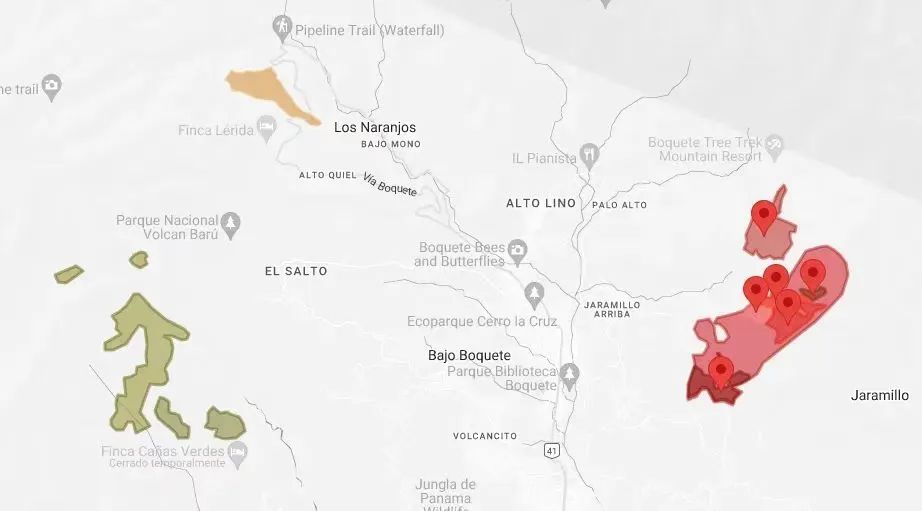
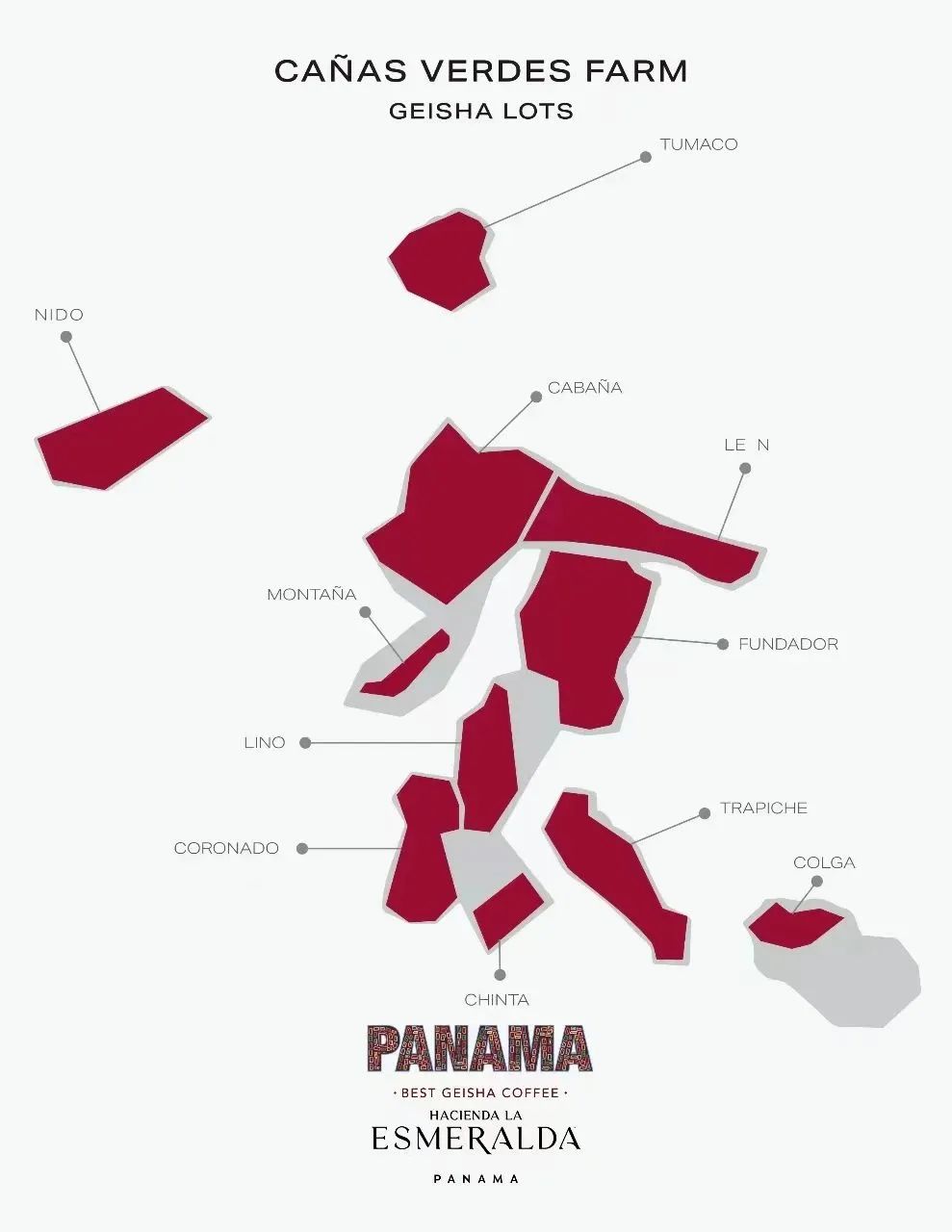
This area has annual rainfall of about 3500ml, average daytime temperatures of 16-23°C, average nighttime temperatures of 10-15°C, and an average altitude of 1600-1800m. Cañas Verdes includes a total of 9 small plots: Lino, Coronado, Fundador, León, Montaña, Trapiche, Chinta, Cabaña, and Tumaco.
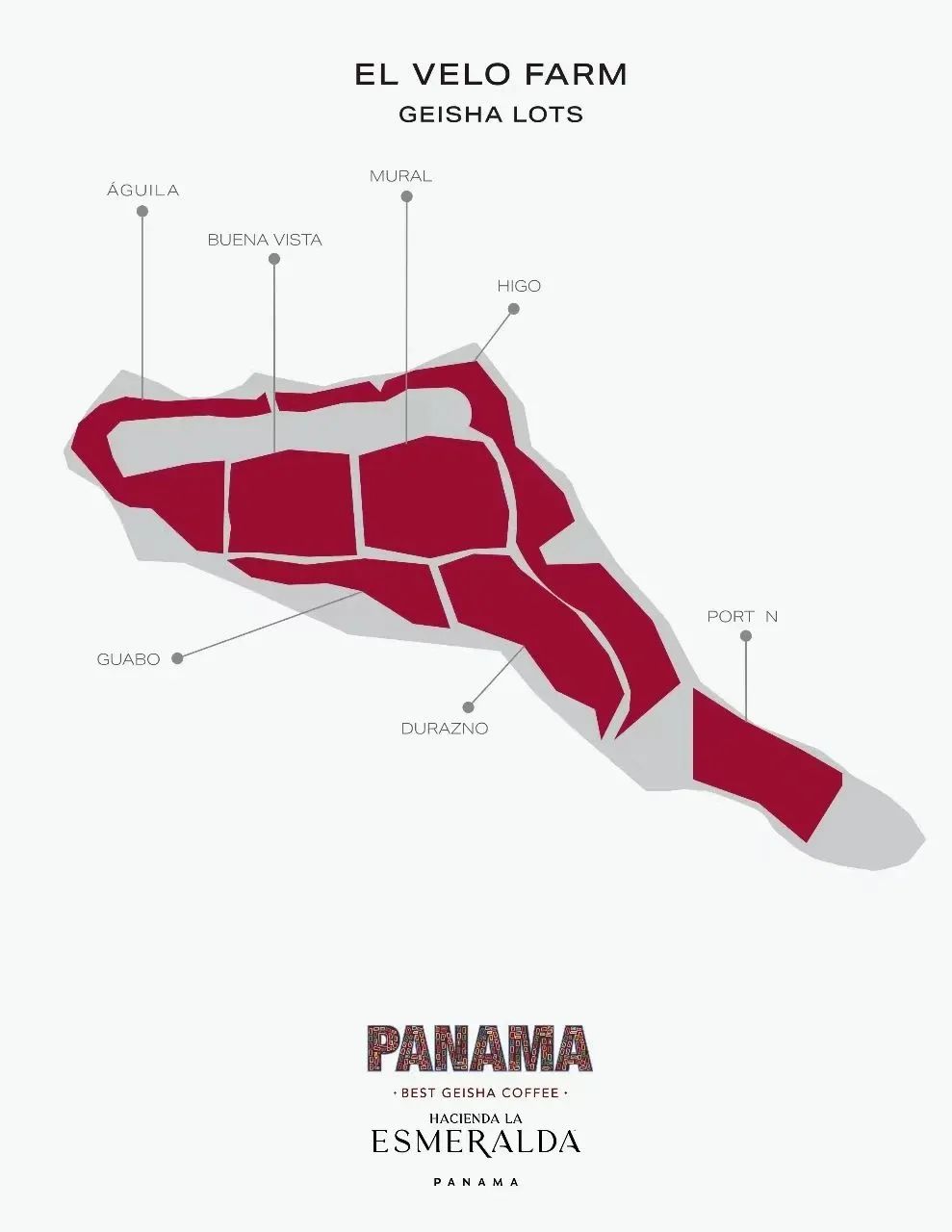
Compare with the satellite map:
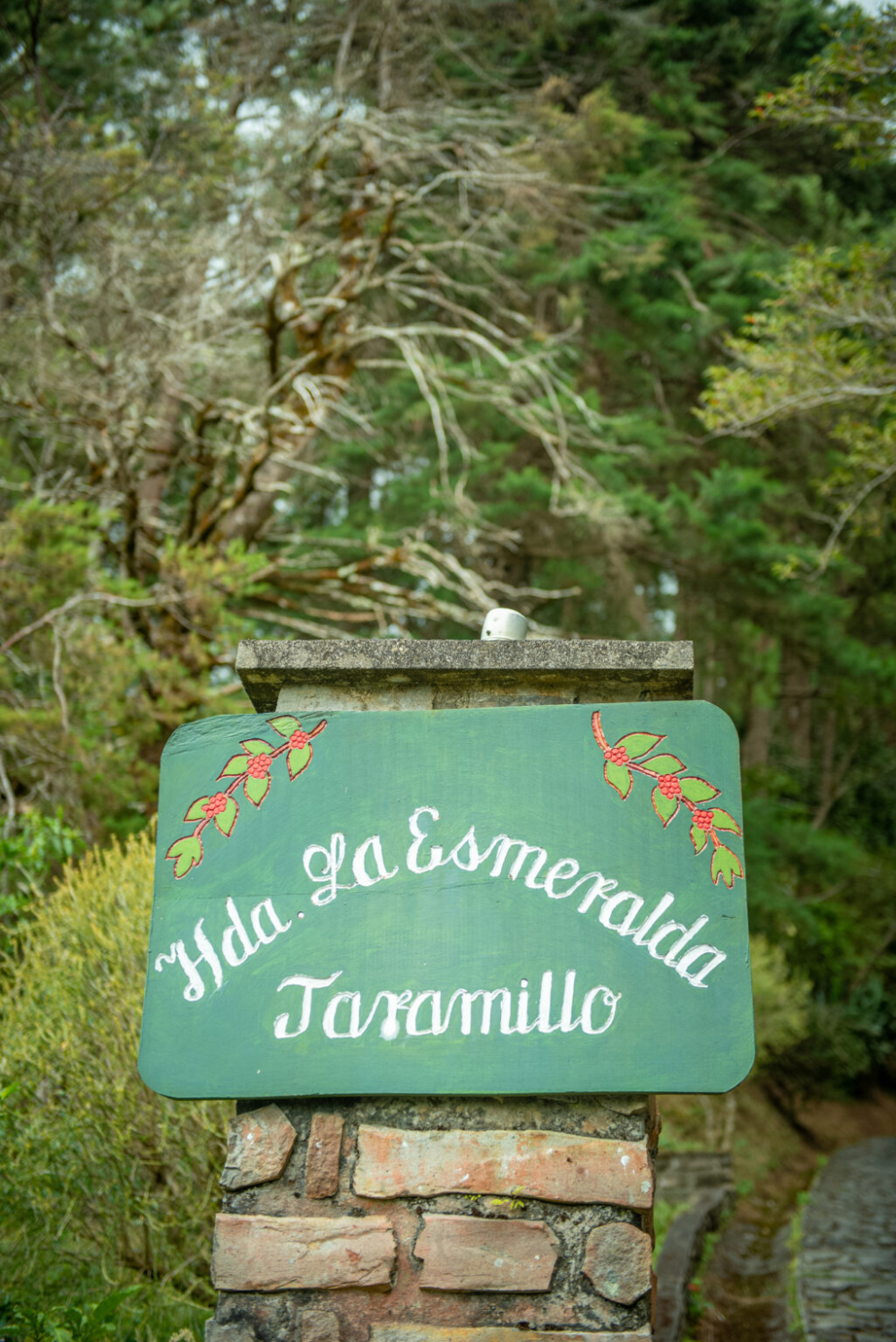
In 2020, the Geisha coffee beans produced by Panama's Hacienda La Esmeralda were still divided into three grades: Blue Label, Green Label, and Red Label.
According to Hacienda La Esmeralda's definition at the time, Blue Label was harvested from areas below 1500 meters; Red Label was harvested from a single plot above 1500 meters; Green Label was a blend harvested from plots above 1500 meters; and auction lots were part of Red Label. Afterward, Hacienda La Esmeralda discontinued Blue Label. During this period, Red Label was the highest-priced grade. Red Label Geisha was picked from above 1600 meters and could be traced to a specific plot. Green Label's picking altitude was the same as Red Label's, with the difference being that it could not be traced to a specific plot. Blue Label, as an entry-level Geisha coffee bean, was picked from areas at 1500 meters and below.
In different periods, there are some differences in the way Hacienda La Esmeralda grades its coffee beans. If only the grading definition from a certain year is used as a reference, it is easy for inaccuracies in expression to arise.
Auction lots also come from the same plots as ordinary Red Label, only the price is raised through the auction method. Individual lots may present more outstanding flavors due to different processing methods, but this difference will not be several times or even a dozen times greater as the price is. Whether it is worth it is a matter of opinion.
For ordinary consumers, coffee reflects more of a regional flavor than a plot flavor; the significance of the plot is greater for producers. If good results come from human factors, small plots can be used as experimental batches to find the optimal solution, then extend it to the entire site, improving the overall level of cultivation and processing so that it reaches the same height. Of course, this is only an idealized outcome; after all, consumers sometimes also need differentiated choices.
The above content is compiled by CoffeeHunters, a coffee news website.


