







Can Self-Service Coffee Hold Coffee Quality Without a Barista?
Self-service coffee shops charge one fee for unlimited freshly brewed cups. Wuhan's first such store offers a 22-yuan wristband for all-day access to six brews, half price after 5 p.m. A Guangzhou shop sells only black and white coffee, poured from eight insulated buckets at the press of a button. The format bets on speed, low cost, and variety.
The model carries clear weaknesses: it relies on heavy foot traffic for site selection, gives little control over coffee quality once customers pour for themselves, and offers limited atmosphere or social appeal compared with a full-service cafe. Machines and batch brewing decide consistency more than staff skill does. Whether the format spreads nationwide depends on solving those gaps without losing its price advantage.
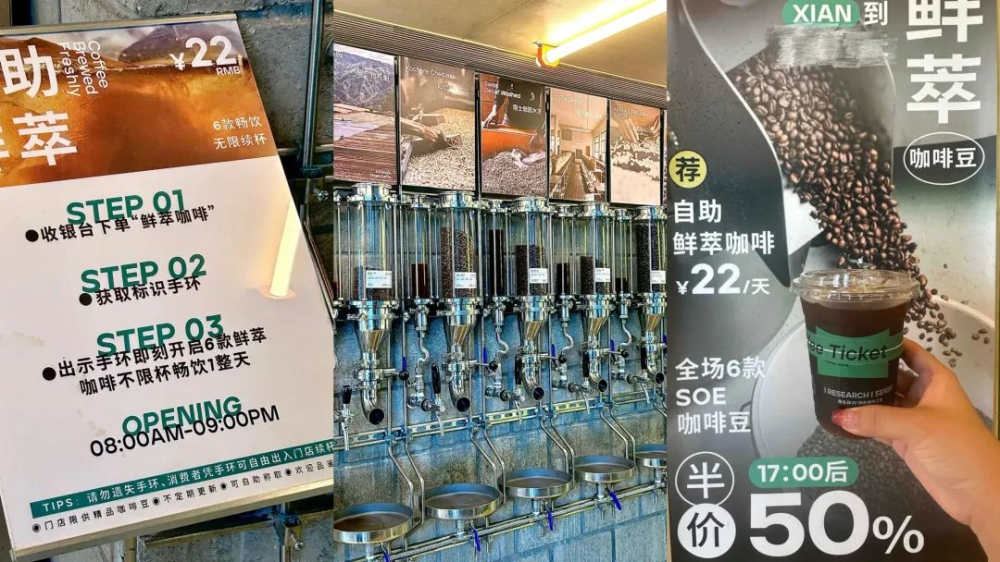
In recent years, a new format has emerged in the domestic coffee market—self-service coffee shops, where consumers pay a fixed fee and can then enjoy unlimited cups of multiple freshly brewed coffees, a model strikingly similar to craft beer bars. Wuhan's first self-service coffee shop opened with a 22-yuan wristband granting all-day unlimited access to 6 freshly brewed coffees, with half price after 5 p.m., quickly sparking attention on social platforms. Guangzhou had previously also seen a self-service store offering only black and white coffee, with 8 insulated buckets lined up on the counter, dispensing coffee liquid at the press of a button. This type of model focuses on speed, low cost, and a multi-flavor experience, but it also faces shortcomings such as dependence on foot traffic for site selection, difficulty guaranteeing product quality, and a lack of atmosphere and social attributes. Can self-service coffee truly spread across the country and become a new normal in coffee consumption? This article will explore this question by combining examples with industry viewpoints.
▲
Click to follow | Daily specialty coffee culture magazine Coffee Workshop
For many office workers, coffee has long been an indispensable "life-extending water" for daily alertness. A morning glass of iced Americano has become an unshakable habit for many people.
At present, domestic coffee shops can be roughly divided into two categories: one is the emerging self-service coffee shop, and the other is the traditional full-service café. The number of self-service coffee shops is not yet large, and many are distributed in urban suburbs.
Not long ago, Wuhan saw the birth of its first local "self-service model" coffee shop. This model quickly sparked heated discussion on Wuhan's social platforms—"Get a wristband for 22 yuan, instantly unlock 6 freshly brewed coffees, drink unlimited cups that day, and after 5 p.m. it's only half price." For office workers, this is undoubtedly highly attractive; and for consumers who want to try coffee, it also perfectly satisfies their curiosity.
In the comments section, some netizens wrote, "Our colleagues have already been led by me to each buy a self-service coffee every morning," while others said, "It's right downstairs from the office, and I've already been drinking it for 3 days straight! Buying a wristband in the morning lets you drink all day." From its appearance, the self-service coffee machine is quite similar to a craft beer machine. For most workers, being able to drink a cup of coffee quickly and at low cost is indeed a real need.
In fact, as early as last year, a "self-service model" coffee shop appeared in Guangzhou. The store offered only two coffee choices, black and white: black coffee meant drip coffee (8 varieties in total), while white coffee was coffee with milk. In the self-service tasting area, 8 black insulated buckets were neatly arranged on the counter, each with a faucet-like device underneath, so consumers only needed to press lightly and the coffee liquid would flow out.
According to the store's manager, this inspiration came from craft beer—many craft beer bars offer small tasting flights of 3 to 5 flavors, allowing customers to taste multiple flavors at once and thereby enhancing the experience. For stores adopting this sales model, abundant supply chain resources are the primary requirement; second, a great deal of testing of coffee bean flavors is needed to find the best taste.
In fact, unmanned self-service coffee shops have long existed domestically and abroad. For example, Hong Kong's "clean coffee" pink coffee shop, "muji" self-service coffee, and self-service coffee equipment in other countries. These self-service coffee machines, like unmanned convenience stores, provide quick and delicious coffee to consumers with caffeine needs.
In recent years, whether chain coffee brands, specialty coffee shops, or self-service coffee, the entire market has shown a flourishing trend, with new models and new玩法 constantly emerging. Although self-service coffee brings advantages such as speed, low cost, and multiple flavor choices, it has also exposed quite a few shortcomings.
First, site selection must rely on areas with high foot traffic; otherwise, coffee made in advance but consumed by no one will result in wasted coffee beans. Second, product taste is difficult to guarantee, coffee quality lacks stability, and it is not easy to win consumer trust—for example, issues such as the crema performance of espresso, the inability to pour latte art with hot milk coffee, and the difficulty of frequently maintaining machine hygiene. In the final analysis, the equipment is still not perfect enough.
Furthermore, the self-service model lacks atmosphere and environment. In fact, many people drink coffee not simply for alertness, but place more importance on enjoying coffee in a comfortable café while chatting with baristas, working, socializing, or resting. In theory, self-service coffee machines can improve efficiency, but once they break down, they actually waste more time; and because they are unattended, feedback on problems is also quite slow.
How far this model can go, and whether it can find suitable soil for growth across the country, remains to be seen.
Image source: Internet
Disclaimer: Some images in this article are from the Internet. For some content on the website, such as images, we will respect the original author's copyright and indicate the source. However, due to the large quantity, a few images and texts may not have been credited in time. Please forgive us. If the original author has any dispute, they may contact the website for handling. Once verified, we will correct it immediately. Compiled and edited by "Coffee Workshop." Please indicate the source when reposting. If there is infringement, please inform us for deletion. Thank you~!
The above content is compiled by CoffeeHunters, a coffee news website.


