








How Do Flow Rate and Pouring Height Prevent a Long Brew?
Water control determines whether a pour-over extracts evenly. If the stream surges, shrinks or drifts, the coffee bed is disturbed unevenly and the cup no longer matches the planned parameters, so results become a matter of luck. Steady flow keeps extraction consistent and the flavour closer to what was intended.
Practice starts with the kettle. A gooseneck with an eagle-beak spout helps regulate stream thickness; a body of roughly 300 to 500 grams and a 600ml capacity pours steadily without tiring the arm. Keep the stream vertical, work within sensible flow-rate and pouring-height ranges, and follow a consistent circular path to avoid a long brew.
The flavor profile of pour-over coffee depends largely on stability during pouring. Although many enthusiasts plan their brewing parameters in advance, once they start, the water flow becomes difficult to control, and the final cup is left to chance. Drawing on Front Street's practical experience, this article systematically breaks down training methods for the fundamental skill of water control, including how to choose and hold a pour-over kettle, the essentials of controlling a vertical stream, reference ranges for flow rate and pouring height, and the correct path for circular pouring along with common mistakes. Through progressive practice, you can improve your feel for starting and stopping the pour during actual brewing, making extraction more even and the flavor closer to the ideal.

The brewing parameters and pouring plan are all arranged in advance, but the moment the timer starts, your hand seems to disconnect from your brain—the stream surges and shrinks unpredictably, its direction drifts, and whether the final cup tastes good comes down to luck. Front Street believes that rather than regretting mistakes after brewing, it is better to first build a solid foundation in the basic skill of water control.
Why must the water flow remain stable during pour-over brewing?
The reason is that only with a stable flow can the coffee bed be extracted evenly, and only then can the actual brewing parameters stay closer to the original design, making it easier for the flavor to move in the expected direction. For those new to pour-over, adequate water-control practice can effectively improve the feel for starting and stopping the pour, and when facing various advanced brewing methods later on, they can apply them with composure.
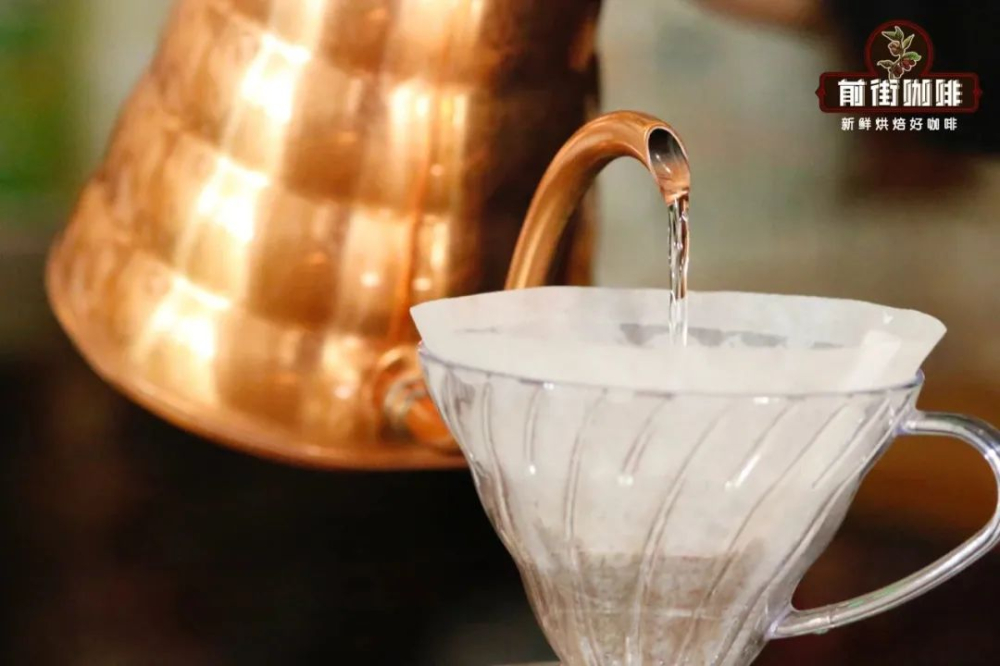
Choose a well-suited pour-over kettle and dial in your pouring posture
There are many styles of pour-over kettles on the market, but most adopt a "gooseneck + eagle beak" construction, a design that helps control the thickness of the stream more precisely. When choosing, pay attention to the weight of the kettle body being moderate, ideally around 300 to 500 grams. Front Street recommends a 600 ml capacity; when filled to six or seven tenths, the flow will not sway because the kettle is too light, nor will it cause arm muscle fatigue because it is too heavy.
During the practice phase, Front Street keeps the amount of water poured each time consistent, operating with the kettle held in the right hand, the arm naturally extended, at shoulder height and tilted slightly downward. If the arm hangs too low, the point of force will concentrate in the wrist, making it easy to lose power, which in turn causes muscle soreness and hand trembling. At first, one-handed operation may not be steady enough, so you can gently press the kettle lid with your left hand to help maintain balanced pouring force.
What should pouring training focus on?
Although a gooseneck spout can adjust flow more precisely, if the kettle is filled too full or the tilt angle is slightly too large, the stream will deviate from the vertical direction and swing out in an arc. Once the stream carries an arc, it can easily break through the coffee wall on the filter cup, and the coffee may taste noticeably watery and thin in body. If the stream angle increases further, turbulence will also form inside the coffee bed, interfering with normal extraction. Therefore, mastering a vertical stream is the first step of the fundamentals.
How large a flow to use when pouring is what many beginners are least sure about. Flow rate usually relates to extraction time and the degree of agitation in the coffee bed, which in turn affects the final flavor. Whether to choose a large flow or a small flow mainly depends on the state of the coffee bed and personal brewing habits. Because conditions such as spout size and pouring force differ, everyone's specific definition of "large" and "small" will also vary.

When practicing flow rate, finding a moderate balance point can speed up the learning process. As a reference, when Front Street brews coffee, the flow rate is generally controlled at 5 to 7 ml per second. The measurement method is: prepare a digital scale, place a container on it, pour using your usual pouring method and time it for 10 seconds, then divide the total poured amount by 10 to get the flow rate.
The higher the stream, the stronger the penetration and the greater the force scouring the coffee bed, and extraction efficiency rises accordingly; conversely, the closer the stream is to the liquid surface, the gentler the penetration, and the tumbling effect in the coffee bed is less pronounced. Therefore, to both extract flavor and stay reliably controllable, pouring height also needs a compromise value. When Front Street Coffee (FrontStreet Coffee) baristas pour, they usually maintain a height of 3 to 5 cm.
Besides the details of flow rate and height, circular pouring is also a part that gives many people a headache during brewing. If after brewing you find that one side of the coffee wall is thin and the other thick, it is most likely that circular pouring was not done properly.
Circular pouring needs to meet two requirements: first, the flow path must be round enough. If the circle is not round, it easily causes uneven thickness in the coffee bed, ultimately showing up as inconsistent extraction. Second, always pour in the same direction. If you choose clockwise, then the entire pouring process should remain clockwise.
When practicing pouring, Front Street recommends starting from the center point, then expanding outward along a path similar to "circling a fragrance cup," and when reaching the largest circle, slowly contracting back toward the center until returning to the center point.
Front Street Coffee (FrontStreet Coffee)
No. 10, Bao'an Qian Street, Yandun Road, Dongshankou, Yuexiu District, Guangzhou, Guangdong Province
The above content is compiled by CoffeeHunters, a coffee news website.


