








How Does Stirring Change Coffee Extraction in Pour-Over?
Stirring the coffee bed during pour-over brewing can change how evenly grounds are saturated and how quickly flavors dissolve, which is why some brewers add it and others skip it. The technique gained attention after 2012 World Brewers Cup champion Matt Perger demonstrated a fast blooming stir with a wooden stick, and roasters Tim Wendelboe and Scott Rao have also endorsed stirring during the bloom.
Stirring acts differently at each stage. During blooming it helps saturate all the grounds, while during the main pour it can speed up coffee extraction and shift sweetness and acidity, but it also risks clogging from fine particles and depends heavily on bean quality. Comparative brewing tests suggest stirring is a variable to manage, not a default step, so a coffee enthusiast should judge it against the specific beans and grind.
In the process of pour-over coffee, the action of stirring the coffee bed has attracted increasing attention from enthusiasts in recent years. Some hope to enhance the sweetness and flavor layers of coffee through stirring, while others remain skeptical of its effects. From the perspective of Front Street, this article reviews the origins and representative figures of the stirring technique, analyzes the different roles of stirring during the blooming stage and the main extraction stage, and combines practical comparative experiments to explore the impact of stirring on extraction results, as well as issues that need attention such as fine particle clogging and bean quality, helping coffee enthusiasts make more rational judgments about whether to stir and how to stir.

Recently, while browsing online content, Front Street noticed that many pour-over enthusiasts deliberately add a step of stirring the coffee bed during brewing, with the aim of enhancing the extraction of certain flavors, such as making the coffee's sweetness more prominent. Does stirring really produce such effects? In practice, what details of stirring need attention?
Today, Front Street will discuss this auxiliary action in pour-over coffee—stirring.
When it comes to the popularity of the stirring technique, one cannot avoid the 2012 World Brewers Cup WBrC champion Matt Perger, as well as a group of well-known coffee figures who later adopted or promoted this method.
Matt once posted a V60 dripper brewing video on an overseas video platform, in which he used a technique he called "Stir like a Bandit." From the video, it can be seen that during the blooming phase, Matt used a wooden stick to stir the coffee bed in a cross pattern: first up and down, then left and right, then up and down again, with quick movements and considerable force.
02:37
Matt's wooden stick bandit stirring
Tim Wendelboe from Norway, hailed as a father figure in the Nordic coffee roasting world, also added stirring during the blooming phase in his V60 tutorial video on his personal YouTube channel. Tim also explained his intention: "I like to stir the coffee during blooming to ensure that all the grounds are fully saturated."
In addition to these two masters from Northern Europe and Australia, Scott Rao, a soul figure in American roasting, and James Hoffmann, the 2017 WBC World Barista Championship winner, also endorse this auxiliary method. In addition, Amis, a barista from Taiwan, China, is a representative figure who has taken "stirring" to the extreme.
The core pursuit of coffee extraction is uniformity. During pour-over, stirring usually uses tools such as spoons or wooden sticks to apply a certain degree of disturbance to the coffee bed. Its purpose is to increase the tumbling of coffee grounds in water through external force, making the contact between water and each coffee particle more uniform, thereby achieving more complete extraction.
From the perspective of the staged extraction process, stirring can be arranged in two stages: the blooming stage and the pouring stage of the main extraction. As for when to stir, how much amplitude to use, the angle and direction of stirring, how long it lasts... this series of questions ultimately comes back to the original purpose: "Why stir?"
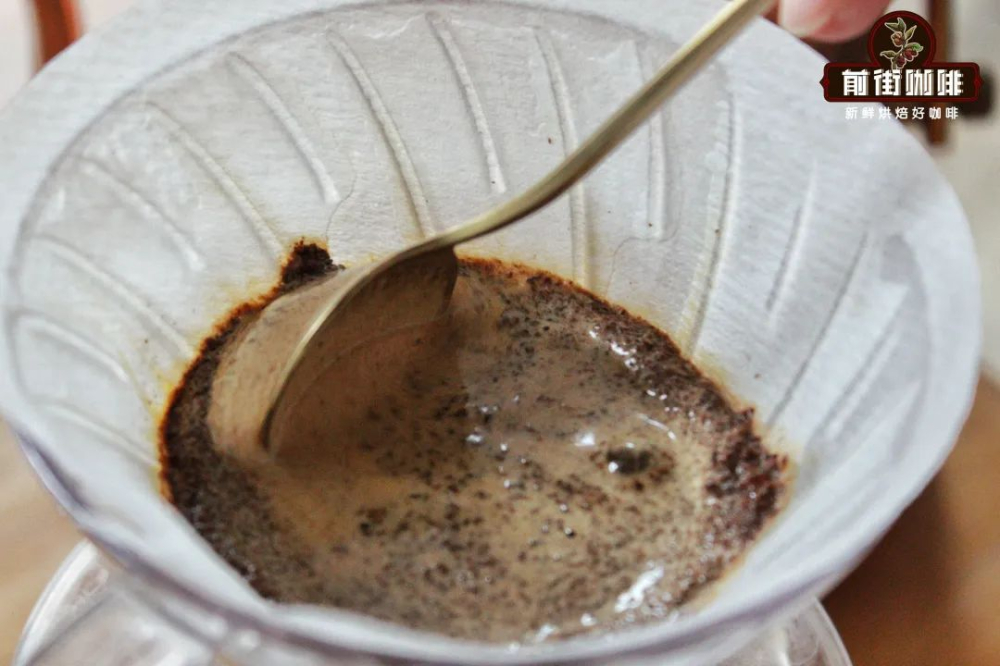
Stirring during the blooming stage, regardless of force or direction, aims to allow the coffee bed at all heights within the dripper to contact water, thereby reducing concentration differences and laying a foundation for subsequent flavor extraction.
In the main extraction phase after blooming, since the pouring itself can already create a certain amount of turbulence, the coffee grounds have more opportunities to "absorb water," so the dependence on stirring is not strong. Stirring after blooming generally occurs at the end of the second pour, where stirring can help the coffee degas, thereby improving extraction efficiency.
To verify the above ideas, Front Street also conducted comparative experiments, extracting the same coffee beans in three ways: no stirring, stirring during blooming, and stirring after the first pour. The experiment used beans from the Goddingding Cooperative, 15 grams of coffee grounds, a coffee-to-water ratio of 1:15, a water temperature of 91 degrees, and a grind size of 10 on the EK43s.
No stirring : Total extraction time was 2 minutes 5 seconds. In terms of flavor, citrus notes were prominent, the acidity was bright, and the finish had a honey-like sweetness.
Stirring during blooming : After the blooming pour was completed, a small spoon was used to stir the coffee slurry once (cross pattern: first up and down, then left and right). The coffee liquid finished dripping at 2 minutes 10 seconds. The flavor showed berries, lemon, green tea, accompanied by a faint white floral note, with clear sweetness.
Stirring after the first pour : After finishing the first pour, a small spoon was similarly used to stir the coffee slurry once (cross pattern: first up and down, then left and right). Dripping completed at 2 minutes 13 seconds. The flavor was likewise citrus-toned fruity acidity, with a weaker aroma, and the finish carried a hint of licorice, slightly over-extracted. It seems that stirring here did not play a positive role.
The biggest problem faced by the stirring method is fine particle clogging. The more stirring turbulence the coffee slurry receives, the greater the probability that fine particles migrate downward to the bottom of the dripper and clog the filter holes. Therefore, excessive stirring will not only prolong the extraction time but also increase the risk of over-extraction.
Because the stirring technique forcibly presses out the coffee's flavors, it places high demands on the quality of the coffee beans themselves. If poorer-quality beans are used, it is very likely to magnify their negative flavors indefinitely. For stirring to truly help flavor extraction, in addition to the action being just right, it also needs to be paired with many "tricky" conditions, such as fine grinding, high water temperature, and fast brewing.
It is precisely because the stirring technique lacks a relatively unified standard and is difficult to measure with precise data that everyone's technique differs, and when applied to one's own equipment and beans, the results often vary greatly, so it naturally lacks universal applicability. Front Street believes that one should first fully understand the characteristics of one's beans and combine them with the features of the dripper before deciding whether to stir and how to stir.
Front Street Coffee
No. 10, Bao'an Qian Street, Yandun Road, Dongshankou, Yuexiu District, Guangzhou, Guangdong Province
The above content is compiled by CoffeeHunters, a coffee news website.


