







What are coffee shops supposed to do about seat hogging?
A coffee shop owner's post about a full room of non-buying guests has revived the long-running seat-hogging debate. The shop sits in a hotel lobby and already uses screens and consumption-required signs, yet staff still hesitate to ask people to leave. Owners say rent, utilities and labor efficiency make the problem hard to absorb.
The dispute traces back through the history of coffee shop industry practice, where selling space is part of the business model. Opinions split between guests who say buying a drink earns them a seat and operators who count seats as inventory. The article reviews minimum-charge rules, legal questions and sample scripts for raising the issue politely.
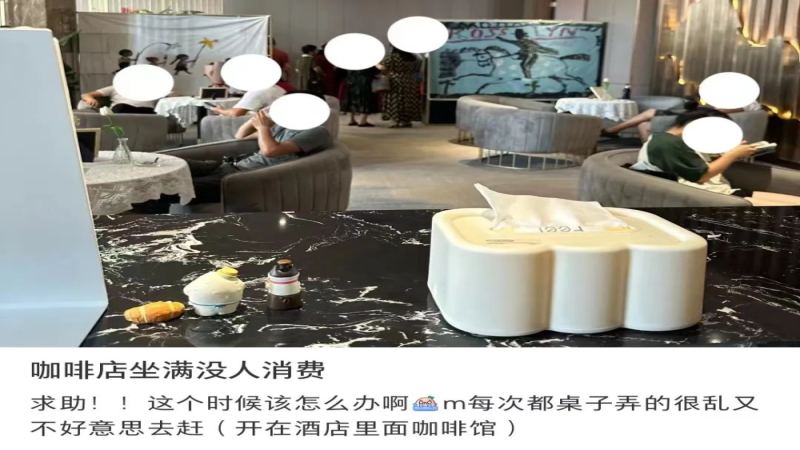
The coffee industry generally relies on spatial experience to attract customers, but a recent help-seeking post about a coffee shop being full of people with no one ordering has sparked extensive discussion on social media. The poster runs a coffee shop located in a hotel lobby. Although they used screens and notice signs to designate a consumption area, they still couldn't escape the problem of customers who only sit without buying. Many peers resonated with this, complaining that similar scenes are a headache. In fact, the topic of #CoffeeShopSeatHoggingWithoutConsumption# has a long history, with the core controversy lying in the balance between consumer rights and shop operating costs. Facing real pressures such as rent, utilities, and labor efficiency, how should independent coffee shops properly handle the seat-hogging issue? Is setting a minimum charge legal? What practical communication scripts have netizens summarized? This article will analyze from the perspectives of regulations, industry experience, and specific suggestions, providing references for coffee practitioners.
▲
Click to follow | Daily specialty coffee culture magazine Coffee Workshop
As everyone knows, compared to tea beverage shops with dense foot traffic, coffee shops rely more on the business logic of "selling space."
Recently, a "help-seeking" post about a coffee shop on a social platform attracted many netizens to watch and discuss. The confusion raised in the post was: the coffee shop is full of people but no one is consuming, what should be done? Every time the scene gets messy, and it's embarrassing to ask people to leave.
From this note and the comment section, it can be learned that the poster's coffee shop is located inside a hotel—more precisely, in the hotel lobby, but the shop has already used screens and "consumption required for seating" signs to create a simple area division.
This post indeed resonated with some netizens who are also coffee shop owners. Many commented: too scary, young people wouldn't dare enter with such a scene, it's just like a park...
Actually, the topic of #CoffeeShopSeatHoggingWithoutConsumption# has existed for a long time. A casual search on any website will show a large number of related reports, and the controversy has never ceased. Some insist that "only those who consume first have the right to enjoy," while others completely ignore others' glances.
However, for many independent coffee shops, real factors such as rent, utilities, and per-square-meter and per-person efficiency determine that they must consider the cost of customers entering the shop. This also reflects a common pain point faced by many coffee shops: Seat hogging without consumption, or not consuming per person, how exactly should this be handled?!
Under this post, many netizens gave suggestions—set a minimum charge!
But according to the relevant provisions of the "Measures for the Administration of Catering Industry Operations": "Catering service operators shall not set minimum consumption amounts. If a minimum consumption amount is set, the market supervision and administration department of the people's government at or above the county level, or the department designated by the people's government at or above the county level, shall order correction and impose a fine of not less than 1,000 yuan but not more than 5,000 yuan."
So if seat hogging without consumption has already occurred and has indeed affected business, is there any way to get customers to "give up their seats"?!
Based on the suggestions and scripts provided by netizens online, they can be roughly summarized as follows—
First, before customers order, inform them in advance of certain consumption requirements to avoid "arguments" after they have ordered.
Second, when encountering customers who enter without consuming, you can first consider things from their perspective and communicate in advance, for example: "You can sit for now. If the shop gets full later, you may need to give up your seat."
Third, during peak hours, persuade gently and friendly, for example: "We have several customers who ordered drinks and have nowhere to sit. Could you give up your seats to them?"
……
Apart from this, when facing "seat hogging without consumption," does anyone have any better solutions?!
Disclaimer: Some images in this article are from the internet. For some content on the website, such as images, we will respect the original author's copyright and indicate the source. However, due to the large quantity, some images and texts may not have been credited in time. Please understand. If the original author has any disputes, they can contact the website for handling. Once verified, we will correct it immediately. Compiled and edited by "Coffee Workshop." Please indicate the source when reprinting. If there is infringement, please inform us for deletion. Thank you~!
The above content is compiled by CoffeeHunters, a coffee news website.


