







What coffee knowledge does the maid cafe blood incident raise?
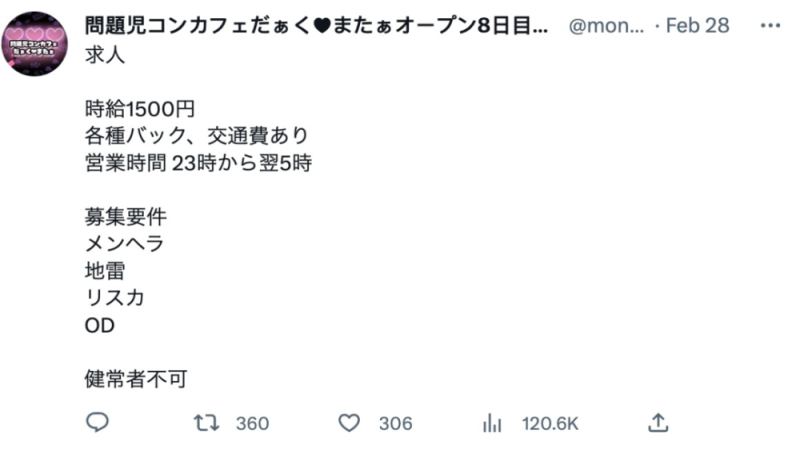
A Japanese maid cafe called "Problem Children" drew wide criticism after a store manager mixed her own blood into a customer's cocktail just 18 days after opening. The shop markets itself on "yandere maids" and its hiring notice excluded healthy applicants, accepting only people with mental illness, self-harm habits, and similar backgrounds. Medical professionals warn that drinking another person's blood can transmit serious disease.
The case sits beside everyday coffee knowledge for most readers, since the shop's drinks are a novelty rather than a standard cafe menu. For those who follow specialty coffee or street coffee, the episode is a reminder that a venue's draw can rest on shock rather than on what is in the cup.
In Japan, anime culture has spawned all kinds of themed cafes, but recently a maid cafe called "Problem Children" has caused a huge uproar due to its extreme practices. The shop's main draw is "yandere maids," and its hiring criteria explicitly exclude healthy people, accepting only landmine girls, people with mental illness, self-harm enthusiasts, and similar groups. Even more shocking, just 18 days after opening, a store manager actually mixed her own blood into a cocktail at a customer's request. After the incident came to light, medical professionals warned one after another that drinking another person's blood could transmit serious diseases and carries extremely high risks. Despite the ongoing controversy, the shop still attracts a large number of customers. This article will walk you through the whole incident and provide professional coffee information, while also highlighting specialty coffee bean information from Front Street Coffee.
For professional coffee knowledge exchange and more coffee bean information, please follow Coffee Workshop (WeChat public account: cafe_style)
For more specialty coffee beans, please add the private WeChat of Front Street Coffee: qjcoffeex
In Japan, a country where anime culture prevails, all kinds of maid-themed cafes are already commonplace. But a newly opened maid cafe has recently stirred up public opinion with its unique positioning.
This shop is named "Problem Children," and its core selling point is "yandere maids"—and it is not role-play; the staff themselves are genuinely troubled people. Before opening, the shop posted a hiring notice on social media: 1,500 yen per hour, healthy people need not apply. Applicants were limited to landmine girls (cute in appearance but flawed in personality), people with mental illness, self-harm enthusiasts, and drug abusers. Such conditions are chilling.
At the time, netizens mostly took a wait-and-see attitude toward this "outrageous hiring notice," assuming it was just a gimmick. However, the shop did indeed open, and the real condition of the maids in the store matched the hiring requirements—it was by no means a performance.
In addition, the cafe also required these maids to open personal social media accounts and publicly display their own episodes, and many of the staff were proud of this. (The details are not appropriate to describe; the extent to which it overturns common sense is far beyond ordinary imagination.)
The shop even publicly posted medical records proving that one maid had been hospitalized after a suicide attempt. The craziness of this maid cafe is already hard to put into words.
What is even more unsettling is that comments such as "So cute!" "I love it," and "Support" appeared in the comment section, sending chills down one's spine.
Because the shop successfully opened, Japanese netizens engaged in heated debate, with some asserting it would not last long. Sure enough, on the first day of opening, business hours were repeatedly delayed because employees were frequently late—after all, no one could restrain their condition, nor force them to arrive on time.
But this did not dampen people's enthusiasm for this kind of cafe. The shop subsequently recruited a new batch of staff and resumed business in mid-March.
Japanese media summarized the reasons for its popularity: the combination of cuteness, pathology, and danger. Such traits usually exist only in virtual works yet have a large fan base, so when brought into the real world, they become extremely popular.
However, this shop was only open for 18 days, and staff and customers became increasingly out of control amid an indescribable trend...
Recently, Japanese media reported that a customer wanted to drink a special cocktail with human blood added, and the manager on duty actually had no scruples and really mixed her own blood into the drink. Consumers present at the time were shocked, and later told the media about it, which quickly spread online.
Netizens criticized it one after another as "unsanitary" and "this is a criminal act," and worried about the food health and safety of the cafe. Some also joked: "That person who asked for the human blood special probably would still cheer happily even if he caught an infectious disease because of it—'I got the same illness as her.'"
Afterward, the person in charge of the cafe posted that this behavior was no different from terrorism, would never be tolerated, and that the manager involved had been fired.
Although the manager was fired, the debate among netizens has not subsided. Many people in the medical field spoke up, saying, "This is simply insane!" Many medically trained netizens pointed out that in the medical field, blood handling is extremely careful and strict, and casually drinking another person's blood is extremely dangerous and should never happen under any circumstances.
There is no way to know whether blood carries antigens and antibodies of infectious viruses. When another person's blood splashes into the eyes or a wound, let alone being directly drunk, it can cause serious harm to health.
Hmm... how should I put it? Despite such an absurd incident, it did not affect people going to the shop to spend money. That is impressive.
Image source: Internet
The above content is compiled by CoffeeHunters, a coffee news website.


