







How Should Iced Pour-Over Coffee Be Brewed for Balance?
Iced pour-over needs different parameters from hot pour-over because ice makes up part of the final drink but does not extract anything. Front Street Coffee's trials point to a 1:10 to 1:12 coffee-to-water ratio with ice at roughly half the coffee weight, so 15 g of coffee, 150 g of water, and 75 g of ice.
Grind finer than usual to offset the shorter contact time, then slow the pour and split it into more stages, keeping the total brew between 1 minute 40 seconds and 1 minute 50 seconds. Do not raise the water temperature to compensate, since that risks burnt bitterness. Light to medium roasts with distinct flavors show better in iced pour-over than dark roasts.
The biggest difference between iced pour-over and regular hot pour-over lies in the introduction of ice as a variable. Ice does not participate in extraction, so you need to rebalance grind size, coffee-to-water ratio, and pouring technique. Through brewing trials with multiple beans, Front Street Coffee has summarized an easy-to-control approach: a 1:10–1:12 coffee-to-water ratio and a 1:5 coffee-to-ice ratio. For example, with 15g of coffee, you pour 150g of water and use 75g of ice. The grind should be adjusted finer to compensate for the shortened extraction time. When pouring, reduce the flow rate and increase the number of pours, keeping the total time between 1 minute 40 seconds and 1 minute 50 seconds. In terms of bean selection, light-to-medium roasts with distinctive flavor profiles better showcase the refreshing quality of iced pour-over, while dark roasts tend to taste thinner and less balanced.
The Extraction Approach for Iced Pour-Over
A good cup of pour-over coffee is essentially about finding the right balance between extraction yield and concentration, usually achieved through the interplay of grind size, water temperature, coffee-to-water ratio, pouring technique, and brewing equipment.
Compared to hot pour-over, iced pour-over introduces an extra variable—ice—which itself doesn't handle any extraction. To avoid losing too much of the coffee's flavor compounds, you need to adjust the hot pour-over parameters accordingly. The most common adjustments include grinding finer, resetting the coffee-to-water ratio, and changing the pouring rhythm. As for water temperature, Front Street Coffee does not recommend raising it to solve the problem, because too high a temperature easily brings out burnt bitterness, and once over-extraction occurs, it's hard to fix.
Coffee-to-Water-to-Ice Ratio
The ice replaces a portion of the water that would otherwise be poured, kept separate and not directly involved in extracting the coffee grounds—its role is essentially that of bypass water. After testing iced pour-over recipes with multiple coffee beans, Front Street Coffee finds that a 1:10–1:12 coffee-to-water ratio is the easiest to manage. With too little water, flavor compounds aren't released sufficiently; with too much water, there's not enough "room" in the concentration for the ice to do its job—the coffee becomes bland before it has even cooled down.
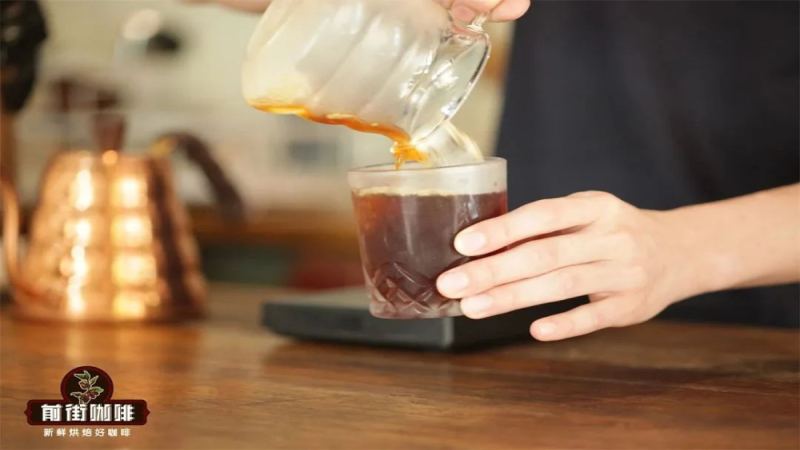
In iced pour-over, ice serves two functions: cooling and dilution. Therefore, the amount of ice depends on whether it can quickly bring the coffee down to a pleasant drinking temperature without over-diluting the concentration and making the coffee taste watery. Through repeated brewing, a 1:5 coffee-to-ice ratio allows all the ice to melt while cooling the coffee adequately. For example, with 15g of coffee, you pour 150g of water and use 75g of ice.
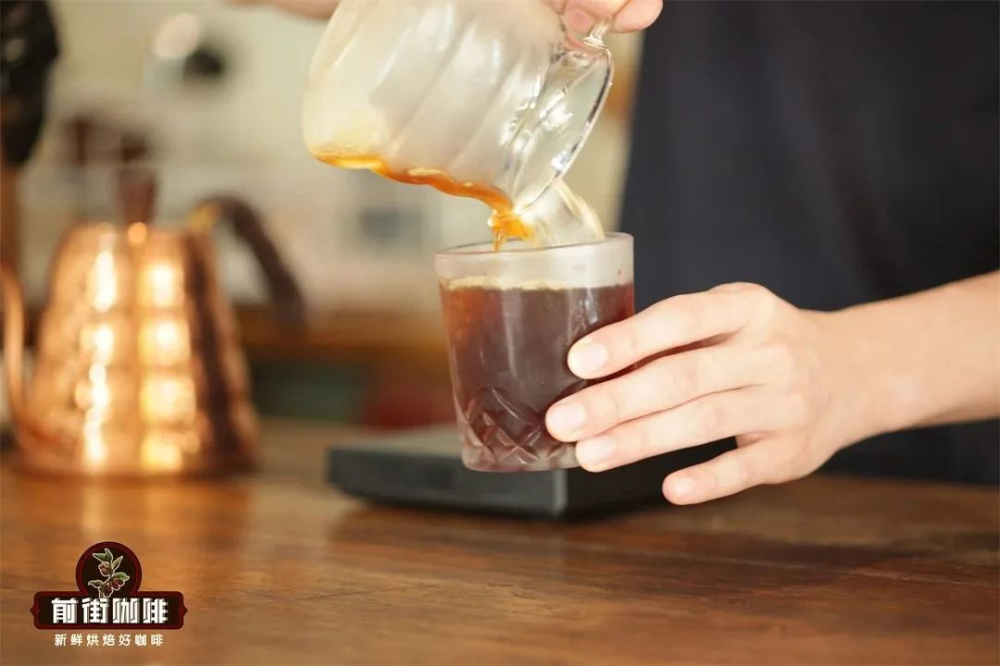
Once all the coffee has dripped into the ice in the server, stir or keep swirling to bring the coffee temperature down to around 5–10°C as quickly as possible (the server should feel ice-cold to the touch). At this point, a small amount of slow-melting crushed ice will float on the surface. If you don't want this crushed ice to further dilute the coffee, you can scoop it out—but you should drink it soon to prevent the coffee's taste from changing at room temperature.
Grinding Finer
Grinding finer serves two purposes: first, to compensate for the shortened extraction time caused by the reduced water volume; second, because a finer grind speeds up the release of coffee compounds. Taking the EK43s grinder used by Front Street Coffee as an example, if a particular coffee uses setting 10 for hot pour-over, adjust to 9.5 for iced pour-over. If using a No. 20 sieve to judge, the passing rate for iced pour-over grind should be between 82–83%.
Adjusting the Pouring Technique
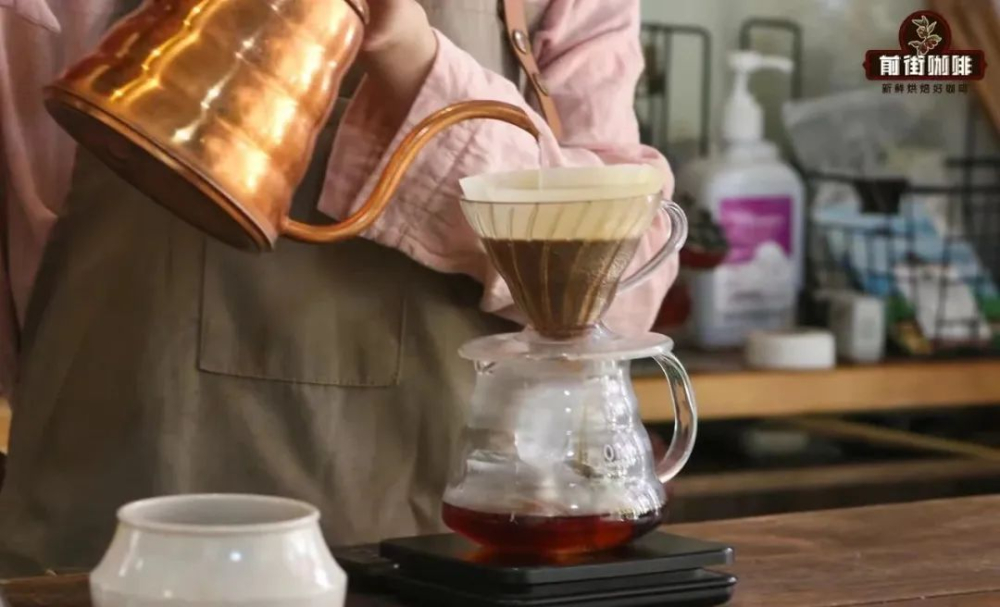
Just like grind size, adjusting the pouring technique is also about addressing the insufficient extraction time caused by the reduced water volume. For example, with 15g of coffee, iced pour-over only requires pouring 150g of water. If you pour as usual, the time will be significantly shortened, so you need to change your technique. Front Street Coffee's approach is to reduce the flow rate and appropriately increase the number of pours, keeping the total time within the 1 minute 40 seconds to 1 minute 50 seconds range.
Keeping the Coffee Iced
When Front Street Coffee serves iced pour-over, it uses 100g of large, high-density ice cubes and also chills the cup in the refrigerator beforehand. The purpose is twofold: first, to ensure the ice melts a bit more slowly; second, to prevent the coffee from warming up quickly at room temperature and affecting the taste.
If you don't follow the standard coffee-to-ice-to-water ratio for extraction, you can also use the ice-passing or ice-bath cooling methods. Ice-passing involves pouring the brewed strong coffee over a large amount of ice, repeating several times to achieve the cooling effect. This method has a much smaller negative dilution impact from ice melting into water compared to directly adding ice, but the downside is it uses a lot of ice. The ice-bath cooling method involves placing the brewed hot coffee in a sealed container and rapidly spinning it in ice to cool it down. Its advantage is that it doesn't dilute the coffee concentration and is less likely to affect the coffee's flavor and taste.
Choosing the Right Coffee Beans
Not all coffee beans are suitable for iced pour-over—dark-roasted beans, for example. These beans are known for their rich body and overall balance, and their flavor expression isn't as bright and uplifting as light-to-medium roasts. Hot pour-over can showcase their characteristics to a great extent, but when made as iced pour-over, they are dominated by roasty notes, the taste becomes thinner, overall balance declines, and the low temperature may bring out unpleasant mouthfeel.

Therefore, Front Street Coffee recommends choosing light-to-medium roast flavor-type coffee beans for iced pour-over, as the taste is more refreshing—for example, Kenya Asalia, Costa Rica Strawberry Candy, Ethiopia Natural Red Cherry... Of course, if you only like dark-roasted coffee, iced pour-over might just be your cup of tea too.
For professional coffee knowledge exchange and more coffee bean information, please follow Coffee Workshop (WeChat public account: cafe_style)
For more specialty coffee beans, please add the private WeChat of Front Street Coffee (FrontStreet Coffee), WeChat ID: qjcoffeex
The above content is compiled by CoffeeHunters, a coffee news website.


