








Why does American coffee clash with Italian espresso culture?
Italians generally do not order Americanos, and many cafes will instead serve an espresso with a separate cup of hot water so the customer dilutes it personally, sometimes with a remark that Americanos are not sold there. Ordering one is not illegal; the resistance is cultural rather than legal, tied to taste habits and national identity.
That identity runs deep. Espresso was added to UNESCO's Intangible Cultural Heritage candidate list in January, and it carries Italy's coffee history from the 16th century onward, from coffee's early reputation as a questionable drink to the first coffee houses and the invention of the steam coffee machine, as covered in coffee history in Europe.
What actually happens when you order an Americano in Italy? A first-hand account from an Italian netizen reveals this amusing cultural phenomenon: Italians generally don't drink Americanos, and café owners will simply give you an espresso and a cup of hot water to mix yourself. What's more interesting is that when Italians see someone diluting espresso with water, their reaction can be described as intense. Behind this is not just a matter of taste preference, but a matter of national identity and cultural dignity. Espresso was added to UNESCO's Intangible Cultural Heritage candidate list in January this year. It carries Italy's coffee history from the 16th century to the present—from "the devil's drink" to "God's drink," from the first coffee house to the invention of the steam coffee machine. Espresso has long been part of Italy's national identity.
For professional coffee knowledge exchange and more coffee bean information, please follow Coffee Workshop (WeChat public account: cafe_style)
For more specialty coffee beans, please add the private WeChat account Front Street Coffee (FrontStreet Coffee), WeChat ID: qjcoffeex
Not long ago, an Italian netizen on social media answered a question many people have: Will you get arrested for ordering an Americano in Italy? (His exact words were: Can you really not order an Americano in Italy?)
This netizen explained that Italians generally don't choose Americanos, and of course, ordering one isn't illegal. It's just that the café owner will bring you an espresso and a cup of hot water to mix yourself, while telling you: We don't sell Americanos here.
If it's summer and Italians want something refreshing, they usually choose cream coffee—though it's actually more of a dessert—or simply add ice cubes to espresso. But if you order an Americano in winter, you might just get beaten up 😂
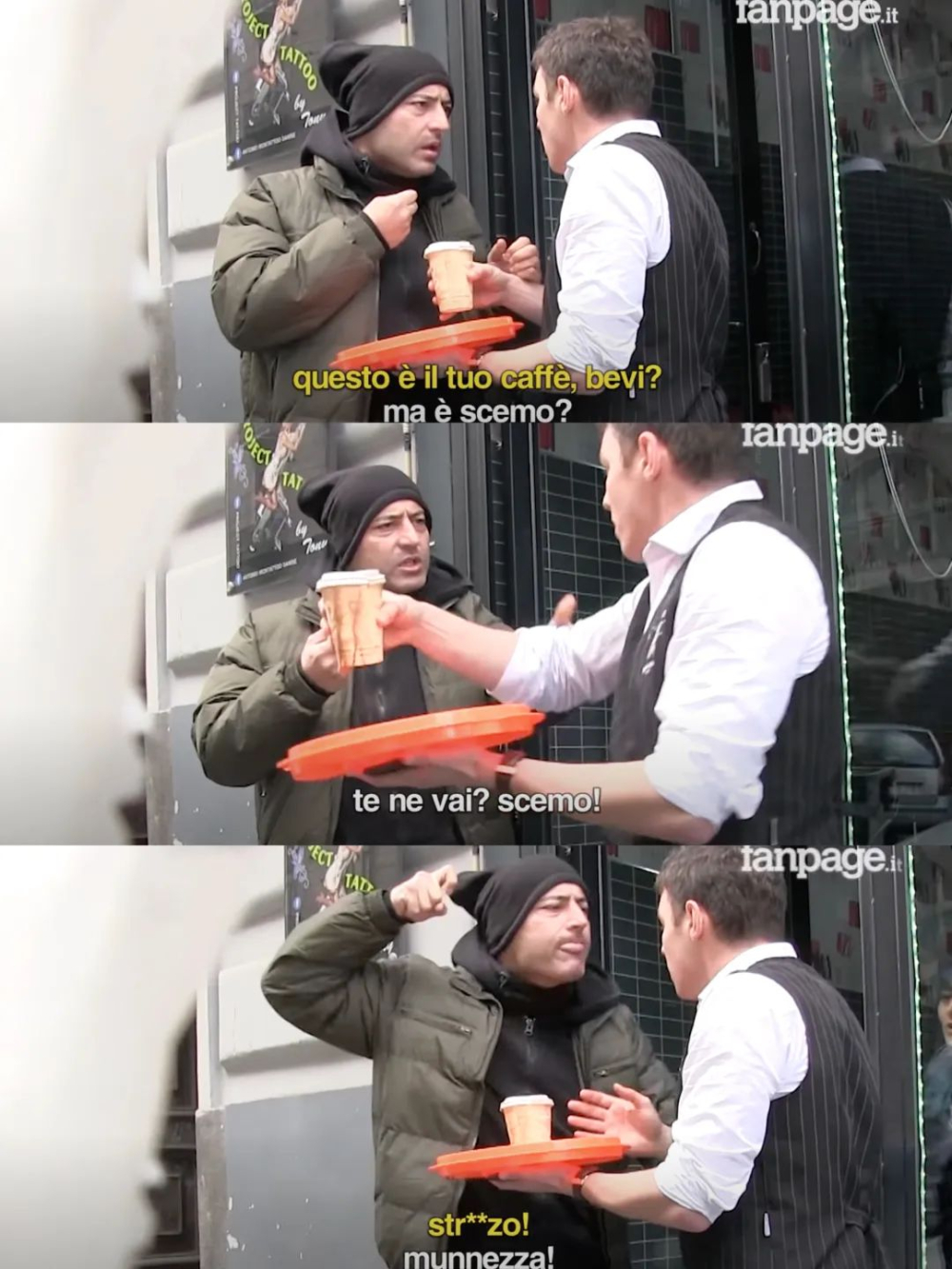
At first, I thought this was just a joke, until I dug up a video filmed by an Italian café four years ago (secretly filmed and edited with consent afterward). The video documents how Italians react when someone orders an espresso but then dilutes it with water. (Translations provided by netizens)
-This is your coffee, are you drinking it?
"Is this a piece of 💩?"
"Get lost! Beep---"
-Italian espresso tastes terrible, this is your coffee
"First of all, don't insult Italians, because this coffee tastes awful"
"The coffee I ordered is just that tiny bit"
"This is a trash can! Watch, this is how we do it"
"What is this stuff? Green bean soup?"
"Are you putting on a show? No no no, I'm not drinking it"

(No translation needed—you can tell that when Italians see their coffee diluted with water, they immediately want to throw hands)
Espresso may just be a strong, rich beverage that wakes you up; or it may serve as a base for making all kinds of coffee drinks. But for Italians, it is a true life ritual, a cultural consciousness, and a component of Italy's national identity that makes Italy unique in the world.
Espresso was also added to UNESCO's Intangible Cultural Heritage candidate list in January this year!
Italians react so strongly to the practice of adding water to their ordered espresso because every shot of espresso tells a history of region, culture, and how the industrial age drove rapid social development. If an Italian recklessly dilutes espresso with water and drinks it, it's akin to an "insult" to their national culture.
Of course, as espresso has spread across the globe, different regions have different ways of drinking it. How foreigners want to enjoy it is their own business, and local cafés in Italy will also accommodate the needs of foreign tourists. But for locals, sticking to traditional espresso can be considered a faith, and a respect for their own national culture.
Coffee was brought to Italy from the Middle East in the mid-16th century. As "the devil's drink," it became popular among the upper class. Then in the early 17th century, a Christian figure baptized coffee and named it "God's drink," which promoted coffee's popularity across Europe.
By 1645, Europe's first coffee house opened in Rome—also Italy's earliest shop dedicated to selling coffee. From then on, coffee spread rapidly and permeated everyday life.
By 1881, the rapid development of the industrial age demanded that everything be faster, more efficient, and more mechanized—coffee was no exception. So people began researching ways to extract coffee quickly, and in 1884, a patent for a steam-powered machine for making coffee was successfully registered in Turin, Italy.
Italians' love for coffee is fervent, and they have made tremendous contributions to coffee's development. Later, this steam-powered machine went through 3-4 rounds of design modifications through cycles of use, feedback, and improvement by different people.
First, Luigi Bezzera, a designer from Milan, acquired the patent for the steam-powered coffee machine, added a handle and a portafilter to the original steam boiler coffee machine, and researched and adjusted the grind size of the coffee beans.
By applying external pressure, the coffee grounds can become compact enough to resist the rapid passage of high-pressure water, allowing the water flow to distribute better and pass evenly through the entire puck, then "squeeze out" a balanced cup of coffee.
Then, a cooling channel was added inside the coffee machine to prevent excessively high water temperatures from causing a burnt, bitter taste in the extracted coffee, and a patent was filed in 1901.
After the patent was acquired by a company called La Pavoni, a pressure relief valve was added, solving the problem of the machine's internal temperature and pressure changing with the intensity of the heating flame . A steam wand was also added, forming the basic functions of the espresso machine as we know it today.
The espresso made using a pressure-increasing machine or filter—the word "Espresso"—was added to dictionaries in 1920. Soon after , Pier Arduino from Turin, Italy, sold this uniquely Italian coffee machine to France and subsequently exported it around the world. He also produced promotional posters that introduced more people to espresso.
From then on, coffee-making methods in cafés around the world changed completely. Speed and convenience became the new benchmark for café service, and Italian espresso began to become the foundational core of today's modern coffee system.
By 1938, Italians had even coined the term "Barista." The word derives from "barman," a bartender or counter server.
Every pot has its lid, and every preference its own—while people in different regions have different interpretations of espresso, as a culture Italians take pride in, whether locally or chatting with Italians, remember to respect each other's culture! Otherwise you really might get beaten up...
Image source: YT Fanpag.it Internet
The above content is compiled by CoffeeHunters, a coffee news website.


