







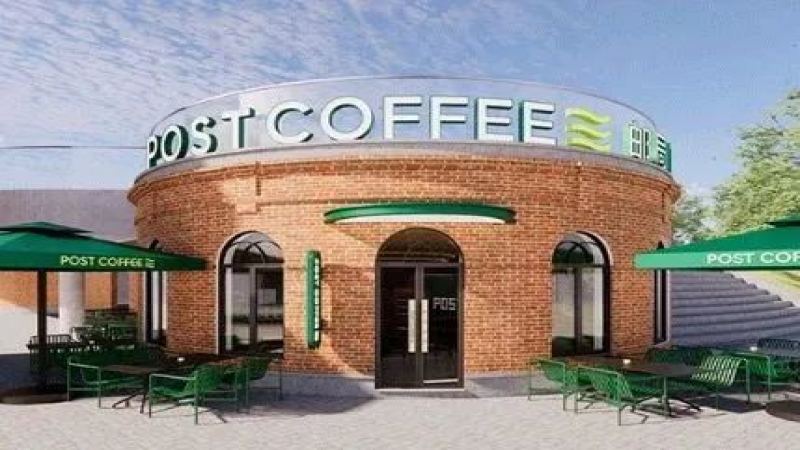
How does China Post's coffee store combine coffee and alcohol?
Post Coffee, the coffee brand under China Post, opened its first day-coffee-night-alcohol concept store in Fuzhou, along with two drinks exclusive to the city: a coffee-added "Post Taro" and a caffeine-free "Taro Milk." The format pairs morning coffee with evening alcohol, a pattern brands describe as "coffee in the morning, alcohol at night."
Post Coffee opened its first store in Xiamen in 2022 and has grown to ten stores across four cities, selling coffee, tea drinks and desserts priced between 20 and 40 yuan, with pickup and delivery. Starbucks, Seesaw, M Stand, Tims and Cotti Coffee have also moved into the evening segment, extending operating hours by adding alcohol alongside coffee.
The combination of coffee and alcohol is becoming a new trend in the food and beverage industry, with "C in the morning, A at night" evolving from a skincare concept into a consumption pattern of "coffee in the morning, alcohol at night." Post Coffee, a coffee brand under China Post, recently launched the country's first day-coffee-night-alcohol concept store in Fuzhou, along with two Fuzhou-exclusive beverages. Since its first store opened in Xiamen in 2022, Post Coffee has expanded to ten stores across four cities. Can this new business format offer new ideas for coffee brands operating at night? Meanwhile, brands such as Starbucks, Seesaw, M Stand, Tims, and even Cotti Coffee have also been positioning themselves in this sector, with coffee brands accelerating their attempts to venture from coffee into alcohol and extend their operating hours.
For professional coffee knowledge exchange and more coffee bean information, please follow Coffee Workshop (WeChat official account: cafe_style)
For more specialty coffee beans, please add our private WeChat Front Street Coffee (FrontStreet Coffee), WeChat ID: qjcoffeex
In the past, "C in the morning, A at night" in the skincare field referred to applying vitamin C products in the morning and vitamin A products at night. However, this term has now been redefined in the food and beverage industry—"coffee in the morning, alcohol at night." Thanks to the rapid spread of social networks, the "coffee + alcohol" day-coffee-night-alcohol business model has formed a new trend in the industry, attracting numerous brands and entrepreneurs to enter the market, and gradually evolving into a brand-new consumption format.
Yesterday, Post Coffee announced through its official WeChat account that its first national day-coffee-night-alcohol concept store has officially opened in Fuzhou. Along with the new store's debut, Post Coffee also introduced two Fuzhou-exclusive beverages: one is "Post Taro" with coffee added, and the other is a caffeine-free "Taro Milk."
Post Coffee is a coffee store opened by China Post as a cross-industry venture, selling products such as coffee, tea drinks, and desserts, with coffee and tea drinks priced between 20 and 40 yuan, supporting both in-store pickup and delivery. By merging the seemingly unrelated elements of the post office and coffee, and leveraging the collision between China Post's nostalgia and coffee leisure culture, it can not only create a national trend brand favored by young people but also convey a concept of culture and a better life.
Since China Post's first Post Coffee store officially opened in Xiamen on February 14, 2022, according to data from the ordering mini-program, Post Coffee has opened 10 stores across four locations: Fujian, Jiangsu, Jiangxi, and Beijing. It is understood that Post Coffee operates under a self-operated model and has not yet opened franchising at this stage.
On May 15, three months after the first store opened, Post Coffee welcomed its second store nationwide, still located in Xiamen, specifically on Xiamen Cat Street. This store differs from the first one; while retaining the postal theme, it incorporates the distinctive features of the surrounding Cat Street environment and is decorated with cat-related elements, aiming to create a place for cats and cat lovers to rest and socialize.
In June, China Post's third coffee store set its sights on a campus. Coinciding with the 120th anniversary of Southeast University, Post Coffee's first national campus store officially opened at Southeast University. This store not only launched stamp cup stickers combining elements of China Post and Southeast University but also introduced exclusive limited-edition tea drinks and desserts. Afterwards, Post Coffee accelerated its expansion pace, successively opening in Beijing and Jiangxi, and continued to explore the coffee market and keep up with industry trends, ultimately opening a day-coffee-night-alcohol concept store.
In fact, besides Post Coffee, several brands have successively made moves in this field in recent years. As early as 2019, Starbucks, a long-established giant in the coffee industry, had already begun experimenting with a coffee-and-alcohol combined model, opening its first "Starbucks Reserve Coffee · Bar" on the Bund in Shanghai. Afterwards, Seesaw and M Stand also successively tested the day-coffee-night-alcohol model. It is reported that M Stand has now launched five day-coffee-night-alcohol themed stores in Shanghai, Shenzhen, and Ningbo.
Not long ago, Tims launched a brand-new business format in Shanghai called "Coffee&Beer," also adopting the day-coffee-night-alcohol model, with alcoholic drinks mainly consisting of beer, covering 31 types including fruit beer and wheat beer, priced between 25 and 58 yuan, with operating hours from 7 a.m. to midnight. Moreover, Cotti Coffee, a new brand created by Luckin Coffee founder Lu Zhengyao, has also chosen the day-coffee-night-alcohol route. However, currently on its WeChat mini-program, the products available for ordering are still limited to different series of coffee.
It is not hard to see that the above coffee brands all enter alcoholic beverages from coffee, extending product forms from a coffee foundation toward alcohol, and together they form a powerful camp for day-coffee-night-alcohol. Day-coffee-night-alcohol can fill the gap in coffee shops' nighttime operations—coffee's nighttime consumption scenarios are inherently limited, and turning a nighttime coffee shop into a bar is equivalent to selling users products for different scenarios, thereby adding another source of revenue to increase turnover. This may indeed be an important attempt by coffee brands to explore new business growth points.
Although Post Coffee has the backing of China Post, a big tree, and enjoys favorable conditions in terms of site selection advantages and store resources, competition in the coffee market is becoming increasingly fierce. Only by accelerating expansion and achieving a model of multi-time-period operation and unlimited scenarios can it have a better chance of winning in the competition.
Image source: Internet
The above content is compiled by CoffeeHunters, a coffee news website.


