







Is Americano More Acidic Than Cold Brew?
Cold brew generally contains more caffeine than a hot Americano, so it tends to be the stronger pick for alertness. Low-temperature immersion also produces a cleaner cup: research from the Coffee Science Foundation and the Specialty Coffee Association found cold brew shows more floral and fruity notes, with fewer bitter, sour, and defective flavors than hot-extracted coffee.
The study linked four sensory attributes to extraction temperature, and the pattern held across origins and roast levels. For anyone asking is americano acidic, hot water extraction tends to pull out more of the sharp, sour compounds, while long cold steeping rounds off that edge and builds a fuller body with more noticeable sweetness and a softer coffee aroma.
Cold brew coffee has gained increasing favor among coffee enthusiasts in recent years, not only because of its simple preparation method, but also because it can showcase the unique flavor charm of coffee beans. Compared with hot-extracted Americano, how does cold brew coffee perform in terms of caffeine content and refreshing effect? How does low-temperature extraction affect the acidity, sweetness, bitterness, and aroma of coffee? Starting from scientific research, this article will deeply analyze the differences between cold brew and Americano in refreshing effect, and share Front Street Coffee's cold brew preparation method and recommended bean varieties, taking you through a comprehensive understanding of this essence extracted by time.
For more specialty coffee knowledge, please follow: Front Street Coffee (Frontsteet Coffee)
The reason cold brew coffee is widely sought after is, on the one hand, that it is extremely easy to make at home or in a coffee shop; on the other hand, the flavor it presents not only fascinates veteran coffee lovers, but even beginners who have just come into contact with coffee often fall in love with it at first taste.
In today's increasingly popular specialty coffee culture, people are pursuing more and more the authentic regional flavor that coffee can reveal without any additives. Compared with high-temperature brewing, long low-temperature immersion can better highlight the uniqueness of a coffee bean and also bring the final cup flavor closer to the ideal state everyone expects.
"Coffee extracted at low temperature tastes cleaner and fuller."
Unlike most other extraction methods, long low-temperature immersion often gives coffee a more prominent sweetness and a fuller body. At the same time, compared with the most familiar iced Americano, cold brew has a higher caffeine content, so its refreshing effect is also superior.
Last week, the Coffee Science Foundation and the Specialty Coffee Association jointly released a latest research report on cold brew coffee, pointing out that coffee extracted by low-temperature immersion has more obvious floral and fruity aromas than the hot-extracted version, and has fewer bitter, sour, and defective flavors.
The study identified four sensory attributes that showed a statistically significant association with extraction temperature (this change held true across all origins and roast levels tested). Among these four attributes, bitterness, sourness, and rubbery flavor were more prominent in hot-extracted coffee, while floral aroma was more obvious in low-temperature-extracted coffee. Of course, for specific origins and roasting methods, there will also be some additional sensory attributes significantly affected by temperature.
Under the premise that the coffee bean variety, amount, and grind size are all the same, the rates at which various chemical substances inside the coffee particles dissolve into hot water and cold water are different.
During high-temperature extraction, tannic acid in coffee decomposes into pyrogallic acid, and various fatty acids dissolve faster and in greater amounts in hot water, thereby bringing bitterness and sourness. Under low-temperature extraction conditions, however, as time passes, the types of acidic compounds gradually decrease, so the sourness and bitterness of cold brew coffee are greatly reduced. At the same time, the volatilization of coffee aroma is also suppressed, so the fragrance can be better locked into the coffee.
Today's coffee beans are becoming fresher and brighter in flavor, but their acidity is also rising, forming a sharp contrast with the mellow richness of coffee in the past. However, for mass consumers, not everyone can accept the sourness of coffee, nor do they prefer the traditional heavy mouthfeel. For this reason, cold brew coffee has soft acidity, little bitterness, and can also display coffee's distinctive floral and fruity notes, making it easier to win the favor and recognition of modern consumers.
When making cold brew coffee, Front Street Coffee (FrontStreet Coffee) gives priority to Front Street Kenya Little Tomato Coffee, Front Street Strawberry Candy Coffee, Front Street Huakui Coffee, and Front Street Mozart Coffee. They have elegant aromas, are sweet and sour, and are suitable for a variety of brewing devices.
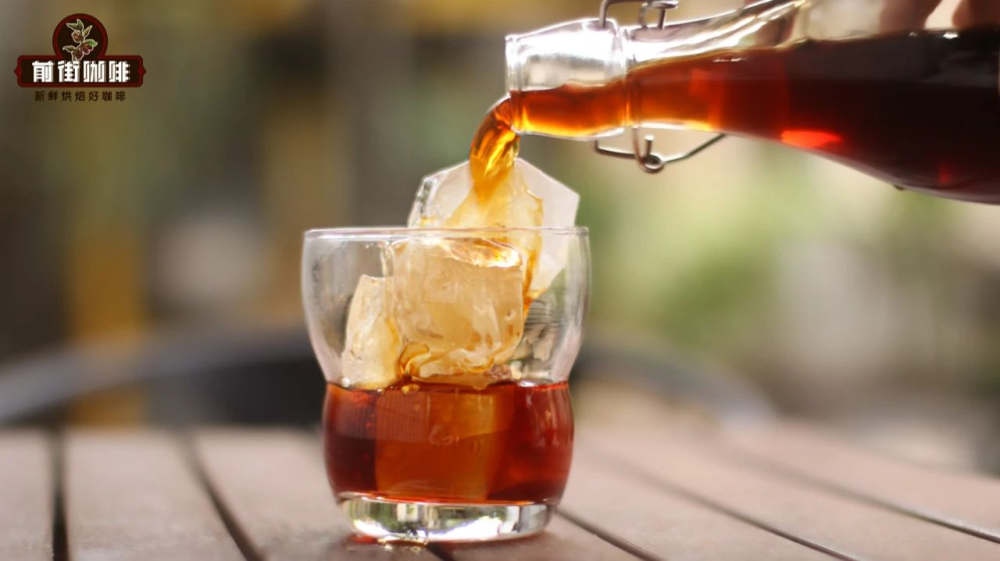
When making cold brew, Front Street first prepares a jar or kettle, puts in the ground coffee powder, then adds cold water at a coffee-to-water ratio of 1:12, places it in the refrigerator or at room temperature for 8-12 hours, and then pours it out and filters it. The coffee powder particle size required for cold brew is similar to that for ice drip coffee, and it can also be adjusted by yourself, but coarser particles require a longer soaking time.
Cold brew coffee can usually be kept fresh in the refrigerator for 5-7 days. There are also special cold brew coffee pots on the market, with a filter mesh inside the pot, making it more convenient to prepare.
I hope the above information can give you a further understanding of ice drip coffee. Slow work produces fine results; ice drip coffee is like the essence extracted by time, and every drop is so precious. Whether to cool off or to try something new, if you love drinking coffee, you absolutely must not miss the good taste of ice drip coffee.
The above content is compiled by CoffeeHunters, a coffee news website.


