







How is the china coffee industry shifting to county towns?
Starbucks is steering its China growth toward county-level markets, aiming to cover more than 300 cities by 2025 and open a new store roughly every nine hours. The company slowed US openings and moved more investment into China, where it added 654 stores in fiscal 2020. Chief Operating Officer Liu Wenjuan says the target markets include close to 3,000 county-level areas.
Store traffic in smaller cities looks different from first- and second-tier locations. Peak periods fall around breakfast, afternoon tea and coffee after lunch or dinner, and customers weigh social and scenario-based needs more heavily than caffeine alone. That mix shapes store design, menu and staffing as the china coffee industry extends into lower-tier markets.
Under the impact of the pandemic, the global catering industry is under widespread pressure, and Starbucks has also set its sights on China's vast lower-tier markets. From slowing the pace of store openings in the United States and increasing investment in China, to proposing the vision of covering more than 300 cities by 2025 and opening a new store every 9 hours on average, Starbucks is treating county-level markets as an important breakthrough. The consumption periods and customer structure of county-town stores are completely different from those in first- and second-tier cities. Instead, breakfast, afternoon tea, and after dinner form peak periods, and social and scenario-based needs far outweigh the need for caffeine alone. Combining frontline observations with the views of Starbucks China Chief Operating Officer Liu Wenjuan, this article analyzes why county-level markets have become an important way out for Starbucks.
For professional coffee knowledge exchange and more coffee bean information, please follow Coffee Workshop (WeChat public account: cafe_style)
For more specialty coffee beans, please add the private WeChat of Front Street Coffee (FrontStreet Coffee), WeChat ID: qjcoffeex
The sudden arrival of the COVID-19 pandemic plunged the global catering industry into widespread difficulty, and even Starbucks, a giant in the coffee industry, could not remain unaffected. Facing this sudden shock, Starbucks pinned its hopes for a breakthrough on China's lower-tier markets.
Since 2020, Starbucks headquarters has begun to slow the pace of new store expansion in its largest market, the United States, while shifting more investment to China. The company said at the time that it would open at least 500 new stores in China during fiscal year 2020 (ultimately adding 654 in that fiscal year), and accelerate the extension of its "FeiKuai" delivery-to-home service, then available only in first-tier cities, to second-tier cities.
This year, according to the 2025 China strategic vision announced by Starbucks China, Starbucks plans to add a net total of 3,000 stores before 2025 at an average pace of opening one new store every 9 hours, covering more than 300 cities in China.
Recently, Starbucks China Chief Operating Officer Liu Wenjuan revealed that these more than 300 prefecture-level markets include nearly 3,000 county-level markets, which means Starbucks will further deepen its cultivation of lower-tier markets.
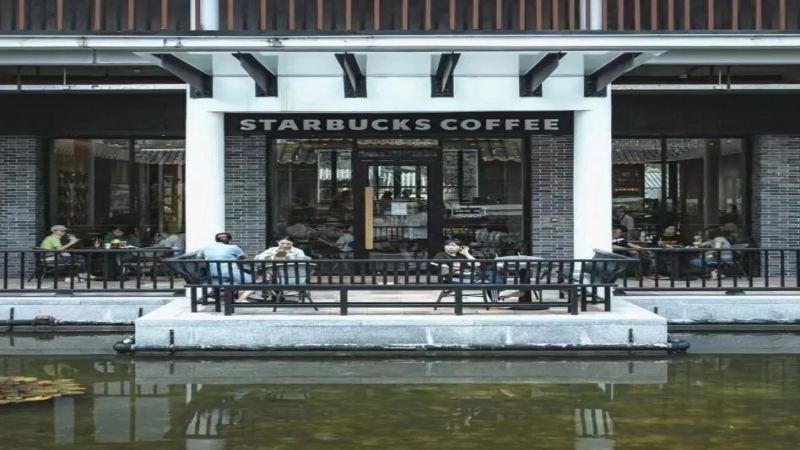
At this point, some people may wonder: given Starbucks' product pricing, who in county towns would pay for it? The author initially had the same question. But upon carefully recalling visits back home over the past year or two, the Starbucks in town was often packed, and customers' standard order was often a cup of coffee plus a piece of cake.
The author observed store conditions at different times. In first- and second-tier cities, breakfast and lunch periods are usually Starbucks' peak hours; in county towns, the situation is exactly the opposite, because local residents are accustomed to having breakfast and lunch at traditional restaurants or at home.
However, once lunchtime passes, students begin entering the store one after another to study, and young people also meet up with friends. After dinner, many parents also bring their children over to pass the time.
Some partners also talked with the author about how working in a store back home is actually busier than in first- and second-tier cities. One partner said that after the county-town store had been open for three years, they gradually felt that local consumers had developed the habit of coming to Starbucks in the morning for coffee and breakfast, with peaks appearing at breakfast, afternoon tea, and after dinner.
Although Starbucks' pricing is relatively high given the consumption level in these areas, no one seems to think it is expensive. This is because everyone believes Starbucks' environment is better than that of many small shops, and many local independent coffee shops are not cheap either, so when it comes to drinking coffee, more people are willing to choose a better-known brand.
"In the past, when I went back home, it was hard to even find a coffee shop. Now, although many people have come back to open shops, they cannot persuade locals to spend. Starbucks is different. People of all ages have some awareness of the brand, so since we opened, the sentence we hear most often is, 'We can finally drink Starbucks next to our home!'" one partner shared.
Indeed, many things that have long been taken for granted in big cities are still awaited by a large number of consumers who hope to enjoy the same convenience one day. Compared with urban office workers' need for caffeine, consumers in these areas have a stronger need for scenarios.
Compared with the dense distribution of stores in big cities, there are not many stores in county towns, so the repurchase rate naturally rises, and stores therefore have more opportunities to deepen their connection with customers.
Starbucks Chief Operating Officer Liu Wenjuan also said: "Because of social needs, consumers in county-level markets will have more occasions for drinking coffee." For Starbucks, which has always been committed to creating a third place for customers, county-level markets are indeed a way out.
Image source: Internet
The above content is compiled by CoffeeHunters, a coffee news website.


