







Does Coffee Beans Production Cost Explain the Luckin Price Gap?
Consumers reported paying between 9.9 yuan and 18 yuan for the same Luckin Cheese Latte across different accounts, prompting allegations of big data price discrimination against loyal customers. Luckin responded that the differences come from store operating costs and randomly issued system discounts, and denied any discriminatory pricing.
The company cites production and operations, labor, rent, and delivery among the factors behind its pricing. This is not the first such controversy; media reported similar cases in 2021. Coffee beans production costs are only one input, which is why identical drinks can appear at different prices to different users.
For professional coffee knowledge exchange and more coffee bean information, please follow Coffee Review (WeChat official account: cafe_style) For more specialty coffee beans, please add the personal WeChat of Front Street Coffee (FrontStreet Coffee), WeChat ID: qjcoffeex Recently, Luckin Coffee has been thrust into the spotlight due to price discrepancies involving its Cheese Latte. Some consumers have reported that the same drink is priced vastly differently across different accounts, ranging from 9.9 yuan to 18 yuan, sparking allegations of "big data price discrimination against loyal customers." Luckin officially responded that the price differences stem from store operating costs and randomly issued system discounts, denying any price discrimination. However, this is not the first time Luckin has been caught up in such controversy—as early as 2021, media exposed similar cases. This article will review the course of events, various perspectives, and industry background to explore the issue of price fairness in online consumption.
For professional coffee knowledge exchange and more coffee bean information, please follow Coffee Review (WeChat official account: cafe_style)
For more specialty coffee beans, please add the personal WeChat of Front Street Coffee (FrontStreet Coffee), WeChat ID: qjcoffeex
Previously, multiple media outlets have reported on the widespread phenomenon of "big data price discrimination against loyal customers" across various industries: video platform members actually being charged higher delivery fees, the same hotel room type being quoted at different prices during travel, regular customers being charged more in stores, and even identical taxi routes costing different amounts. Consumers who let their guard down may become targets of such "loyalty penalty" practices.
Recently, Luckin Coffee has drawn widespread attention for similar issues. Many netizens have complained that the price of Luckin's Cheese Latte has risen from 9.9 yuan to 18 yuan, yet some users can still enjoy the discounted price of 9.9 yuan. This inevitably raises suspicions about whether Luckin is also using big data for differential pricing.
Luckin Coffee staff explained in a media interview that the company's pricing is the result of comprehensive consideration involving multiple factors such as production and operations, labor costs, rent, and delivery, leading to price differences across different stores, while discount activities are randomly issued by the system. This confirms that the same product is priced differently among different consumers, but the company denies the allegation of "price discrimination against loyal customers." So how exactly do price differences among different users arise?
Netizens have been sharing their own experiences. One user said: "The prices on my account keep getting more expensive, yet some people can even get a Cheese Latte for 0 yuan, while I don't get that treatment." Another complained: "I bought the Freedom Card and it's still this expensive—how dare they? If this continues, I'll stop drinking it." Yet another consumer said bluntly: "Loyal customers are not appreciated at all. Even Starbucks, which I haven't visited in ages, sends me 40%-off coupons from time to time. What makes Luckin so arrogant? I'm switching away today."
However, some netizens hold different views. They argue: "You can't expect a 9.9 yuan coupon every day, and then cry 'price discrimination' when you don't get one. It was a promotional coupon to begin with, so it's perfectly normal for it to disappear after the promotion ends." In the eyes of these consumers, it is understandable that Luckin offers different discount plans to users with different consumption habits.
In fact, as early as March 2021, CCTV Finance's "Consumer Advocacy" program reported on possible big data price discrimination at Luckin Coffee. Ms. Xu from Changsha, Hunan, reported that when she and her colleague bought the same Luckin coffee at the same address, not only were the product prices different, but even the delivery fees were treated differently. She believed the reason for the price difference was that she bought coffee every day.
As a high-frequency consumer, Ms. Xu was furious and initially filed a complaint directly and called Luckin customer service. Luckin replied that this was their pricing system—different customers pay different prices—but they were willing to compensate with a coffee coupon. However, Ms. Xu was not satisfied, saying: "I'm not communicating with you for the sake of this one coffee coupon."
Subsequently, Luckin called back again to explain the details of their pricing system. Ms. Xu responded directly: "You don't need to explain your pricing system anymore. I don't need compensation now either—I just won't drink your coffee again." Although Luckin later hoped to reach an understanding with a coffee coupon, it seemed unable to win back this consumer's trust.
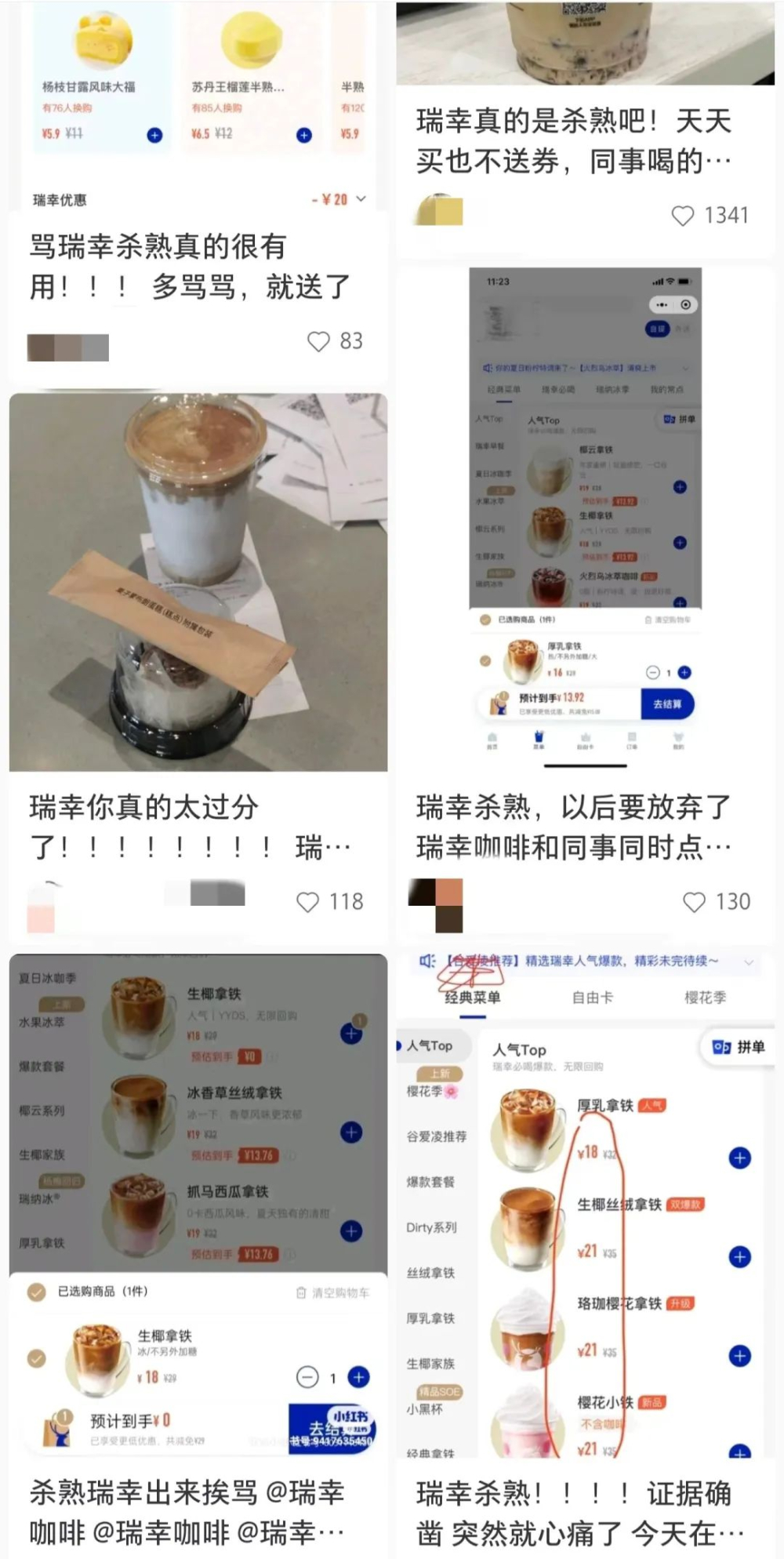
Big data "price discrimination against loyal customers" in online consumption has become a hot topic of common concern for regulators and consumers in recent years. According to media reports, the director of a law firm pointed out that if pricing and rules differ not for new users but based on different users' consumption habits and frequency, it constitutes "price discrimination against loyal customers." Clearly, Luckin holds a different view on this.
Image source: Internet
The above content is compiled by CoffeeHunters, a coffee news website.


