







Why Does Coffee Scope Matter for Tea Beverage Trademarks?
Mixue Bingcheng won a trademark infringement suit against Mixueyue, a milk tea brand whose name and marks closely resembled its own. The court ordered Mixueyue's parent company, Mixueyue (Guangzhou) Technology Co., Ltd., to pay 512,184 yuan, and its appeal was rejected. Mixueyue has since been deregistered. Mixue Bingcheng now operates more than 22,000 stores worldwide and its A-share listing application has been accepted.
The case reflects a wider pattern in the new tea beverage sector, where brands including Heytea, The Alley, and Sexy Tea have all faced copycat disputes. Copycats divert customers and can raise doubts about product quality. For brands with a broad coffee scope of products and coffee beans for commercial use, building a defensive trademark portfolio is a common legal strategy to protect name recognition and market position.
The new tea beverage sector continues to heat up, and the phenomenon of brands having their trademarks maliciously piggybacked on is becoming increasingly frequent. Well-known brands such as Heytea, The Alley, and Sexy Tea have all encountered copycat troubles, and this time it is Mixue Bingcheng's turn, with its stores spread across the globe. A milk tea brand called Mixueyue was sued by Mixue Bingcheng on grounds of trademark infringement because its text and trademark were highly similar to the Mixue Bingcheng series of trademarks. The final judgment ordered Mixueyue to pay 512,184 yuan in compensation, and its appeal request was rejected. Mixue Bingcheng's global stores have exceeded 22,000, its A-share listing application has also been accepted, and Mixueyue company has now been deregistered. Behind this lawsuit is a reflection of the strategy by leading tea beverage brands to build a legal moat through defensive trademarks. This article takes you through the whole case, the backgrounds of both parties, and the logic behind how defensive trademarks work.
For professional coffee knowledge exchange and more coffee bean information, please follow Coffee Workshop (WeChat public account: cafe_style)
For more specialty coffee beans, please add the private WeChat of Front Street Coffee (FrontStreet Coffee), WeChat ID: qjcoffeex
Where there is popularity, there is a market, and where there is a market, there are profits to be made. Driven by profit, the new tea beverage industry has continued to break boundaries in recent years, and with it have come endless incidents of malicious trademark piggybacking. Once a brand becomes popular, it easily attracts copycats. A host of well-known tea beverage brands such as Heytea, The Alley, and Sexy Tea have all been mired in copycat controversies. Copycat brands not only divert some customers, but may also make consumers doubt product quality, thereby weakening the credibility of the original brand.
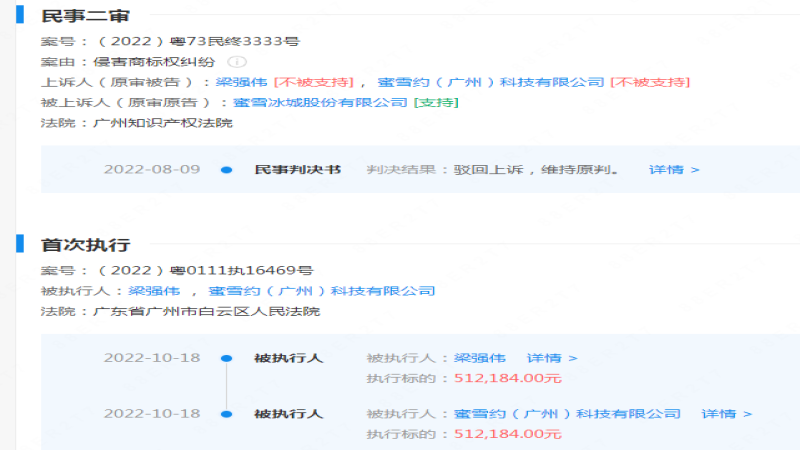
Recently, a milk tea shop called Mixueyue got caught up in a lawsuit for piggybacking on the tea beverage giant Mixue Bingcheng. Because the shop's text and trademark were extremely similar to the Mixue Bingcheng series of trademarks, Mixue Bingcheng sued Mixueyue's parent company, Mixueyue (Guangzhou) Technology Co., Ltd., on grounds of trademark infringement. At present, the final judgment in this case of infringement of Mixue Bingcheng's trademark rights has landed, and Mixueyue must pay Mixue Bingcheng 512,184 yuan.
After the first-instance judgment, Mixueyue company refused to accept it and filed an appeal, but the court determined that Mixueyue's text and trademark were indeed highly similar to the Mixue Bingcheng series of trademarks, that the intent to piggyback was obvious, and that it had seriously infringed Mixue Bingcheng's trademark rights. Therefore, it rejected the appeal and upheld the first-instance judgment that Mixueyue company and its legal representative Liang were jointly liable for compensating the trademark owner for economic losses.
Public information shows that Mixue Bingcheng is an ice cream and tea beverage brand founded in Zhengzhou in 1997. After more than two decades of development, its global store count has reached 22,276, covering 31 provinces, municipalities, and autonomous regions within China and extending to overseas markets such as Vietnam and Indonesia.
On September 22, 2022, information on the official website of the China Securities Regulatory Commission showed that the A-share listing application of Mixue Bingcheng Co., Ltd. had been accepted and its prospectus officially pre-disclosed, with plans to list on the main board of the Shenzhen Stock Exchange and GF Securities as the lead underwriter.
Turning to Mixueyue (Guangzhou) Technology Co., Ltd., according to Qichacha enterprise information, the company was established in September 2019, registered in Baiyun District, Guangzhou, with registered capital of 200,000 yuan. Its business scope covers natural science research and experimental development, education consulting services (excluding education and training activities involving licensing approval), business training (excluding training such as education and training and vocational skills training that require permission), food business (sales of prepackaged food), and so on. The enterprise's status is now shown as deregistered.
It is understood that a large number of "Mixueyue" beverage shops once appeared on the market, but on the Ministry of Commerce's unified business system platform, no commercial franchise filing information for Mixueyue company could be found.
Tianyancha information shows that Mixue Bingcheng Co., Ltd. has a total of 2,161 trademark records, of which 1,517 have been successfully registered. Core trademarks such as "Mixue Bingcheng," "Snow King and device," "Mixue," and "Mixue" have all been registered across all classes. So why register so many seemingly unrelated classes when applying for trademarks? This is precisely a direct manifestation of Mixue Bingcheng's extremely strong trademark protection awareness.
This practice is a defensive trademark strategy, meaning the owner of the same trademark registers the same famous trademark on non-identical goods to avoid adverse effects caused by others' use of that famous trademark. Defensive trademarks may not actually be used after registration, so they are generally not easy to approve. But once successfully registered, they are not subject to the restriction that they must be used in order to maintain the trademark.
As market competition becomes increasingly fierce, some people with ulterior motives will exploit others' already registered trademarks by "playing edge balls" to open up sales channels and markets for themselves. Registering defensive trademarks is precisely a "sharp weapon" for preventing others from freeloading off a brand's popularity. It can both protect the trademark and reserve a certain "space" for the company's future development.
Those acts of deliberately piggybacking on well-known trademarks and causing consumer confusion will sooner or later be subject to legal sanctions. To prevent trademark infringement, registering defensive trademarks has become the preferred practice of many large enterprises.
Image source: Internet
The above content is compiled by CoffeeHunters, a coffee news website.


