







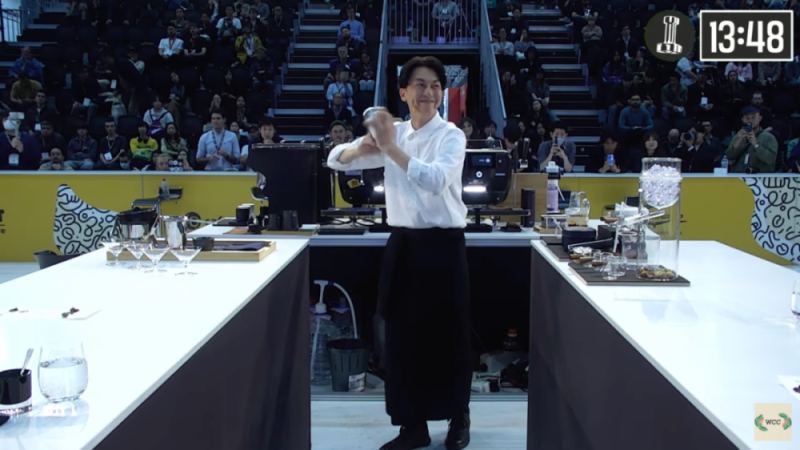
Why did a Panama Geisha and Robusta blend place fourth?
At the 2022 World Barista Championship, Japanese competitor Takayuki Ishitani took fourth place using a blend of Panama Geisha and high-altitude Vietnamese Robusta instead of pure Arabica. He adjusted the ratio for each round, in espresso, milk coffee and signature beverage, and the blend drew attention for challenging assumptions about competition beans.
In the espresso round he used 19 grams of natural-process Panama Hartmann Geisha plus 1 gram of Robusta, extracting 40 grams in 21 seconds. The milk round shifted to 17 grams Geisha and 3 grams Robusta, extracting 40 grams in 18 seconds. The Robusta added body and sweetness while the arabica beans kept flavor complexity, producing notes of blood orange, dark chocolate and vanilla.
At the 2022 World Barista Championship (WBC), Japanese competitor Takayuki Ishitani secured fourth place with a blend of Robusta and Panama Geisha, overturning many people's assumptions about competition beans. He adjusted the ratio of Robusta to Geisha for each of the three rounds—espresso, milk coffee, and signature beverage—using high-altitude Robusta to enhance body and sweetness while preserving Geisha's delicate flavors. This quiet and sincere performance not only showcased the ingenuity of blending but also sparked discussions about the value of Robusta, the essence of competition, and the overall competence of baristas. This article presents his complete competition plan and philosophy, along with relevant recommendations from Front Street Coffee.
Professional coffee knowledge exchange For more coffee bean information, please follow Coffee Workshop (WeChat public account: cafe_style)
For more specialty coffee beans, please add the private WeChat of Front Street Coffee, WeChat ID: qjcoffeex
On the stage of the World Barista Championship, must one compete using only pure Arabica beans? At the 2022 WBC, Takayuki Ishitani, representing Japan, chose to blend Robusta with Geisha, ultimately claiming fourth place.
All the espressos he made throughout the competition were based on high-altitude (1,000 meters) natural-process Robusta from Vietnam paired with natural-process Panama Hartmann Geisha, with only the ratio of the two adjusted for each round.
The reason for blending Robusta with Arabica is that high-altitude Robusta can impart surprising body and more pronounced sweetness to the coffee, while Arabica contributes finer flavor complexity.
In the espresso round, Takayuki Ishitani used 19 grams of Panama Geisha plus 1 gram of Robusta, extracting 40 grams of coffee liquid in 21 seconds. Before tasting, the espresso should be stirred three times with a spoon to make the overall flavor more uniform. The final espresso displayed rich aromas of blood orange and pineapple, with medium body and smooth crema.
In the milk coffee round, he switched to 17 grams of Geisha plus 3 grams of Robusta, extracting 40 grams of coffee liquid in 18 seconds. With the increased Robusta in the espresso, the sweetness became more pronounced, and after blending with milk, it revealed flavors of dark chocolate, blackberry, and vanilla, along with a rich creamy texture.
In the signature beverage round, Takayuki Ishitani made an espresso martini. He first extracted espresso using 15 grams of Geisha plus 5 grams of Robusta, then added 40 grams of a botanical distillate made from rose petals, cardamom seeds, and hops, followed by 15 grams of syrup made from Japanese sugar and water. He also added 0.5 grams of a fermented liquid made from coffee grounds, water, and a Japanese bacterial culture through two weeks of anaerobic fermentation, to enhance umami and bring a tonka bean note.
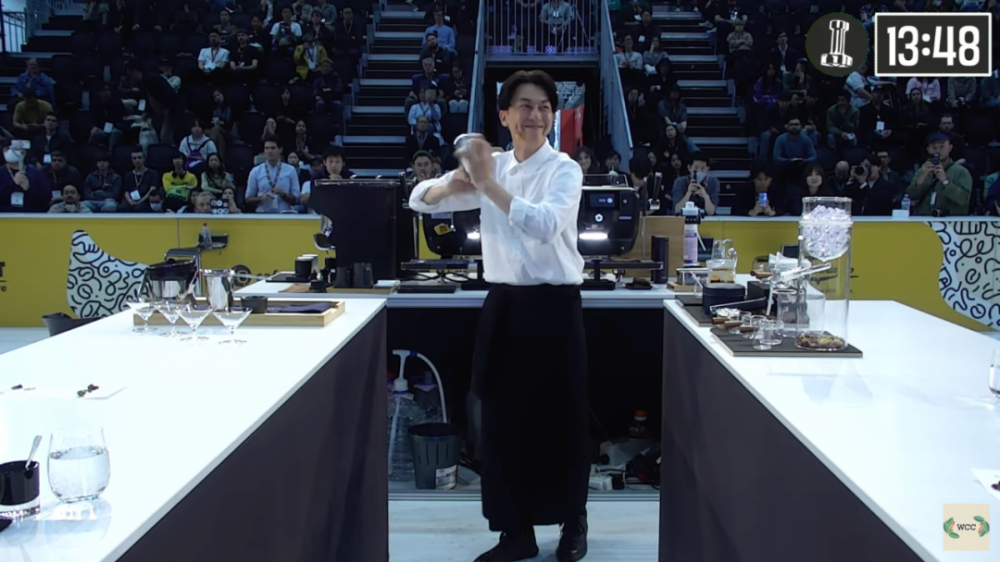
Finally, all ingredients were poured into a shaker, ice was added, and the mixture was shaken well to fully combine all components while creating a fine, dense foam texture. The finished drink expressed flavors of berries, grapefruit, blood orange, and tonka bean, with a full and silky mouthfeel, and a very persistent dark chocolate aroma in the finish.
Throughout the competition, Takayuki Ishitani had few lines, and compared with other competitors, his presentation seemed especially quiet. But he kept smiling throughout, facing the judges with a smile at every step. His drinks were simple to make, yet they overturned many people's fixed impressions of world coffee competitions.
Perhaps many people's first reaction upon hearing about blending Robusta with Geisha is: isn't that a waste? And how could Robusta appear at the World Barista Championship?
In fact, the World Barista Championship has never restricted competitors to using only Arabica varieties. What the competition values is not whether the coffee beans are top-tier or whether the flavors are one of a kind, but whether the competitor can bring new perspectives to the coffee industry, as well as the service details throughout the entire competition process.
Because Robusta's flavor is usually inferior to high-quality Arabica and does not match the public's current expectations for coffee flavor, it is often used in instant coffee and regarded as a synonym for "bad coffee." But is Robusta really that bad? Clearly not—people simply tend to focus on its shortcomings while overlooking its strengths.
Although Robusta falls short of Arabica in flavor, it possesses extremely strong body and can give coffee a solid, full mouthfeel. Brewed on its own, it may not taste good, but when used in a blend, Robusta can be an excellent "partner."
Although more and more people are beginning to pursue coffee's acidity, many mainstream consumers still cannot accept pronounced sourness. Coffee with high body and good balance is what dominates consumption. Robusta has its shortcomings in flavor, but adding a small amount can appropriately enhance coffee's mouthfeel and body.
If Takayuki Ishitani had used only Hartmann Geisha this time and had not relied on more new techniques, the judges might not have given him a high score.
However, Takayuki Ishitani cleverly seized on the sharp contrast between Robusta and Geisha, delivering a powerful impact to everyone watching the competition and changing many people's "prejudice" against the Robusta variety.
Nowadays, many competitors use various high-tech methods. The process is spectacular and also drives the specialty coffee industry forward, but for ordinary baristas, it is not easy to learn from.
Sometimes, simplicity is what is most genuine. Technique is not the most important thing for a barista, and professionalism is not limited to understanding coffee brewing. What was most impressive about Takayuki Ishitani was that he could always maintain a sincere smile, whether in daily service or in various competitions.
He said: As a barista, one must not only make good coffee, but also focus on cultivating abilities in communication, service, research and development, language, and other areas, thereby enhancing one's own value.
Image source: YouTube (World Coffee Championships)
The above content is compiled by CoffeeHunters, a coffee news website.


